Estrogen Dominance Symptoms and Hormonal Imbalance
Why progesterone drops first and how to discuss it with your doctor.
"Estrogen dominance" is not a diagnosis you'll find in any clinical guideline, and no major medical body recognizes it as a defined condition. The pattern it points to, estrogen's effects going unopposed because progesterone dropped first, is biologically real and produces a specific, recognizable set of symptoms. That gap between the term's informal reputation and the physiology underneath it is where a lot of women get stuck: they bring the phrase to a doctor's appointment, get waved off, and leave with no better explanation than they walked in with. This piece is about closing that gap, so the biology can be named precisely enough to survive a clinical conversation.
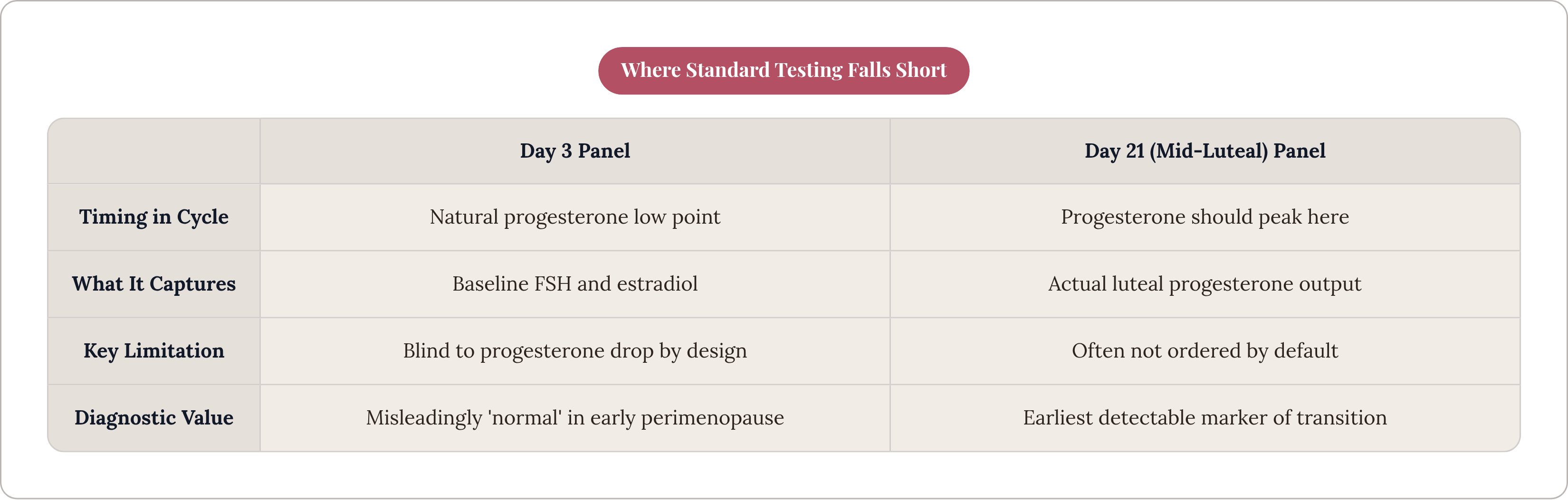
Doctors dismiss "estrogen dominance" because it is not a diagnosis found in any clinical guideline, and the phrase carries a wellness-industry connotation that can shut a conversation down before symptoms get discussed. The underlying biology, however, is clinically real: as ovulation becomes inconsistent in early perimenopause, progesterone drops first while estrogen continues to swing, sometimes running 20% to 30% above premenopausal levels, leaving estrogen's effects on breast tissue, the uterine lining, sleep, and mood to go largely unchecked. A more productive approach at an appointment is to describe the pattern precisely rather than name it: cycles still arriving on schedule, but heavy periods, worsening luteal-phase PMS, disrupted sleep, and mood shifts that follow the second half of the cycle. From there, asking specifically for mid-luteal progesterone testing on day 21, rather than a standard day-3 panel that is by design blind to the progesterone drop, gives a clinician something concrete to act on.
How progesterone drops first, and what that does to estrogen's effects
Almost all the progesterone a woman's body makes comes from the corpus luteum, the structure that forms after ovulation. No ovulation, no real progesterone rise. That single fact is the hinge the whole pattern turns on.
Early perimenopause is sneaky because cycles often keep arriving on something close to schedule, even as ovulation itself becomes inconsistent underneath. A woman can be having periods that look normal on a calendar while progesterone quietly stops showing up most months. This is why the imbalance frequently starts years before anyone mentions perimenopause to her, let alone before bleeding gets irregular enough to raise flags.
Estrogen doesn't decline in step with this. It swings, sometimes climbing well above premenopausal levels before crashing down again. Data compiled by NCBI shows estradiol concentrations during perimenopause running roughly 20% to 30% higher on average than levels seen in premenopausal women, which is a big part of why a woman can be told her labs look normal, or even elevated, while she's feeling worse every month. Some cycles feel like estrogen flooding an unguarded system; others feel like sudden withdrawal. Both can happen within the same month, sometimes within the same cycle.
FSH is a piece of why the spikes happen. As follicles age and become harder to recruit, FSH surges to try to stimulate them into action, and that surge can trigger an outsized burst of estrogen output before the feedback loop between ovary and pituitary catches up and corrects it. The system is trying to compensate; the compensation itself produces the swing.
The symptoms that follow from unopposed estrogen
Once progesterone's counterbalance is gone, estrogen's normal effects start showing up at full strength with nothing to check them. Heavy or prolonged periods are one of the clearest signs: without enough progesterone to stabilize it, the uterine lining keeps building until it sheds in a much heavier flow than usual. Breast tenderness follows a similar logic, since estrogen stimulates breast tissue and progesterone is what normally offsets that stimulation.
Bloating and water retention show up because progesterone helps regulate fluid balance; take it out of the equation and estrogen's tendency to promote water retention goes unchecked. PMS symptoms, mood swings, headaches, breakouts, tend to intensify specifically in the luteal phase, which is exactly the window when progesterone should be present and often isn't. Sleep gets disrupted too, since progesterone modulates melatonin, the hormone that governs sleep regulation; when progesterone drops, sleep quality tends to follow it down.
Mood instability deserves its own mention. Estrogen fluctuations affect serotonin and dopamine pathways directly, and research funded by NIMH and conducted at the University of North Carolina found a 2 to 4-fold increase in major depression risk during the menopausal transition. Lower libido often gets pinned on low estrogen alone, but it shows up just as often when progesterone loss is what's disrupting the broader hormonal balance. Weight gain around the midsection rounds out the list; the mechanisms are multifactorial, but the distribution of estrogen receptors in adipose tissue plays a documented role.
This pattern isn't exclusive to estrogen-progesterone imbalance, and that's worth sitting with for a second. Thyroid dysfunction, insulin resistance, elevated cortisol, all of these produce overlapping symptoms. The biology described here explains one plausible cause among several, and it shouldn't be treated as a default explanation before other things get ruled out.
Why estrogen affects so many systems at once
Why does one hormone touch so many seemingly unrelated systems? Estrogen works through two nuclear receptors, ERα and ERβ, and those receptors extend well beyond reproductive tissue. They're distributed across breast tissue, cardiovascular tissue, bone, liver, and brain, which means a single shift in estrogen signaling can hit cognition, mood, sleep, cardiovascular function, and bone density more or less simultaneously.
That receptor geography is also why women with this pattern often end up bouncing between specialists, a cardiologist for palpitations, a psychiatrist for mood, a sleep clinic for insomnia, before anyone connects the dots back to hormones. Each specialist is looking at a real symptom in their own domain; none of them may be positioned to see the shared root underneath.
Progesterone's reach is just as broad, even if it gets less attention. Beyond modulating melatonin, it reduces vascular stiffness and directly counters estrogen's proliferative effects on breast and uterine tissue. When it drops out quietly, the consequences spread across the same wide map that estrogen's receptors already cover.
Where testing helps and where it routinely misleads
NICE guideline NG23, updated in 2024, advises against using lab tests to diagnose perimenopause in women 45 and older. For women 40 to 45 with symptoms, FSH testing is considered reasonable. Under 40, testing serves a different purpose entirely: ruling out premature ovarian insufficiency. ACOG holds a similar position, stating that in most cases, age, symptoms, and cycle changes are enough to identify perimenopause without routine hormone testing.
That guidance reflects a real limitation. Hormone levels during perimenopause fluctuate so much that a single blood draw is genuinely unreliable as a diagnostic anchor. FSH can be elevated one day and unremarkable the next; estradiol can look normal, sometimes even high, while progesterone is essentially nonexistent that cycle.
The guidelines tell clinicians not to lean on tests for diagnosis, yet they don't give women any framework for interpreting what a "normal" result actually means alongside symptoms that are clearly not normal. A woman with heavy bleeding, disrupted sleep, and worsening mood gets a panel back that reads fine, and the conversation often ends there.
Part of the problem is structural. Most standard panels draw blood on day 3 of the cycle, which is precisely when progesterone sits at its lowest point regardless of whether a woman is perimenopausal or not. The test is, by design, blind to the progesterone drop that drives so many early symptoms. Day 21, or seven days after ovulation, is the window when progesterone should actually peak; a low reading at that specific point is one of the earliest detectable markers of perimenopause. It's also worth flagging that hormonal contraceptives, exogenous estrogens, and androgens can all skew FSH results, so testing should happen at least two weeks after stopping any of them.
What serial testing reveals that a single result cannot
If the defining feature of perimenopause is volatility, then a single data point can only ever capture a moment, not a trajectory. That raises an obvious question: what does capture the trajectory?
Two or three tests spaced three to six months apart start to show direction. Is FSH climbing over that stretch? Is mid-luteal progesterone consistently low across multiple cycles, or was one low reading a fluke? Is estradiol swinging by wide margins from one test to the next? The SWAN study, which followed 3,302 women for as long as 22 years, built much of the evidence base connecting hormone trajectories to cardiovascular, mood, and bone outcomes across the transition, and it did so precisely because its longitudinal design could separate the effects of aging from the effects of the transition itself.
In late perimenopause, the stage researchers label STRAW -1, FSH commonly climbs above 25 IU/L; by early postmenopause it's typically above 40 IU/L. Fixating on a threshold, though, misses the more useful signal: direction of change. A woman whose FSH sat at 8 IU/L two years ago and now reads 22 is in a meaningfully different place than a woman whose FSH has held steady at 22 the whole time, even though a single snapshot would show them looking identical. Serial testing also gives a clinician a better shot at separating this pattern from thyroid dysfunction or other overlapping conditions, since trends over time are harder to misread than any one number in isolation.
Why do doctors dismiss estrogen dominance, and how do you explain the biology at your appointment?
Leading with "estrogen dominance" tends to backfire. The phrase carries a wellness-industry connotation that many clinicians associate with unverified claims, and it can shut a conversation down before the actual symptoms get discussed.
A more productive opener describes the pattern directly: cycles are still arriving, but symptoms point toward low progesterone specifically, heavy periods, PMS that's gotten worse, poor sleep, mood that dips in the second half of the cycle. From there, ask specifically about mid-luteal progesterone testing on day 21 rather than accepting a standard day-3 panel by default. If that first test comes back normal but the symptoms are ongoing and clear, ask about retesting in three to six months, and frame the request around the well-documented variability of perimenopausal hormones rather than as a personal hunch.
It also helps to ask that TSH and prolactin get included in the workup, which frames the request as differential thinking rather than self-diagnosis; ruling out thyroid dysfunction and other overlapping causes is standard practice, not a stretch. Keeping a symptom log with the cycle day noted for each entry gives a clinician something concrete to look at, and a pattern tied to cycle phase is a lot harder to wave off than a verbal description alone.
Women are showing up to these appointments more prepared than they used to, and midlife women are increasingly arriving to these appointments with more detailed symptom records and pointed questions. Precision is what makes that advocacy land. The biology behind "estrogen dominance" is real, the tests to investigate it exist and are well defined, and arriving with the specific language of hormonal staging tends to produce a far better conversation than arriving with a label that invites dismissal before the real discussion even starts.