Early vs Late Perimenopause Stages Explained
Understanding the two distinct hormonal stages of perimenopause improves diagnosis.

Perimenopause is the transitional stretch of years leading up to menopause, and it only ends once a woman has gone 12 consecutive months without a period. Until that milestone arrives, she remains in perimenopause, regardless of how long the transition has already lasted or how erratic it has become. That duration varies enormously: four years on average, but anywhere from two to ten depending on the woman. What drives the whole process is estrogen, specifically its decline and its unpredictable fluctuation, which throws off its balance with progesterone. Both hormones come from the ovaries, and as ovarian function shifts, both change, but not at the same pace or in the same direction at the same time.
That last point is the one most often missed, and it is also the one responsible for more misdiagnoses than any other single fact in this field. Early perimenopause is mechanistically distinct from late perimenopause: different hormonal pattern, different symptom set, different clinical picture entirely. Most ten-minute appointments treat the two stages as one continuous blur, and a woman's symptoms can end up filed under stress, aging, or some unrelated diagnosis instead of under perimenopause at all. STRAW+10 gives clinicians and patients a shared, evidence-based language for locating exactly where someone stands in the transition, and the rest of this piece uses that framework as its spine.
How the STRAW+10 framework defines early and late perimenopause
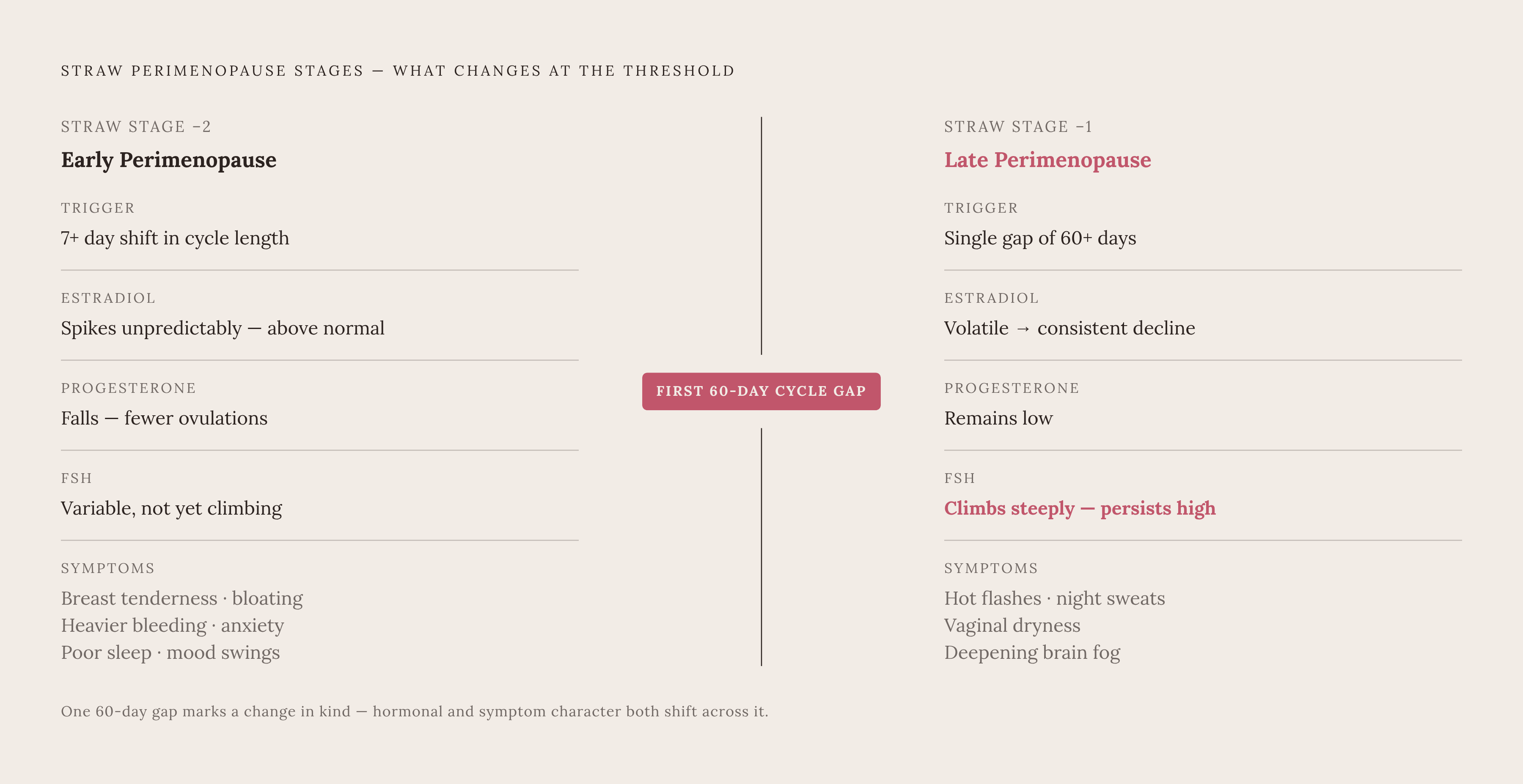
STRAW+10, short for Stages of Reproductive Aging Workshop, is the reference framework for classifying the female reproductive trajectory from the final years of regular cycling through the years following the last period. It breaks the whole arc into seven stages, with substages bringing the total to ten. Perimenopause occupies exactly two of them: early perimenopause is STRAW Stage –2, and late perimenopause is STRAW Stage –1.
The system leans on menstrual cycle behavior as its primary marker, which is what makes it usable outside a lab. A single hormone number pulled from one blood draw plays a much smaller role, a deliberate design choice given how much hormone levels can shift day to day. A woman can get a reasonably accurate read on her own stage just from her cycle history, well before any test gets ordered. The line between –2 and –1 comes down to how far cycles have drifted from her personal baseline, and specifically whether a gap of 60 days or more has shown up yet.
Worth saying plainly: STRAW+10 describes what is typical across a population. Some move through Stage –2 in a year; others spend the better part of a decade there, and both are consistent with the same framework.
Early perimenopause: what is happening hormonally and in the cycle
The defining menstrual marker for Stage –2 is a cycle length shift of seven days or more from a woman's own usual pattern. Someone who has cycled every 28 days for most of her adult life and starts cycling every 21 might still look "regular" on paper, even as ovulation itself becomes sporadic. More cycles skip ovulation altogether while bleeding keeps arriving on something resembling a schedule, and that mismatch is exactly what makes this stage so easy to miss on a chart.
That matters because progesterone is produced largely as a byproduct of ovulation. Fewer ovulations mean less progesterone, even in cycles that appear, from the outside, perfectly normal. Meanwhile estradiol is doing something that surprises most women: it can spike to levels higher than those typically seen in women under 35, then fall sharply within that same cycle. This volatility, more than any steady decline, drives most of the early symptom picture. The detail most likely to get missed is that "estrogen is dropping" is the assumption most doctors and patients walk in with, and that assumption doesn't hold for this stage specifically.
FSH does begin climbing in Stage –2, but the mechanism behind that initial rise deserves unpacking rather than assumption. It is driven more by declining ovarian inhibin than by falling estradiol; the two signals are not interchangeable, and reading a rising FSH as proof that estrogen has already dropped is a mistake, full stop. AMH, meanwhile, has usually been declining for a while before any of this becomes visible on the calendar. It functions as a leading indicator of ovarian reserve depletion, which is part of why so many women feel the shift long before a test confirms anything.
That gap, between the internal experience and what a standard FSH panel shows, is widest here. FSH can still read as textbook "normal" while the hormonal environment underneath it has already become significantly disordered. Early perimenopause gets waved off in a standard visit largely for this reason: the test everyone reaches for first is poorly suited to catch this stage.
What early perimenopause actually feels like
The first symptoms tend to be neurological rather than reproductive: fatigue that does not track with sleep, brain fog, and a rise in anxiety that feels foreign. There is also a sense, hard to articulate in a ten-minute visit, of not feeling like oneself. That last phrase is not just colloquial; a study published in the journal Menopause in March 2024 formally named this symptom cluster "Not Feeling Like Myself," or NFLM, giving it clinical standing rather than leaving it as anecdote.
Irritability shows up on nearly every list of commonly reported perimenopausal symptoms, and it reflects hormone-driven changes to the nervous system. Cycle changes are usually the first concrete, trackable signal: periods running heavier, longer, or unexpectedly shorter.
Here is where the estradiol spikes described above become tangible. High-estrogen symptoms, breast tenderness, bloating, heavier bleeding, tend to dominate early perimenopause, and the instinct that follows is almost always mistaken, since more estrogen tends to make these symptoms worse. Running beneath the high-estrogen symptoms are the low-progesterone ones: poor sleep, mood instability, a background hum of anxiety. Progesterone has a calming, sleep-supportive role in the body, and that role erodes quietly, even while estrogen is technically spiking. Chasing the estrogen symptom while ignoring the progesterone deficit underneath it is where a lot of early treatment goes wrong, and it is worth naming as the primary treatment error of this stage.
This pattern is not confined to women in their late 40s, and treating it as though it is may be a damaging assumption in how this stage gets discussed. A 2025 survey of 4,432 U.S. women published in npj Women's Health found meaningful symptom burden even among those aged 30 to 45. The mismatch between real neurological and mood symptoms and a lab report that comes back "normal" is a major reason early perimenopause gets misattributed to anxiety disorders, thyroid conditions, or plain burnout, particularly in women who are nowhere near the age where a clinician thinks to look for it.
Late perimenopause: how the hormonal and menstrual picture shifts
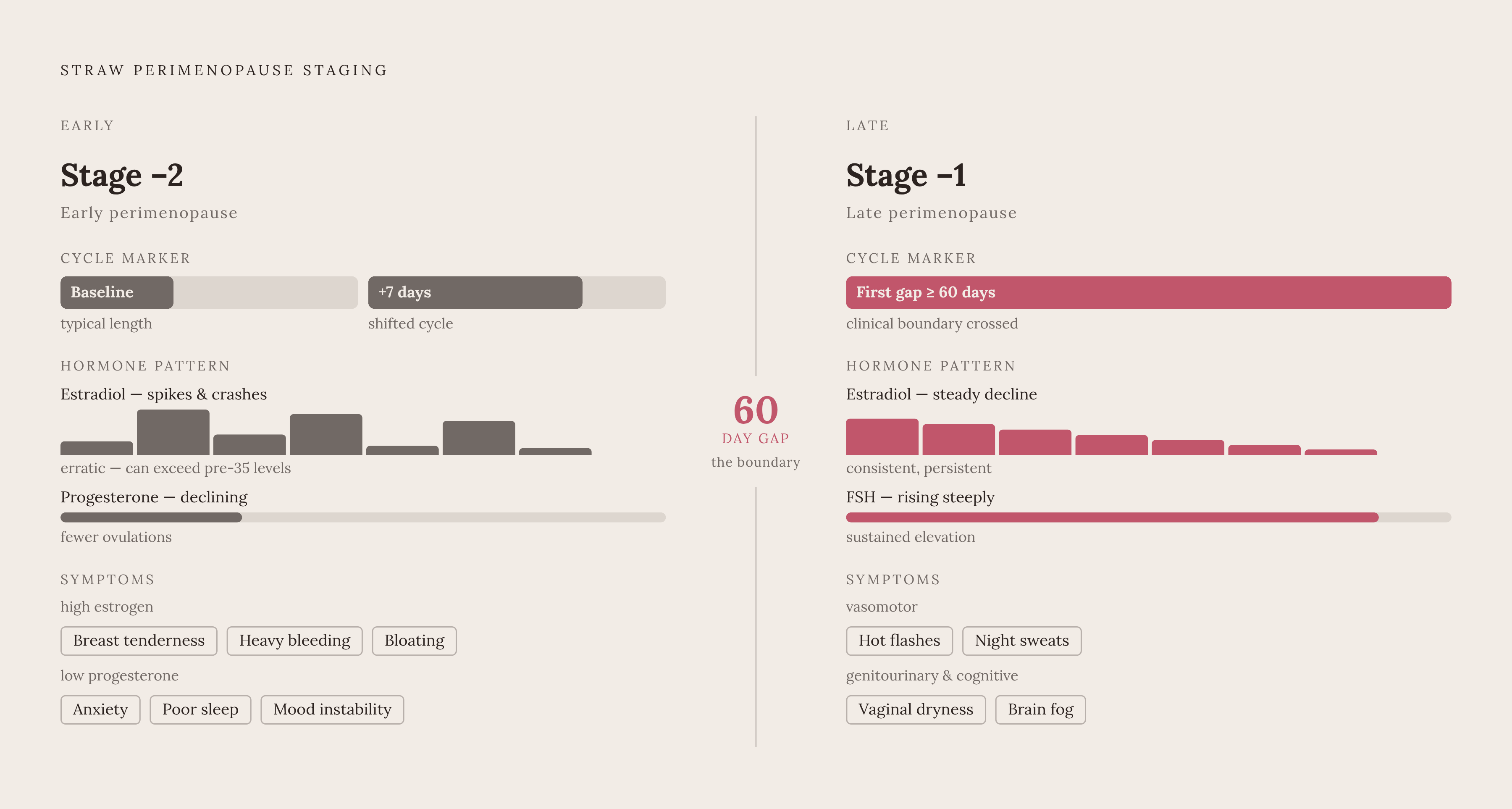
The line into Stage –1 is crossed with the first menstrual cycle that stretches beyond 60 days. That single data point, one cycle longer than 60 days, is the clinical marker separating early from late perimenopause under STRAW+10. From there, periods become increasingly sparse; gaps of two months or more become common, and eventually periods stop entirely.
Late perimenopause typically arrives in a woman's late 40s or early 50s and lasts somewhere between one and three years. It officially closes 365 days after the final period, at which point menopause gets confirmed, retroactively, as having already happened.
The hormonal character of this stage differs in kind, not just degree, from Stage –2. Estradiol stops its dramatic spiking and settles into a more consistent decline, while FSH climbs more steeply and, this time, persistently. SHBG, sex hormone binding globulin, also shifts during the menopausal transition, and that affects how much of the remaining estrogen is actually bioavailable to tissue, which helps explain why some women feel worse even when a lab report shows total estrogen holding fairly steady.
AMH becomes genuinely predictive by this point rather than just informative. AMH below 100 pg/mL detects significant bone mineral density loss with 98% sensitivity in late perimenopause, a finding that pushes this stage into the category of measurable, clinically serious risk. The hormone trajectory itself varies by individual, too: the SWAN study identified four distinct estradiol patterns and three distinct FSH patterns across the transition, with race, ethnicity, and BMI all shaping which pattern a given woman follows. There is no single "late perimenopause hormone profile" that applies universally, which is worth sitting with before comparing any one woman's labs to a population average.
How symptoms change in late perimenopause
Vasomotor symptoms, hot flashes and night sweats, generally intensify here as estradiol's decline turns from erratic to consistent. Vaginal dryness and changes in libido become more pronounced too; these are downstream effects of estrogen settling at a lower, steadier baseline rather than the wild swings that defined Stage –2.
Sleep disruption often gets worse, and the reasons split into two separate mechanisms worth naming individually. Part of it comes from night sweats waking a woman directly, and part of it comes from progesterone's continued decline, independent of any hot flash. Joint pain enters the picture for many perimenopausal women, and clinicians rarely connect it back to hormones. It often gets chased down as an orthopedic issue instead, sometimes for months, when the actual driver is sitting in a hormone panel nobody ordered. Brain fog and cognitive symptoms can persist or deepen; estrogen plays a real role in neurotransmitter regulation, so its steadier decline in late perimenopause has a biologically grounded effect on cognition.
There is also a less obvious mechanism worth naming: as estradiol and progesterone decline, the HPG and HPA axes interact in ways that tend to push cortisol upward. That cortisol rise compounds fatigue, worsens sleep disruption, and deepens mood symptoms, which is part of why late perimenopause can feel like a systemic destabilization reaching beyond the reproductive system. The underlying driver shifts from volatility to sustained low levels, and that shift produces a genuinely different symptom texture, one that deserves to be read as diagnostically meaningful in its own right.
Why a single hormone test taken at one moment cannot place a woman in a stage
Here is the part worth sitting with before anyone orders a blood panel expecting a clean answer: a single draw carries real limits, and treating it as definitive is a common mistake in how perimenopause gets tested. Estradiol fluctuates so unpredictably during this transition that one reading might catch a peak, a trough, or anything in between, and any of those values could register as "normal" or "abnormal" purely depending on the day it was drawn. FSH has the same problem from a different angle: it rises across the transition but also fluctuates monthly as it does its normal job of stimulating ovulation, so one FSH value in isolation can mislead just as easily. What actually carries clinical weight is the pattern across several cycles.
There is a specific threshold worth naming and then immediately qualifying: FSH above 40 mIU/mL is associated with menopause, as is estradiol below 30 pg/mL, though each threshold carries its own context. Using that threshold to rule out perimenopause while someone is mid-transition is a category error, plain and simple, and it happens often enough to deserve calling out directly.
Age changes how much testing even matters here. For women 45 and older who have symptoms and irregular cycles, clinical guidelines note that testing may not be necessary at all to confirm the diagnosis; the cycle and symptom picture alone is often sufficient. For women under 45, where symptoms show up early and get dismissed more readily, testing carries more diagnostic weight, but it still has to be read in context. A "normal" FSH does not erase a clinical picture that includes irregular cycles, disrupted sleep, and new mood changes, and the lived symptom picture deserves real weight alongside the lab value, not second place to it.
Progesterone testing makes the timing problem almost impossible to ignore. It needs to be drawn 5 to 7 days after ovulation to mean anything at all; drawn at a random point in the cycle, it produces a number with little context to interpret it against. The practical takeaway across all of this holds regardless of which hormone is in question: a single snapshot shows where hormones sat on one particular day, while repeated testing across several months reveals whether FSH is escalating, whether estradiol is declining, whether progesterone is falling off. That pattern is where much of the diagnostic value lives, more than any single draw, however well timed, can offer on its own.
What knowing your stage makes possible in practice
Stage awareness changes how a woman reads her own body. Someone in early perimenopause dealing with anxiety, breast tenderness, and heavier periods can recognize that combination as a high-estrogen, low-progesterone picture, a known pattern, easing some of the fear that comes with feeling like her body is malfunctioning at random.
It also changes the conversation with a clinician. A woman who can say her cycles have shifted by more than seven days, or that she has just had her first gap longer than 60 days, is handing her doctor a STRAW-compatible history, a more specific starting point than "I just don't feel right lately," even though both descriptions might be pointing at the same underlying shift.
It sets expectations that are actually accurate, which matters more than it sounds like it should. Early perimenopause can run for years, during which vasomotor symptoms may stay mild or not show up at all; late perimenopause is generally when hot flashes and sleep disruption escalate in earnest. Knowing which stage is in play prevents two opposite mistakes: assuming the worst too early, or dismissing real symptoms because "it's not supposed to be like this yet."
Tracking becomes more concrete, too. Cycle length and the duration of gaps between periods are the most accessible leading indicators available, and they require nothing more than a calendar or a note-taking app. Hormone levels add real depth on top of that, but only when tracked longitudinally alongside symptoms rather than treated as a single verdict. The SWAN study's finding, that estradiol and FSH trajectories vary meaningfully by individual, race, ethnicity, and BMI, is a useful reminder that population curves are a starting reference. Her own data, gathered over months, tells her more about her own trajectory than any average ever could.
This is the gap that longitudinal, perimenopause-specific hormone testing is built to close. Estradiol swings and progesterone's decline follow a pattern rather than a fixed point, so a single blood draw can land between spikes and miss the story entirely. Testing services structured around repeated draws across a cycle, including Intermission Health, are built to catch that pattern across time. The point of any of this, ultimately, is to gather enough information, clinical and personal both, to stop guessing about what the body is doing and start understanding, with some actual precision, what is likely coming next.