Unusual Low Estrogen Symptoms Women Often Miss
Why doctors miss joint pain, brain fog, and other symptoms all driven by one falling hormone.
Perimenopause produces roughly 36 recognized symptoms, according to the National Menopause Foundation, yet most women recognize only a handful. That gap between the scope of the transition and what actually gets recognized as part of it is what this piece is about: why joint pain, brain fog, dry mouth, and bladder trouble trace back to the same falling hormone, and why almost no one connects them until someone names the mechanism out loud.
The default story is hot flashes and missed periods, and that story isn't wrong so much as dangerously incomplete. Women get referred to rheumatologists, dermatologists, and psychiatrists for symptoms that might have a much simpler explanation sitting one bloodwork panel away. Clinicians pattern-match to the familiar presentation, and anything outside it tends to get treated as its own isolated problem instead of a piece of something larger. That habit is the real failure here, not any single missed diagnosis: the medical system is built to look for hot flashes and miss almost everything else estrogen touches on the way out.
How estrogen receptors distributed across the body create a wide symptom footprint
"Women have estrogen receptors throughout our bodies," says Zubina Mawji, MD, MPH, a menopause specialist at Cleveland Clinic. "So, it makes sense that menopause can affect nearly every organ system in every part of the body." That single sentence does more explanatory work than most menopause literature manages in a page, because it flips the question around. The better question isn't why perimenopause causes so many unrelated symptoms; it's why anyone expected it to stay contained to one system in the first place.
Estrogen receptors sit in bone and joint tissue, skin and mucous membranes, the brain, the cardiovascular system, the gut lining, the salivary and meibomian glands, and connective tissue generally. That's not a niche distribution. It's close to full-body coverage. Estrogen does a lot of quiet maintenance work across those tissues: it helps sustain bone density, plays a role in blood sugar regulation, supports serotonin production through the tryptophan-to-5-HTP pathway, acts as an anti-inflammatory agent, and helps keep skin, mucosal, and urinary tissue intact.
So when estrogen output starts to fall, the effect doesn't show up as one dramatic symptom in one obvious place. It scatters. A woman might get stiff knees, then dry eyes, then a patch of thinning hair, then trouble finding words mid-sentence, each showing up months apart, each looking on its own like nothing in particular. None of it is random. It's just spread across a map that most people, including plenty of clinicians, never learned to read.
Before naming those symptoms one by one, it helps to see the timeline they're riding on, because estrogen doesn't fall in a straight line. It does something messier.
What actually happens to estrogen during perimenopause, and when
Perimenopause typically starts in the mid-40s, most commonly between 45 and 47, and lasts an average of four years, though anywhere from two to ten years counts as normal. The average age of menopause in the United States is 52, which puts the start of perimenopause somewhere between four and seven years earlier.
Here's the part that trips up a lot of hormone testing, and it's the part most people get backwards: estrogen isn't the first hormone to drop. In early perimenopause, progesterone falls while estrogen often stays high, or swings erratically between high and low. Estrogen's more sustained decline doesn't start until late perimenopause, and even then it's still riding alongside suppressed progesterone. The widening gap between estradiol and progesterone, particularly in the second half of the menstrual cycle, is often the earliest measurable sign that the transition has begun, well before cycles become visibly irregular.
Layered on top of that is cortisol, which tends to rise during this window as the HPA axis gets more reactive. That adds a second axis of disruption, fatigue, mood swings, sleep trouble, that compounds whatever the ovarian hormones are already doing on their own. A woman tested in early perimenopause may show high-normal or even elevated estrogen next to low progesterone. Read that single number as a stand-in for the whole picture, and it will actively mislead.
Menopause itself has a clean clinical definition: 12 consecutive months without a period. Everything before that, including years of cycles that still seem to be running on schedule, counts as perimenopause. That matters here specifically, because most of the symptoms covered below tend to show up early, well before the more recognizable signs make the diagnosis obvious.
Joint pain that shows up before the hot flashes do
More than half of women experience joint pain, body aches, or stiffness during the menopause transition, a presentation with an actual clinical name: menopausal arthralgia. The mechanism isn't mysterious once you know it. Estrogen has anti-inflammatory properties, and when it drops, inflammatory activity in joint tissue picks up.
The trouble is the symptom looks a lot like something else. Menopausal arthralgia can closely mimic rheumatoid arthritis or early osteoarthritis, and that resemblance is exactly what sends a woman to a rheumatologist instead of prompting any conversation about her cycle. A woman in her mid-40s who develops new stiffness in her hands or knees is far more likely to get told she's "getting older" than to get asked when she last had a period that felt normal.
What makes this one especially easy to miss: it frequently arrives before hot flashes, before cycle changes are noticeable, sometimes years before anyone would think to ask about hormones. And because the root cause isn't being addressed, standard arthritis treatment tends to underperform. Anti-inflammatories help at the margins, but they aren't correcting the thing actually driving the inflammation. Treating menopausal arthralgia like garden-variety arthritis is treating the symptom while the cause keeps running underneath it.
Cognitive changes and brain fog as a neurological consequence of estrogen loss
Estrogen supports serotonin production through the tryptophan to 5-HTP to serotonin pathway. When estrogen declines, that chain gets disrupted, and the fallout hits mood and cognitive sharpness at the same time. The complaints tend to cluster: word-finding trouble, losing the thread mid-sentence, slower processing, trouble holding concentration on something that used to be routine.
This is one of the few areas where longitudinal data actually backs up what women have been reporting for decades. The SWAN study followed women through the menopause transition with repeated cognitive testing, and during perimenopause, the improvement normally expected from repeated testing, the practice effect, simply didn't show up. That absence lines up with what women were independently reporting about their own memory. The fog isn't a self-report artifact. It tracks with a measurable hormonal shift happening in the same window.
What the data doesn't settle is how long it lasts. Individual variation is wide, and while much of the research suggests improvement after menopause is complete, not everyone gets back to baseline. The more common outcome is a woman getting told the fog is stress, burnout, anxiety, or, in worse cases, an early sign of dementia, with hormones never entering the conversation unless she brings it up herself. Mood disruption, irritability, sadness, sudden emotional reactivity, tends to ride along with the cognitive symptoms, since both trace back to the same disrupted serotonin pathway.
Skin, hair, and dental changes driven by collagen loss and bone remodeling
Estrogen keeps skin hydrated, elastic, and stocked with collagen. Take it away and skin ages faster than the calendar would predict: thinner, drier, less vascular, quicker to wrinkle. Estrogen also helps skin cells manage oxidative stress, so its decline speeds up biological skin aging past what chronological age alone would account for. Hair often follows a similar pattern, showing up as diffuse thinning and a change in texture rather than the patterned loss typically tied to androgen-driven hair loss.
Dental changes get the least attention on this list, and they deserve more. Teeth sit in bone, and estrogen deficiency affects the jawbone directly, which can mean shifting teeth, greater fracture risk, and microfractures that show up on routine dental imaging. Sleep disruption and anxiety, both common in perimenopause, can also drive bruxism, adding mechanical grinding on top of bone that's already losing density. A woman might raise all of this with her dentist, get fitted for a night guard, and never once hear the word estrogen.
Dry mouth belongs in the same category. Salivary gland function is also estrogen-receptor dependent, so its decline shows up there too. In every one of these cases, a perfectly plausible non-hormonal explanation sits right next to the real one: new skincare routine, stress, diet, aging in general. That's exactly why the hormonal read gets delayed or skipped entirely.
Fatigue, sleep disruption, and the cortisol interaction that amplifies both
Estrogen has a hand in energy regulation, and its decline can produce a fatigue that doesn't respond to more sleep or a lighter schedule. Sleep itself gets hit from several directions at once. Night sweats and hot flashes fragment sleep architecture directly. Progesterone, which has a sedating effect on its own, is the first hormone to drop in perimenopause, so that natural nightly wind-down mechanism weakens early. And rising cortisol, a documented feature of the perimenopausal shift in HPA-axis activity, raises alertness in a way that makes both falling asleep and staying asleep harder.
That cortisol piece is worth sitting with, because it means the fatigue isn't only about ovarian hormones falling. A second axis, the stress-response system, gets pulled into the disruption alongside estrogen and progesterone. The result is a specific, recognizable pattern: fatigue that feels out of proportion to the day's actual demands, waking at 3 a.m. for no clear reason, or getting a full eight hours and still not feeling rested.
Why does this one slip through so easily? Fatigue is one of the most common complaints in primary care, for almost any reason imaginable. Without a specific reason to suspect hormones, there's no natural prompt to test for them, and "you're probably just stressed" becomes the default answer by elimination rather than by evidence.
Urinary and bladder symptoms as estrogen loss affects urogenital tissue
Estrogen helps maintain the bladder lining and the urethra. As levels fall, that tissue thins, and the consequences follow directly: more urgency, more frequency, higher susceptibility to urinary tract infections, and for some women, stress incontinence that wasn't there a few years earlier.
Clinically, this cluster falls under genitourinary syndrome of menopause, or GSM, which covers both vaginal and urinary symptoms because they share the same estrogen-dependent tissue base. That overlap matters: bladder symptoms and vaginal symptoms aren't two separate problems needing two separate specialists. They're two expressions of the same tissue change.
In practice, though, a woman dealing with recurring UTIs is more likely to end up in a urologist's office than in a conversation about hormones. She gets antibiotics, maybe repeatedly, while the underlying tissue change that keeps making her susceptible never gets addressed. Recurring UTIs in a woman in her mid-40s deserve a hormonal look, not just another round of the same prescription. Treating the infection without touching the tissue that keeps letting infections in is treating the wrong layer of the problem.
Cardiovascular changes that begin during late perimenopause, not after it
Estrogen has a protective effect on blood vessel walls, and its decline correlates with increased arterial stiffness. This is where the SWAN study's longitudinal carotid ultrasound data adds something genuinely important: the progression of carotid intima-media thickness, a standard marker of arterial aging, sped up substantially at the late perimenopausal stage specifically, and it did so independent of age and ethnicity.
That finding reframes the whole transition, and it's the point most people get exactly backwards. The cardiovascular risk tied to menopause doesn't wait for menopause to finish; it starts building while perimenopause is still underway. A woman in her late 40s dealing with palpitations, blood pressure changes, or a new sensitivity to exertion has every reason to wonder whether that's anxiety or declining fitness. It might be. It's also worth considering that something is happening in her arteries right now, not a future risk she gets to worry about later.
That's arguably the most consequential point in this entire piece. Perimenopause isn't a waiting room before the real health changes start. It's already the room where some of them are happening.
Why these symptoms get misdiagnosed, and what the pattern actually looks like
Look back across every symptom covered so far and a pattern emerges: each one has a plausible, non-hormonal explanation sitting right next to it. Joint pain becomes arthritis. Brain fog becomes burnout. Skin changes become ordinary aging. Fatigue becomes lifestyle. Recurring UTIs become a hygiene or anatomy issue. None of those alternative explanations is unreasonable on its own, which is exactly the problem.
When symptoms land in different organ systems at different points over several years, no single specialist ever sees the full shape of it. The woman ends up divided by symptom: rheumatology for the joints, dermatology for the skin, urology for the bladder, psychiatry for the mood, each visit treated as its own isolated case with no one positioned to connect the dots across all of them.
Mayo Clinic notes that there's no single test or symptom that confirms perimenopause has started; clinicians rely on age, menstrual history, and the overall pattern of change over time. That's a structural admission as much as a clinical one. Part of the recognition failure is specialty silos, where each doctor only sees the piece in front of them; part of it is cultural, since hot flashes remain the dominant image of what perimenopause is supposed to look like. What the actual pattern looks like is a cluster of seemingly unrelated changes arriving in a woman's mid-40s, frequently before her cycle has become irregular enough to raise a flag on its own. And per the SWAN data, late perimenopause is the stage most strongly tied to both symptomatic changes and measurable physical ones across multiple systems at once. The point where symptoms peak and get missed most often is the same point where the underlying hormonal shift is at its most severe.
What hormone testing can and cannot tell you when symptoms are ambiguous
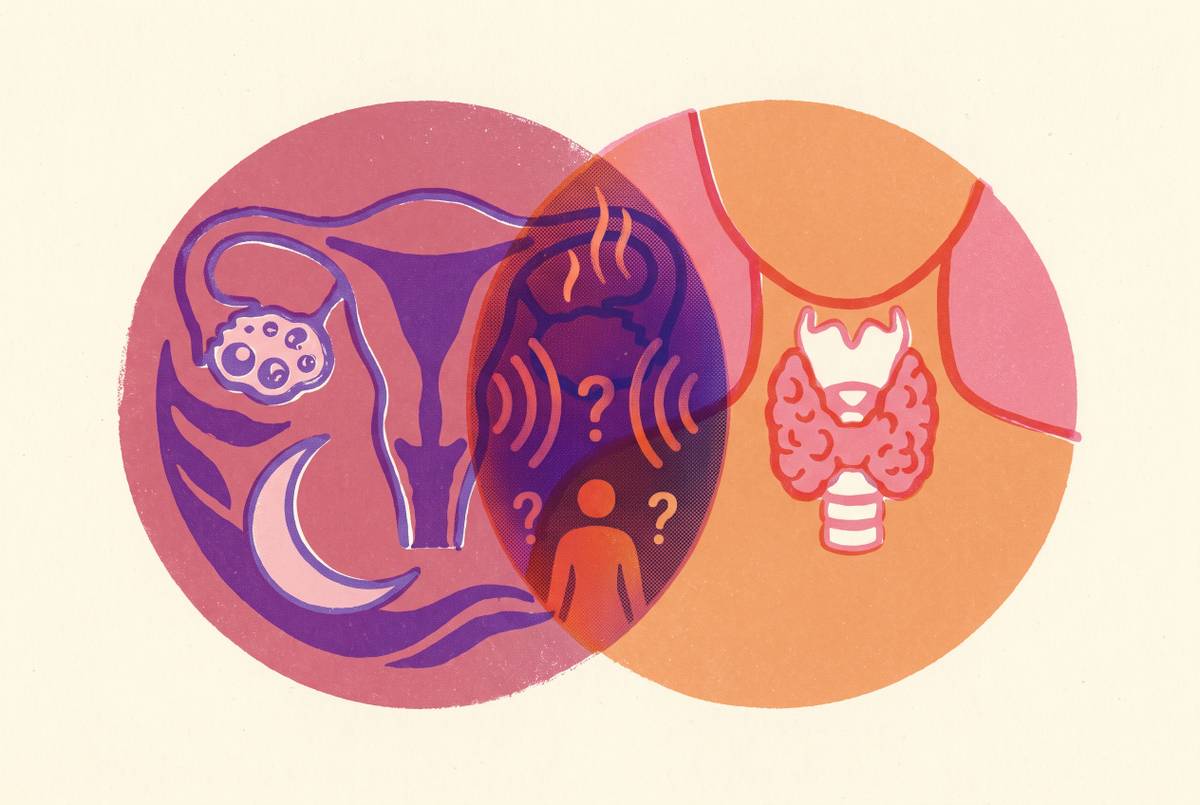
No single test diagnoses perimenopause. A panel covering FSH, estradiol, progesterone, and thyroid hormones gives far more useful information than any one marker read alone, and treating one number as the answer is where a lot of the confusion starts.
FSH is a good example of why. In the early reproductive years, FSH runs roughly 4 to 20 mIU/mL depending on where a woman is in her cycle. In menopause, it typically climbs above 40 mIU/mL. But FSH swings monthly during perimenopause, so a single elevated reading isn't diagnostic on its own. What matters more is whether levels stay elevated across repeated tests over time.
Estradiol testing captures the erratic swings that define perimenopause: low estradiol tends to correlate with hot flashes and tissue thinning, while high estradiol in early perimenopause can show up as heavy bleeding or breast tenderness instead. Progesterone testing shows whether ovulation is still happening, which matters both for managing irregular cycles and for understanding the estrogen-to-progesterone balance at a given point in time. Thyroid screening belongs in the same panel, since thyroid dysfunction shares several symptoms with perimenopause, fatigue, mood changes, cognitive slowing, and the two conditions can and do coexist, muddying the picture further if only one gets checked.
The limitation worth sitting with: hormones fluctuate constantly, so timing within the cycle changes what a single result means, and one draw can genuinely mislead. Serial testing is where the real information lives. Tracking values across multiple points in time reveals the trajectory rather than a snapshot: whether estrogen is swinging erratically high and low, whether FSH is trending upward over months, whether progesterone has quietly disappeared from the luteal phase. None of that shows up in one draw. A woman who tracks her levels over time ends up with something more useful than a diagnosis. She gets a record of her own inflection points, which makes it far easier to tell perimenopause apart from thyroid disease or other conditions that mimic it, and far easier to walk into a conversation with a clinician that starts from data instead of a guess.