Signs Perimenopause Is Beginning in Your Thirties or Forties
Hormone fluctuations, not just decline, drive early perimenopause symptoms in your thirties.

Perimenopause does not wait for the late 40s. For a meaningful share of women, it starts in the mid-30s to early-40s and shows up disguised as something else entirely, such as stress, burnout, a bad year, or a thyroid problem. This piece is about what the hormonal transition actually does at its earliest stage, why the standard symptom list gets misread almost on arrival, and what a woman can reasonably do about it before her cycle has even changed. That last part matters most, because by the time the cycle changes, the transition is often well underway already.
The cultural script says perimenopause starts around 50. The research says something messier: average onset sits closer to 47, but meaningful hormonal shifts can begin in the mid-to-late 30s, catching women off guard precisely because everyone, including their doctors, told them it was too early to think about it. Approximately two million women in the United States are estimated to begin perimenopause each year. That is not a rare event. It is closer to a demographic constant, and yet it remains one of the least anticipated transitions in women's health, which is the strange part worth sitting with.
Perimenopause has exactly one hard clinical endpoint: 12 consecutive months without a period. Everything before that, and it can be a long "before," counts as the transition. Average duration runs about four years, but it can stretch up to eight years in a meaningful number of cases. A woman noticing changes at 38 could still be in the thick of it at 46. Onset skewing earlier than expected is only half the story. The other half is that when symptoms show up in someone's 30s, neither she nor her clinician is looking for perimenopause as an explanation, so it gets ruled out by default rather than ruled in.
Here is the part that gets missed most often: hormone levels do not slide downward in a smooth line. They fluctuate, often wildly, and the fluctuation itself, not simply an eventual decline, drives most of the earliest symptoms. That distinction matters more than it sounds like it should, because it explains why a single test, taken on a single day, can miss the entire picture. Ask what a snapshot can tell you about a moving target, and the answer is: less than most people assume.
The sequence runs in a fairly consistent order. Progesterone drops first, since it is only produced after ovulation, and ovulation grows inconsistent well before estrogen does anything dramatic. So a woman can be having largely normal-looking cycles while her progesterone is already erratic month to month. Estradiol, the primary form of estrogen active during reproductive years, follows with its own pattern: instead of declining steadily, it spikes and drops unpredictably, sometimes within the same cycle. FSH (follicle-stimulating hormone) climbs as the pituitary gland pushes harder against ovaries that respond less reliably, but in early perimenopause, FSH can still come back normal on any given test. A woman can be actively in transition and still get a lab result that looks unremarkable, which is exactly the trap.
AMH, anti-Müllerian hormone, behaves differently. It peaks around age 25 and then declines in a measurable curve until it becomes undetectable around ages 50 to 51. Because it does not swing the way estradiol and FSH do, it works as a more stable marker of where a woman sits in ovarian aging, even when other numbers still read premenopausal.
Why does the brain feel this before the body does? Estrogen interacts directly with serotonin and dopamine pathways, so when estradiol starts fluctuating rather than declining predictably, neurotransmitter signaling gets disrupted along with it. That is a plausible reason mood, sleep, and cognition often surface as the first noticeable symptoms, ahead of hot flashes or an obviously irregular cycle. Layer onto that the HPA axis, the body's stress-response system: declining and fluctuating estrogen and progesterone also affect cortisol regulation, which helps explain why early perimenopause can feel almost indistinguishable from chronic stress. The two systems are, biochemically, tangled up with each other, and untangling them from a single blood draw is not really possible. The fluctuation is the story here, not the eventual number, and treating it as a decline instead of a swing is the first mistake most explanations make.
The symptoms that show up first, and why they get explained away
A 2025 study in npj Women's Health, drawing on thousands of women, found that among those aged 30 to 35, 55.4% reported symptoms rated moderate or severe on the Menopause Rating Scale. That figure alone should retire the assumption that perimenopause is a late-40s concern. More than half of women in their early 30s, an age group almost never screened for this, were already carrying a real symptom burden.
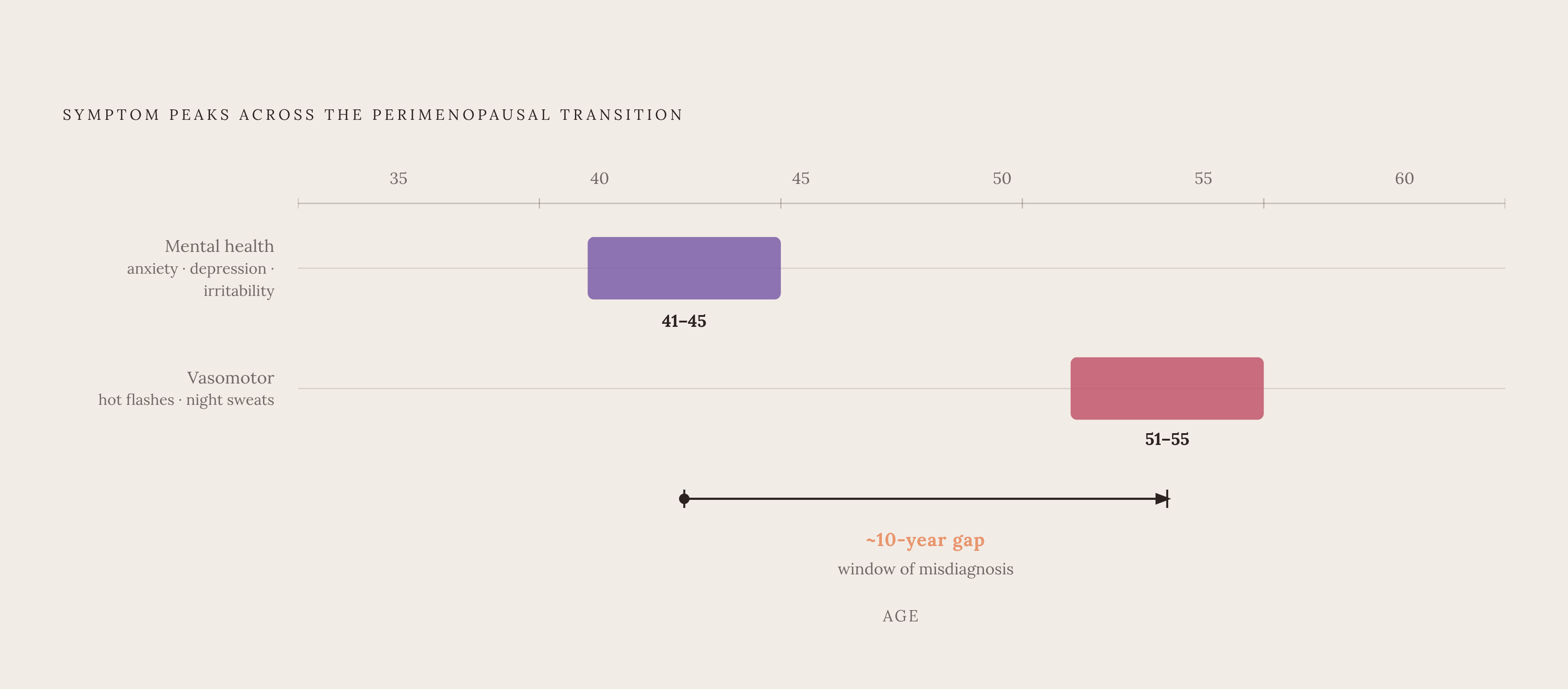
Mental health symptoms arrive first, and this is the part most people get backwards. Anxiety, depression, and irritability generally show up years before hot flashes or obvious cycle disruption, not after. The same study found mental health symptoms peaking in women aged 41 to 45, while classic vasomotor symptoms, hot flashes and night sweats, peaked later, in the 51-to-55 range. That is roughly a decade of lag between the psychological signal and the symptom everyone associates with menopause, and it is exactly the decade during which most women are told nothing hormonal is going on.
Sleep disruption gets chalked up to stress, a newborn, a demanding season of life. Mood changes, heightened anxiety, irritability, a flatter baseline, get attributed to work pressure or relationship strain, and often lead to an antidepressant prescription rather than a hormone panel. Brain fog and poor concentration get dismissed as burnout or "mom brain." A longer, more intense premenstrual phase gets read as simply a PMS problem, when it may actually be an early signal of progesterone decline. Subtle cycle shifts, a period landing a few days early or late, get folded into "it's probably stress."
Worsening PMS deserves far more attention than it gets. Clinicians rarely frame it as a hormonal transition marker, and that is a real gap, because it is one of the more concrete tells that progesterone is already behaving irregularly, well before anything else changes.
A 2024 paper in BJPsych Open makes the dismissal problem explicit: because the link between hormonal transition and mental health symptoms often goes unrecognized, many women get prescribed antidepressants and anxiolytics while the hormonal cause stays uninvestigated. Those medications can offer partial relief. They are not built to correct a hormonal root cause, and they do not.
The overlap is the deeper issue. Early perimenopause symptoms line up almost exactly with the symptoms of stress, sleep deprivation, anxiety disorder, and thyroid dysfunction, all of which are already common among women in their 30s and 40s for reasons that have nothing to do with hormones. That overlap makes perimenopause the last item on the differential, when it should sit much closer to the front. Per the same npj Women's Health study, somewhere between 59% and 65% of women experience vasomotor, psychological, or urogenital symptoms during the transition. That is a majority experience, not an edge case, and it should be treated like one.
How cycle changes signal the transition is underway
Irregular periods get called the most visible sign of perimenopause, and in a narrow sense that is true: they are the easiest thing to point to on a calendar. But they typically follow the neurological and mood symptoms by months, sometimes years. A woman whose sleep and mood have felt off for a year may only now be watching her cycle start to shift. The cycle change is confirmation, and treating it as the first sign is how so much time gets lost.
In early perimenopause, watch for a cycle varying by more than seven days from what used to be typical. A 28-day cycle sliding to 21 days, then out to 35, is not "running late." It is erratic in a way a stressful month alone does not usually produce. Flow shifts too: heavier, sometimes with flooding, or lighter, or simply inconsistent from one cycle to the next, with spotting between periods, color changes, or more clotting than before. PMS tends to intensify alongside all of this.
Later in the transition, the pattern changes shape entirely. Cycles start spacing out to more than two months apart. Missing three months of periods, when pregnancy is not the explanation, is worth bringing to a provider, particularly for women under 45. At this stage, vasomotor symptoms intensify sharply: a large longitudinal study of women's health found an adjusted odds ratio of 6.64 for vasomotor symptoms at the transition into late perimenopause. That is not a gradual slope. It is a real shift in phase.
One nuance trips up a lot of women, and clinicians sometimes miss it too: hormonal contraception can hide all of this. Birth control regulates bleeding patterns, which masks the very irregularity that would otherwise be the earliest visible sign, even as the underlying hormonal transition keeps moving underneath it. So the absence of cycle changes on the pill tells you almost nothing, and reading it as reassurance is a mistake.
What is worth tracking? Cycle length, flow volume, duration, spotting, and PMS severity. A written log, or one kept in an app, over several months turns a vague sense that "something's off" into an actual dataset. That dataset is one of the more useful things a woman can bring into a clinical conversation, a point worth returning to later in this piece.
Who is more likely to notice these changes earlier
As many as 11 to 12% of women begin perimenopause before age 41. That share is large enough to belong in the baseline conversation clinicians have with women in their late 30s, not raised only as an exception after every other explanation has failed. And the symptom burden builds through that decade rather than appearing suddenly: the same 2025 npj Women's Health study found that 64.3% of women aged 36 to 40 reported moderate to severe symptoms on the Menopause Rating Scale, a higher share than the 30-to-35 group.
Certain factors shift the timeline earlier, and family history carries more weight than any of them. Women whose mothers went through earlier menopause tend to follow a similar pattern, making family history one of the more meaningful predictors available. Smoking is linked to onset one to two years earlier than in non-smokers. Prior cancer treatment, chemotherapy or pelvic radiation in particular, can affect ovarian function directly. Autoimmune conditions, including Hashimoto's thyroiditis, matter twice over: they can accelerate ovarian aging, and they produce symptoms, fatigue, mood changes, that overlap with perimenopause closely enough to complicate diagnosis further. Some studies also associate longer use of hormonal contraceptives, being breastfed for a month or less as an infant, and maternal smoking during pregnancy with earlier onset, though these associations are less settled than the genetic and smoking links.
None of these risk factors function as a diagnosis on their own. Having one does not confirm perimenopause is underway, and having none does not rule it out. They shift probability, not certainty, and a risk factor checklist is not a verdict. But if a woman has any of these factors alongside the early symptom cluster described above, that combination, not age alone, is what should prompt closer attention.
Why these symptoms are so often misattributed, and what that costs
Thyroid disorders, anemia, anxiety disorders, depression, and perimenopause all produce a strikingly similar cluster: fatigue, mood disruption, sleep trouble, cognitive fog. Thyroid conditions in particular are at least as common in this age group, which is part of why TSH testing usually happens before anyone raises the question of hormonal transition. That is a reasonable first step. It becomes a problem the moment it is treated as the only step.
The antidepressant pathway is where this misattribution has its clearest cost. Per the 2024 BJPsych Open paper, women presenting with hormone-related psychological symptoms are frequently prescribed SSRIs or anxiolytics. These can ease some symptoms for some women, but they do not address a hormonal root cause. When the underlying driver actually is hormone deficiency or fluctuation rather than a primary mood disorder, hormone therapy tends to work better. Prescribing a common first-line medication is not wrong on its face, but treating it as the endpoint instead of a bridge is where things go sideways, and that is the mistake worth naming directly.
The scale of the anxiety burden alone says this is not a marginal issue. Between 1990 and 2021, the global age-standardized disability-adjusted life year rate for anxiety disorders among perimenopausal women rose from 625.51 to 677.15 per 100,000. Projections put that figure at 1,180.43 per 100,000 by 2035, a 40.67% increase over 2021 levels. That trajectory points to a growing population whose symptoms are only partially explained by current clinical practice, and the gap is widening rather than closing.
The dismissal follows a familiar pattern. A woman in her late 30s or early 40s raises these symptoms, and the responses she gets are lifestyle advice, a referral to mental health services, or reassurance that it is simply too early for this to be perimenopause. What gets lost in that exchange is real. Years pass without an accurate explanation for what is driving the sleep loss, the mood instability, and the fog, and that erosion compounds. Decisions about fertility timing, career moves, relationships under strain, get made without the relevant context that hormones are actively in flux. Access to things that might actually help, lifestyle adjustment, structured tracking, clinical support tailored to the transition, gets delayed simply because no one named what was happening.
This is not a crisis framing. It is an information framing, and the cost is specifically the cost of not knowing. Once a woman understands what is actually going on physiologically, she has real options in front of her, which is more than can be said for someone still operating on the assumption that she is too young for this.
What hormone testing can and cannot tell you at this stage
No single blood test diagnoses perimenopause, and that needs to be said, because it cuts against the instinct to ask for "the test" that will settle the question once and for all. Hormone levels fluctuate enough that a one-time draw can come back looking entirely normal in a woman who is, in every practical sense, already transitioning. Chasing a single definitive number is the wrong goal from the start, and clinicians who order one panel and stop there are missing the point of what the biology is actually doing.
FSH climbs as the pituitary compensates for ovaries that respond less predictably, but in early perimenopause it can still register at premenopausal levels on any given day. A consistently elevated FSH across multiple tests over time carries more weight than a single elevated reading, and it is typically drawn on cycle days 2 through 6 for consistency. Estradiol behaves even less cooperatively: it can run high one week and low the next, so a single normal result does not rule out perimenopausal fluctuation at all. It is usually drawn alongside FSH, same cycle window, for the same reason.
AMH stands apart as the more stable marker. It does not depend on where a woman is in her cycle, is not disrupted by exogenous hormones the way some other markers can be, and declines in a fairly steady curve as ovarian reserve drops. That makes it genuinely useful for understanding where someone sits in ovarian aging, even when FSH still looks unremarkable. Progesterone, meanwhile, often shows the earliest measurable change of all: a drop relative to estrogen frequently shows up before other markers move, and it lines up with the worsening PMS and sleep disruption that mark the earliest phase of the transition.
So what is testing actually good for here, if not a clean yes-or-no answer? It rules out other conditions that mimic the same symptoms, TSH testing for thyroid function being the standard first move, since hypothyroidism produces a nearly identical picture. It establishes a baseline, and a baseline matters because a single number in isolation says very little, while that same number compared against a reading from six months earlier starts to say something real. It gives a patient and a provider a shared, concrete vocabulary to work from, even when no individual result is diagnostic on its own.
The principle underneath all of this is longitudinal tracking. A pattern across repeated tests over time turns a confusing set of fluctuating numbers into something legible, in a way a single panel never can. For women under 45 specifically, testing tends to be most useful paired with a detailed symptom history and a menstrual cycle log. Neither the lab work nor the symptom record does the job alone, and treating either one as sufficient by itself is how women end up with a folder of "normal" results and no explanation for how they feel.
How to bring this to a clinical conversation and what to ask for
Women presenting in their late 30s or early 40s with this symptom cluster often are not asked about perimenopause at all. In practice, that means the burden of raising it tends to fall on the patient herself, and knowing what to bring to that conversation changes how it goes.
A symptom log carries real weight: dates, what happened, how severe it was, covering sleep, mood, cycle changes, and cognitive symptoms. A single bad week reads as an episode. Several months of consistent entries reads as a pattern, and patterns are what clinicians can actually act on. Cycle records matter alongside it: length, flow, timing of PMS, measured against what used to be typical, since "different from your own baseline" is a far more useful comparison than "different from some general population norm." Family history rounds this out. The age at which a mother or sisters reached menopause is a meaningful predictor, and it costs nothing to ask.
None of this guarantees a fast answer. Perimenopause resists the tidy, single-test diagnosis most people expect from modern medicine, and that resistance is exactly why the fluctuation itself, tracked over months rather than caught in a single draw, has to become part of the story a woman tells about her own body. The earlier that story gets told accurately, the less time gets lost to explanations that never quite fit.