Estradiol vs Estrone vs Estriol in Perimenopause
Three estrogens, not one, explain why perimenopause hits every system at once.

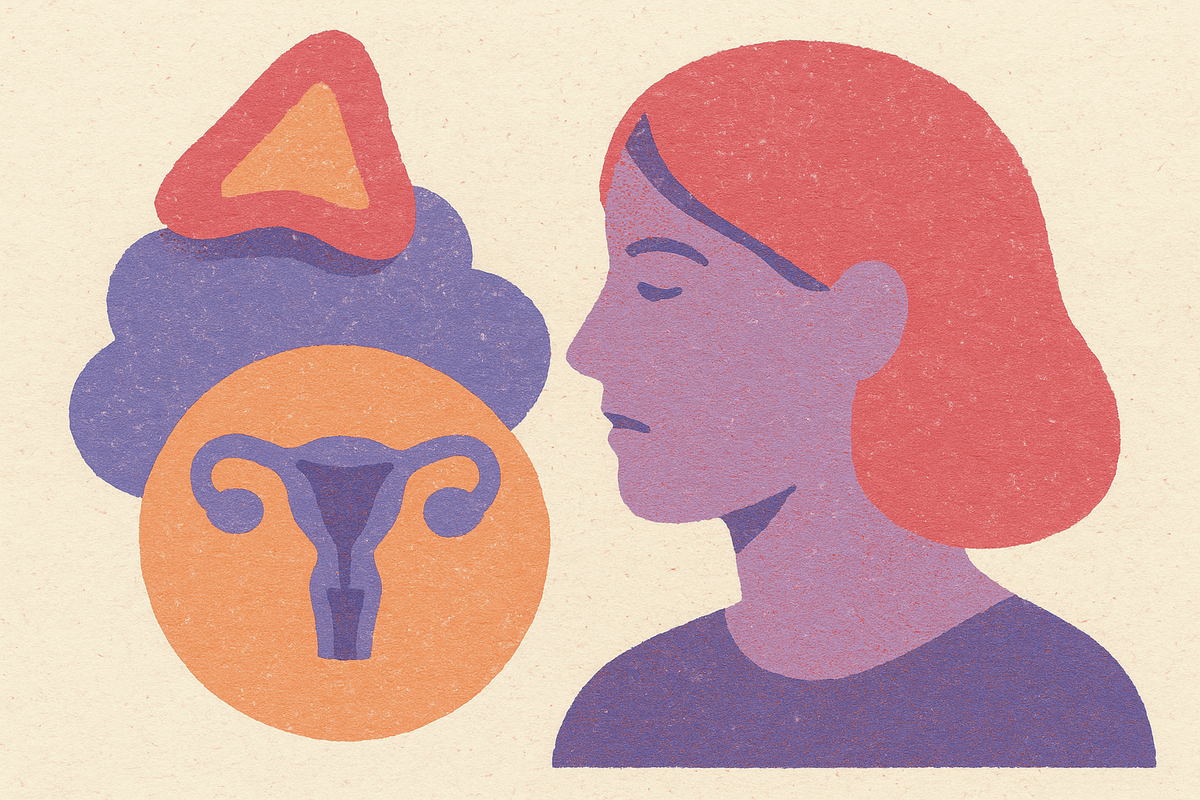
Estrogen is not one hormone, though clinicians and lab reports routinely treat it that way. The body runs on three distinct compounds, estradiol, estrone, and estriol, each with its own source, its own strength, and its own job. Perimenopause is what happens when the balance among those three starts to shift, and that shift, more than any single falling number, explains why this transition seems to hit every system in the body at once.
Start with where each one comes from. Estradiol (E2) comes from the ovarian follicles and dominates from puberty through the reproductive years. Estrone (E1) is made mostly in fat tissue, through a pathway that has nothing to do with ovarian function, and becomes the dominant estrogen after menopause. Estriol (E3) shows up in large amounts during pregnancy and, outside that window, barely registers at all.
Potency separates them further, and the gap is not small. Estradiol binds most strongly to estrogen receptors and stays attached for roughly 24 hours, long enough to trigger a full response in tissue. Estriol's binding affinity is only 1 to 4% of estradiol's, and it stays bound for about 6 hours, a gentler, more localized signal. Estrone is weaker than estradiol molecule for molecule, but becomes the principal circulating estrogen once ovarian estradiol production winds down. Receptor distribution is what makes this matter clinically. Estrogen receptor alpha concentrates in the endometrium, breast, and ovaries, while estrogen receptor beta spreads across the brain, heart, kidneys, bones, and lungs. Losing estradiol touches all of those systems at roughly the same time, and that is a good part of why perimenopause symptoms feel so scattered.
Estriol's jurisdiction is narrow. It acts on vaginal and urinary tissue and barely reaches systemic circulation, which is why it is not approved in the U.S. for systemic hormone therapy. Estrone is available in systemic formulations, as sodium estrone sulfate, the main component of esterified estrogens like Menest. So when a standard blood panel reports "estrogen," it is almost always reporting estradiol, because that is the form that tracks with symptoms and actually guides treatment decisions.
What actually happens to estrogen during perimenopause, and why it is not a smooth decline
Perimenopause gets described, constantly, as a steady downward slope: estrogen fading out gradually until it's gone. That picture is wrong, and longitudinal hormone sampling shows why. Estradiol doesn't decline in a straight line. It swings, hitting peaks well above typical reproductive-age levels and then dropping into troughs, sometimes within the same cycle. Average levels can stay inside normal reproductive ranges well into the early transition. The decline is real, but treating it as smooth is where most of the confusion about this stage starts.
Early perimenopause often looks like too much estrogen, not too little, and that catches a lot of women off guard. Progesterone falls first, and it falls faster than estradiol does in these early stages. That leaves a lot of women dealing with breast tenderness, heavier periods, and mood swings, symptoms of estrogen excess relative to progesterone, at exactly the point when they and their clinicians are watching for signs of estrogen running low. The mismatch between what people expect (a slow fade) and what's actually happening (an estrogen-high, progesterone-low imbalance) means real symptoms get missed or blamed on the wrong thing entirely.
The staging system clinicians use to map this, STRAW+10 (first published in 2001, updated in 2012), breaks the transition into distinct phases. Late Reproductive stage shows declining ovarian reserve and a rising FSH, with cycles still regular or just slightly shorter. Early Menopausal Transition brings variable cycle lengths, higher FSH, and stretches of no period lasting 60 days or more. Late Menopausal Transition is when FSH keeps climbing, estradiol keeps dropping, and vasomotor symptoms like hot flashes tend to show up. Early Postmenopause covers roughly two years after the final period, during which FSH and estradiol keep shifting before settling into a stable postmenopausal pattern.
The data behind that staging system comes largely from the SWAN study, a large longitudinal cohort of midlife women followed over time. That's a genuinely large longitudinal dataset, and it's worth naming outright, since so much of what gets stated with confidence about perimenopause traces straight back to it.
For readers trying to locate themselves on this timeline: perimenopause typically starts in the mid-40s, the average age of menopause in the U.S. is 52, and the transition itself can vary considerably in length from one person to the next. That range alone should tell you something. Two people both described as "in perimenopause" could be having completely different hormonal experiences, and neither one is wrong.
Eventually there's a handoff. As ovarian estradiol production winds down, estrone, made in fat tissue through its own separate pathway, becomes the principal circulating estrogen. Calling that a replacement gives the wrong impression, though, as if one hormone simply steps in to do the other's job. It's a structural change in what the body has available to work with, and estrone doesn't behave like estradiol at the receptor level. That difference has consequences, and the next section walks through what they are.
How each estrogen's behavior maps onto specific perimenopause symptoms
A large majority of women experience symptoms during this transition, and the range of those symptoms, hot flashes, mood changes, joint pain, memory lapses, is not random scatter. It follows the receptor map from above, plus the specific pattern of estradiol fluctuation. "Perimenopause symptoms" gets used as a catchall phrase far too often, when really each symptom cluster has a mechanism sitting underneath it, and treating them as one blurry syndrome is exactly what leads to the wrong fix.
Take hot flashes and night sweats first. Estradiol helps stabilize the hypothalamic thermostat, the part of the brain that regulates body temperature. When estradiol turns volatile, not just low but unstable, that thermostat starts misfiring. The instability does the damage here, not the lower average level on its own.
Cycle changes, periods that come heavier, longer, shorter, or with no pattern at all, trace back to the same erratic follicular activity driving erratic estradiol, combined with progesterone dropping and leaving the uterine lining less regulated. That loops right back to the estrogen-high, progesterone-low paradox from early perimenopause.
Mood is where the fluctuation argument gets genuinely interesting, and it's the piece of this section worth sitting with longest. Estradiol plays a role in how the brain produces and clears serotonin and dopamine, so when E2 swings, the chemistry regulating mood swings right along with it. A small pilot study from Gordon and colleagues, published in Frontiers in Psychology in 2019, tracked 15 perimenopausal women with weekly urinary estrone glucuronide (E1G) measurements over 12 weeks. The finding: it was the fluctuation in E1G, not the absolute level, that correlated with anhedonic depressive symptoms, negative affect, higher heart rate, and increased anger, rejection sensitivity, and sadness. Fifteen women is a small sample, so this shouldn't be read as the final word. But it points at something worth taking seriously: the swings themselves seem to do the damage, separate from whatever direction the hormone happens to be moving.
Anxiety tracks a similar pattern at the population level. One 2025 study found the global age-standardized disability burden from anxiety disorders among perimenopausal women rose from 625.51 to 677.15 per 100,000 between 1990 and 2021, with projections putting that figure at 1,180.43 per 100,000 by 2035, a rise of over 40% compared to 2021. Whatever the exact mechanism turns out to be, that trend line is not subtle.
Cognitive changes fit the receptor story too. In the MsBrain cohort (n=199, mean age 59.3), estradiol levels were positively associated with activation in the temporal and frontal cortices during verbal memory encoding tasks. Estrone showed its own, separate pattern of brain activation, also associated with memory-related neural responses. So even after menopause, once estrone has become the dominant estrogen, it appears to be doing something genuinely different in the brain than estradiol did, not just a weaker version of the same job.
Genitourinary symptoms, vaginal dryness, painful urination, pain during sex, live in estriol's narrow jurisdiction of local vaginal and urinary tissue. But the trigger is systemic estradiol decline: once E2 drops, tissue that depends on estrogenic signaling to stay healthy starts to atrophy without that support, and estriol's local, gentler signaling can't fully cover the gap.
Newer allergy symptoms, disrupted sleep, breast tenderness, all show up on the documented symptom list too, and all connect back to estrogen receptor beta's presence across so many organ systems at once. That's the throughline for this whole section: perimenopause resembles a dozen different conditions at the same time because ERβ is spread across a dozen different organs.
One consequence follows directly from all of this, and it's the one worth carrying into the next section. Because symptoms come from fluctuation patterns and shifting ratios among three different estrogens, not from a single, steady decline, a symptom that's severe one week can ease off the next. Figuring out what's actually causing what, on your own, without some kind of data behind it, is genuinely hard to do.
Why a single hormone test during perimenopause can mislead rather than clarify
NICE guidelines, updated in 2024, are blunt about this: don't use laboratory tests, including estradiol, inhibin A, inhibin B, anti-Müllerian hormone, antral follicle count, or ovarian volume, to diagnose perimenopause or menopause in people 45 and over. FSH gets a narrower carve-out, restricted mainly to specific contraceptive contexts. At 45-plus, diagnosis is meant to run on clinical grounds: age, symptoms, cycle history. ACOG lands in roughly the same place, noting that OB-GYNs can typically identify perimenopause without routine hormone testing at all.
Why would guidelines actively discourage testing something as central as estradiol? Because a single value can land anywhere depending on exactly when in the cycle, or wherever in the erratic non-cycle, the blood draw happened. Levels during perimenopause can swing across a wide range, and postmenopausal levels tend to be considerably lower, but one reading at either extreme can't confirm or rule out anything. A woman could test at 380 pg/mL on a Tuesday and 60 pg/mL two weeks later, both readings accurate, neither one telling the whole story. That gap alone should settle the argument for anyone still inclined to trust a single draw.
FSH runs into the same wall. It tends to rise as ovaries become less responsive over time, but perimenopause's volatility means the same woman can show a normal FSH one day and an elevated one on another. NICE guidance does recommend FSH testing for people 40 to 45 with symptoms, or under 40 when early menopause is suspected, but says it's not routinely needed at 45 and older. There's also a masking effect worth understanding: when estradiol runs high, it can suppress an FSH reading that would otherwise show up as elevated. So a "normal" FSH on a given day might just mean estradiol happened to be high that morning, not that ovarian function has stabilized. That's also why hormone readings alone should be interpreted with caution in any contraceptive decision. Hormone values can be misleading about actual ovarian activity at any given moment.
AMH declines as ovarian reserve drops, but both ASRM and NICE's NG23 guidance are clear that it shouldn't be used to diagnose perimenopause or predict when menopause will actually arrive in routine care. DUTCH panels and saliva testing haven't been shown to add more useful diagnostic information than symptom tracking and standard blood work, so neither is recommended for routine use.
The real problem with a snapshot test is simpler than any of the specific numbers above. It answers "what is the level right now," when the question that actually matters clinically is "what pattern is this hormone following over time." A single result cannot answer that second question. It was never built to.
What tracking estradiol over time reveals that a one-time measurement cannot
Perimenopause is defined by change, so the rate, direction, and volatility of that change carry real diagnostic weight of their own, weight a single snapshot simply can't capture. One number, taken once, tells you almost nothing about which way things are headed. If there's one habit worth building out of everything in this piece, it's treating estradiol as a line on a chart, not a fact fixed at a single point in time.
Bone loss makes this concrete. Research shows the fastest phase of bone loss can begin before estradiol visibly bottoms out, right when FSH is climbing but estrogen concentrations are still relatively stable. The bone damage is already accelerating before estradiol visibly bottoms out, so waiting for a low estradiol reading to flag bone risk means missing the exact window where the fastest loss is happening.
A 2025 cross-sectional study by Feng and colleagues, published in Frontiers in Endocrinology (n=130), tested this directly. Using estradiol alone to predict perimenopausal bone loss, the threshold was 62.7 pmol/L, with 79.1% sensitivity and 93.2% specificity. Using the bone turnover marker β-CTX alone, the threshold was 0.30 ng/mL, with 79.3% sensitivity and 96.4% specificity. Combining both markers pushed performance up substantially: an AUC of 0.950, sensitivity of 88.4%, specificity of 97.7%. That's a real jump, not a rounding error, and it argues for tracking estradiol alongside bone markers rather than checking either one in isolation.
HRT absorption is the other clear case for tracking over time, and arguably the more urgent one. A cross-sectional analysis of 1,508 perimenopausal and postmenopausal women at a UK specialist menopause clinic (Glynne et al., Menopause, February 2025) found a median estradiol concentration of 355.26 pmol/L, with an interquartile range of 198.44 to 646.15 pmol/L. Nearly a quarter, 24.84%, of women using the highest licensed transdermal dose still had subtherapeutic estradiol, below 200 pmol/L. Older women, 50 and up, and patch users specifically were more likely to land in that low-absorption group. A woman can sit at the maximum licensed transdermal dose on paper and still not be getting a therapeutic amount into her bloodstream, and there's no way to catch that without measuring it directly. The study put the optimal plasma estradiol range for symptom relief and bone protection at 220 to 550 pmol/L, or roughly 60 to 150 pg/mL. Anyone on patches assuming the dose alone guarantees the result is skipping a step that 1 in 4 women in this study needed.
The mood research fits the same pattern. That Gordon et al. pilot study linking E1G fluctuation, not level, to mood disruption suggests tracking variability over time carries more clinical meaning than any single value ever could on its own.
Put plainly: the same estradiol number means something completely different depending on where a woman sits in her transition, what her previous reading looked like, and which direction the trend is heading. That context only builds up across repeated measurements. One data point, however precise the lab work behind it, can't manufacture that context out of thin air.
How to read what your estrogen results actually mean when you have them
Start with which hormone actually got tested. Standard blood panels measure estradiol, not estrone and not estriol, because E2 is the form that correlates with symptoms and drives treatment decisions. When a lab report says "estrogen," it means E2, essentially without exception.
Reference ranges shift depending on where someone sits in the transition, so don't read them like a fixed yardstick. During perimenopause, a wide range of values can show up as normal, and where a given reading falls matters less than whether the trend is climbing, falling, or bouncing around unpredictably. After menopause, levels typically settle below the low end of reproductive-age ranges, usually stabilizing about two years after the final period.
FSH works the same way. A single elevated reading means far less than a rising trend across several draws over time. And a normal FSH reading on a given day should be interpreted in the context of where estradiol happened to be at the same time.
Estrone becomes more relevant once ovarian estradiol production has largely wound down and estrone has taken over as the dominant circulating estrogen. Clinicians may start considering E1 alongside E2 in postmenopausal women, particularly around cognitive health, since the MsBrain research found estrone's brain activation patterns were associated with memory-related neural responses in their own right.
Estriol, for its part, isn't a useful thing to test outside of pregnancy. Compounded estriol products do exist, but E3 simply isn't part of the FDA-approved systemic hormone therapy landscape the way estradiol and estrone are, and treating a random E3 number as clinically meaningful is a mistake worth naming directly.
Taken together, these five sections point at the same idea from different angles. "Estrogen" was never one hormone to begin with, and perimenopause is the stretch of life where that fact stops being a technicality on a lab report and starts actually mattering, symptom by symptom, test by test.
Sources
- A threshold of β-CTX (0.3 ng/mL) with low estradiol identifies high-risk perimenopausal women for bone loss: a cross-sectional study
- The range and variation in serum estradiol... : Menopause
- Endogenous Estrogens and Brain Activation During Verbal Memory Encoding and Recognition in the Postmenopause
- Estradiol Fluctuation, Sensitivity to Stress, and Depressive Symptoms in the Menopause Transition: A Pilot Study