High Progesterone Symptoms and What They Mean
Understand how progesterone swings trigger real symptoms—and when the numbers actually matter.

Progesterone swings harder across a single menstrual cycle than almost any other hormone in routine circulation, close to a 17-fold change from baseline to peak. The fatigue, bloating, breast tenderness, and mood shifts that show up like clockwork in the back half of a cycle aren't random complaints; they're downstream effects of a hormone doing exactly what it evolved to do.
What the numbers mean: reading a progesterone result against cycle phase
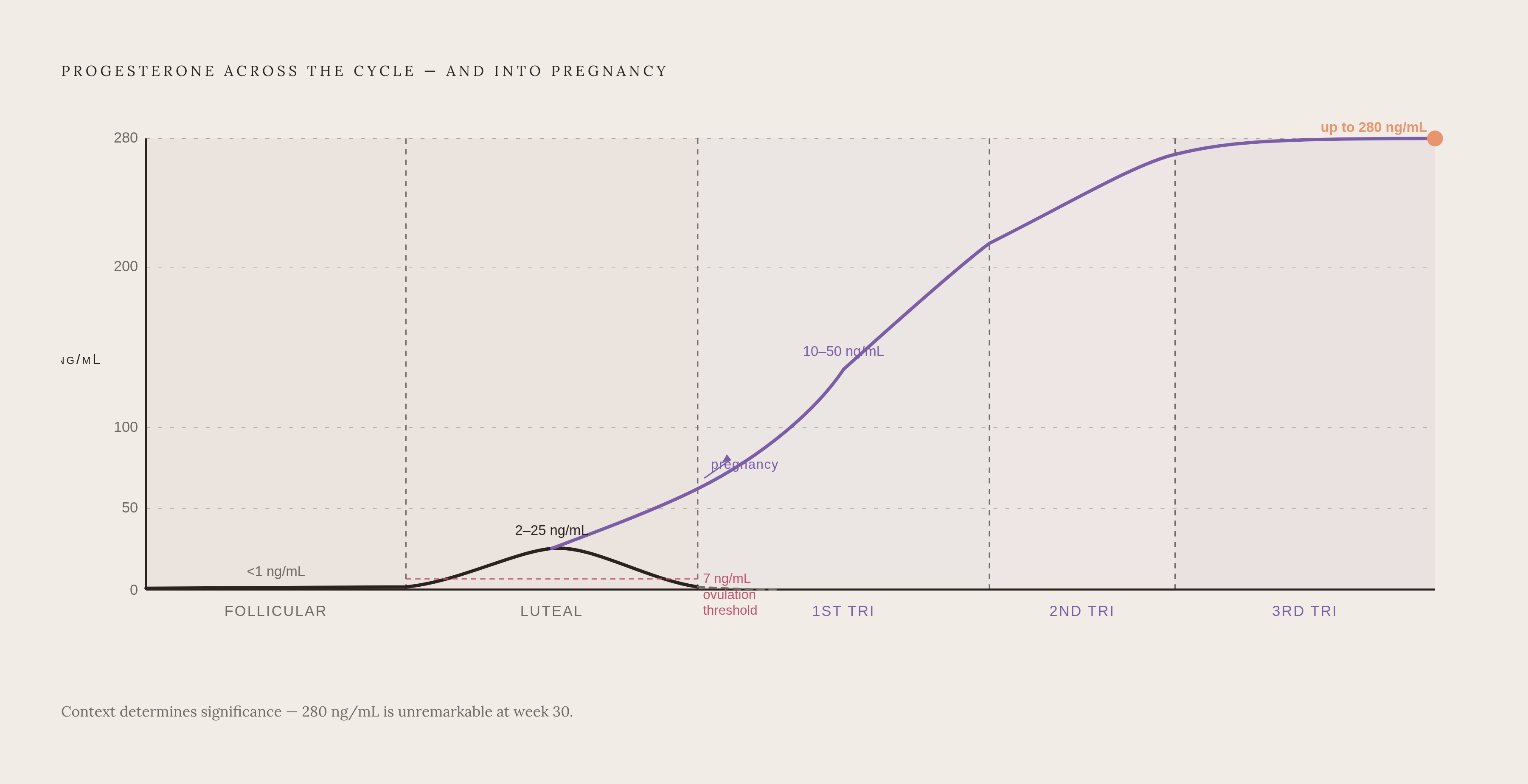
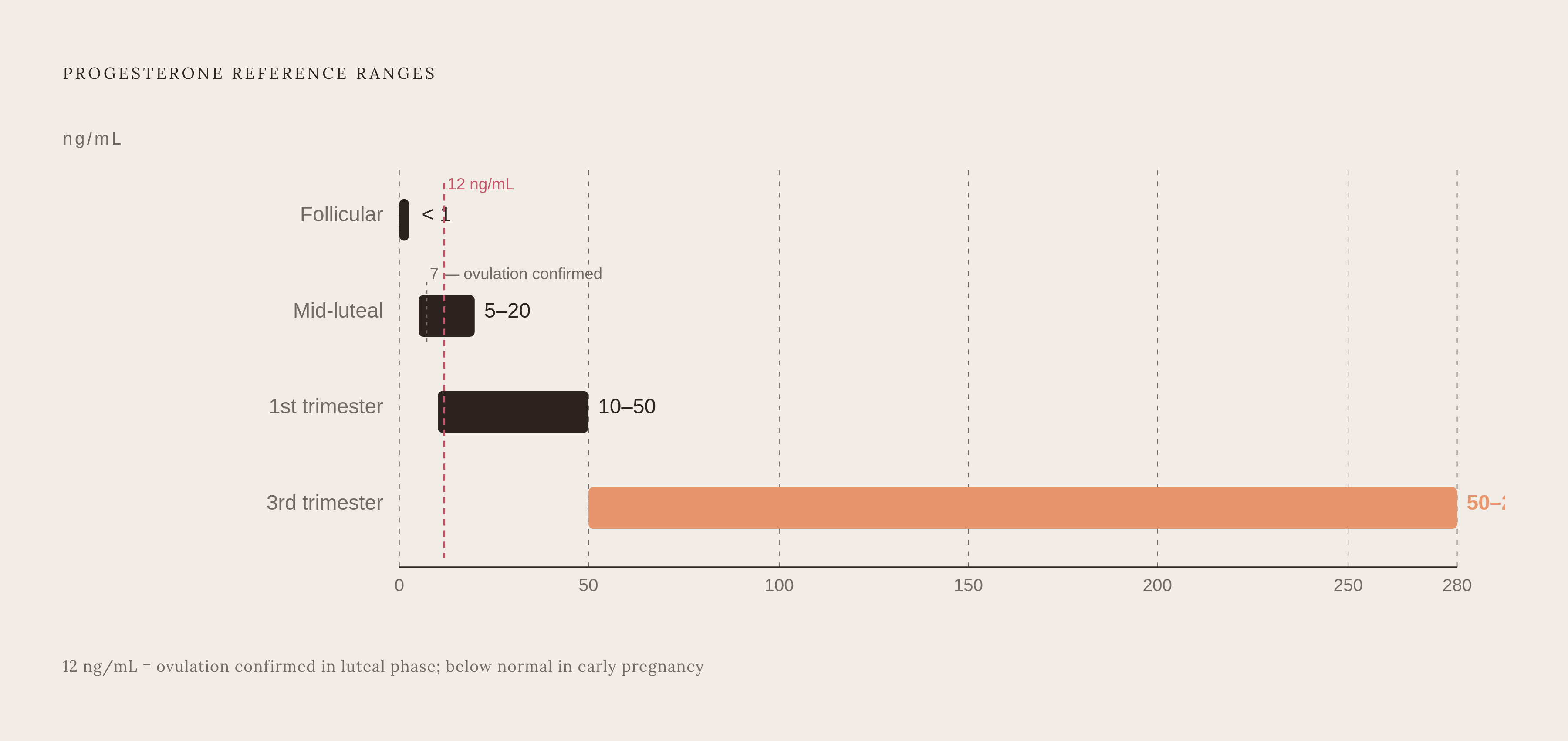
Before ovulation, progesterone sits under 1 ng/mL, essentially absent, because there's no corpus luteum yet to make it. Ovulation happens, the corpus luteum forms, and the number climbs fast, typically landing in the 5 to 20 ng/mL range at its mid-cycle peak. The broader luteal window runs anywhere from 2 to 25 ng/mL depending on which day you catch it and how that particular body runs its cycle.
Clinicians lean on a threshold around 7 ng/mL, tested near day 21 of a 28-day cycle, as evidence ovulation occurred. Land above that line on the right day and the reading confirms the system did what it was supposed to do.
Pregnancy throws the whole scale out the window. First trimester progesterone runs roughly 10 to 50 ng/mL as the placenta starts pulling its weight, and by the third trimester you're looking at 50 to 280 ng/mL. A number that would send up flares in a non-pregnant cycle is unremarkable at week 30 of gestation, while a number that looks perfectly normal for a luteal phase would be strangely low for a third trimester.
Context beats the raw figure, every time. A 12 ng/mL result means "ovulation confirmed" on day 21, but on day 5 it means almost nothing, and in early pregnancy, where a much higher trajectory is expected, that same number is a reason to look closer. Labs also disagree on what counts as high, so a result flagged abnormal at one lab might sit comfortably inside another lab's normal band, and reading a luteal-phase number against a follicular-phase range, or the reverse, is one of the more common interpretive mistakes out there, generating a lot of alarm that didn't need to happen.
The symptom cluster that high progesterone produces, and the mechanism behind each one
Fatigue, bloating, breast tenderness, mood shifts, headaches, mild nausea, skin changes: these tend to show up together in the luteal phase, one driver producing several downstream effects rather than a coincidence.
Take fatigue first, since it's the most misunderstood of the bunch. Progesterone has a genuine sedative action on the central nervous system; that's pharmacology, worth telling apart from thyroid fatigue or anemia, both of which sit flatter and more constant across the month. Progesterone-driven fatigue peaks in the luteal phase and lifts once progesterone drops, right before menstruation starts.
Bloating follows a similarly direct line. Progesterone changes how the body handles fluid, and water retention in the luteal phase is a predictable physiological response, worth recognizing rather than chasing down with an elimination diet.
Breast tenderness runs on the same rail: progesterone acts directly on breast tissue, so tenderness climbs with the luteal surge and falls when progesterone falls. Mood is messier to pin down but no less real, and low motivation, sadness, and anxiety tied specifically to the luteal window are distinct from the mood disruption more commonly pinned on estrogen. That distinction gets flattened constantly, especially later in a woman's reproductive life, when everyone defaults to blaming "hormones" broadly instead of asking which hormone, and when.
Rounding out the list: headaches, digestive sluggishness, mild nausea, and oilier skin, with less airtime but the same mechanism behind them, worth naming so they get recognized instead of treated as unrelated nuisances that showed up out of nowhere.
Here's the real payoff, though: pattern recognition. These symptoms cluster in days 15 through 28 of a typical cycle and resolve around menstruation, and that timing is itself diagnostic information. Fertility treatment research backs this up too, since women receiving oral progesterone during assisted reproduction cycles report sleepiness, nausea, dizziness, headache, and fatigue at notably high rates, which tracks, given that the drug is producing exactly the effects progesterone is known to produce.
When elevated progesterone is normal and when it signals something worth investigating
Most elevated progesterone reflects exactly what it should: a luteal peak, a confirmed pregnancy, the expected result of supplementation. First question worth asking: does the elevation fit the timing? A reading of 15 ng/mL on day 21 confirms ovulation, and that's normal physiology doing its job.
What happens, though, when the number shows up somewhere it shouldn't? A handful of conditions can produce genuinely abnormal elevations. Luteal ovarian cysts form after ovulation and keep pumping out progesterone past the point where it should be tapering. Congenital adrenal hyperplasia works through a completely different route: an enzyme block diverts progesterone toward androgen production, so progesterone rises as a byproduct of a pathway that's jammed, usually alongside acne, hirsutism, irregular periods, or hair thinning rather than showing up in isolation. Rare ovarian tumors, lipid ovarian tumors and choriocarcinoma among them, can elevate progesterone too; naming them isn't a suggestion they're likely, just an acknowledgment they exist on the list a clinician has to rule out. Ectopic pregnancy is its own case, where elevated progesterone in the wrong location calls for prompt evaluation.
Exogenous progesterone adds a separate wrinkle entirely. Synthetic progestogens used in hormone therapy or fertility treatment can activate receptors and produce real, felt symptoms even when the serum number on the lab report looks unremarkable. The number and the lived experience diverge here, because what's driving symptoms is receptor activation, not necessarily what's circulating in the blood.
So the principle underneath all of this, and it took some sitting with these numbers to see it clearly: a progesterone value read alone tells you less than the same value read next to estradiol, LH, and FSH. Ratios carry more weight than any single number sitting by itself on a page.
How progesterone fits into the broader hormonal picture during perimenopause
Progesterone starts declining before estrogen does in perimenopause. That sequencing gets left out of most explanations, which is a shame, because it accounts for a good chunk of the confusion women report to their doctors.
In early perimenopause, STRAW Stage -2 if you're using the staging system, ovulation turns irregular, and the corpus luteum forms inconsistently, so progesterone becomes erratic rather than simply low. A cycle with strong ovulation still produces a full progesterone surge and the familiar luteal symptoms; an anovulatory cycle produces almost none. That's why symptom intensity can swing wildly month to month in a way that tracks ovulation, not age.
By late perimenopause, STRAW Stage -1, ovulation largely stops. Progesterone falls to minimal levels while estrogen keeps lurching around unpredictably, and this is the stage where hot flashes, night sweats, and sleep disruption tend to take over as the headline complaints. A 2021 study in Menopause found 60 to 80% of women report vasomotor symptoms during late perimenopause, and at that stage, estrogen instability drives most of it, with progesterone playing a smaller supporting role.
The erratic push and pull between the two hormones also raises the risk of perimenopausal depression, and the mechanism seems to run through neuroinflammatory pathways, a more layered explanation than the flat "hormones are low" one most women get handed at a ten-minute appointment. Meanwhile FSH climbs as the pituitary works harder to get a response out of ovaries that are increasingly unresponsive. Elevated FSH marks the transition, worth noting on a lab report, though the symptoms a woman actually feels come from other mechanisms entirely.
Zoom out far enough and the pattern runs deeper than "progesterone runs low." The reliable rhythm that made progesterone's effects predictable in the first place breaks down, and once that rhythm goes, so does the old shortcut of "day 21 should look like this."
Why high-progesterone symptoms are so often misread — by clinicians and by women themselves
Fatigue, mood changes, bloating, breast tenderness: these overlap heavily with the symptom lists for depression, thyroid disorders, chronic fatigue, generalized anxiety. A clinician looking at these symptoms with no cycle-phase context has every reason to chase one of those other diagnoses first. Sometimes that's the right call, and sometimes it isn't, with the actual driver sitting in plain sight on a calendar the whole time.
Perimenopausal symptoms are routinely pinned on other conditions instead of the hormonal transition actually producing them, a pattern clinicians and researchers have noted repeatedly. That's not a rounding error; it points to a structural blind spot, not a handful of unlucky missed cases.
Timing is the most underused clue on the table, and it costs nothing to track. Symptoms showing up predictably in the luteal phase and easing around menstruation, that pattern is clinical information in its own right, arguably more useful than a single lab draw, yet most women are never taught to track it this way, and most clinicians, boxed into a fifteen-minute visit, don't think to ask.
Then there's what I'd call the single-snapshot problem. A progesterone test drawn on the wrong cycle day, or interpreted without anyone knowing what day it was drawn, can look completely normal while masking a real pattern underneath, or look abnormal when it was just badly timed. Exogenous progesterone muddies things further still, since synthetic progestogens used in hormone therapy or contraception can drive receptor-level symptoms that never register as a flagged number anywhere on paper.
Maybe the most practical thing a woman can do here has less to do with lab work and more to do with self-advocacy. Being able to describe when symptoms happen, not just what they are, hands a clinician something far more useful than a list of complaints ever could.
What useful hormone testing actually looks like for progesterone-related symptoms
Progesterone is cycle-phase dependent in a way most routine hormone tests aren't, so timing the draw matters nearly as much as running it at all. Mid-luteal testing, generally around day 21 of a 28-day cycle, is the standard way to catch the relevant peak. Test during the follicular phase and compare against luteal-phase reference ranges, and the resulting number doesn't mean much of anything; you're comparing two different physiological states as though they were interchangeable.
Progesterone alone rarely tells the full story. Read it against estradiol and you get a ratio, and that ratio reflects hormonal balance in a way an isolated number simply can't. FSH adds staging on top of that: rising FSH paired with erratic progesterone helps separate early perimenopause from other, unrelated causes of irregular cycles.
There's a longitudinal case worth making too, and it's the piece that took the longest to click into place. One progesterone result is a snapshot and nothing more. Test the same woman across several cycles, though, and you find out whether her luteal output is steady, declining, or missing altogether, something a one-time draw can't tell you no matter how carefully it's timed. This matters most in perimenopause, where the cycle-to-cycle variation is the diagnostic signal, not noise sitting around it. Tracking over time can catch an anovulatory cycle, one with low or absent luteal progesterone, sitting right next to an ovulatory one with a full surge. That contrast is what explains fluctuating symptoms, not a single number pulled from a single Tuesday morning.
None of this replaces a clinician actually looking at the whole picture. The same number means something different depending on cycle day, life stage, and what estradiol and FSH happen to be doing at that same moment; a number without that context is just a number sitting on a page. Knowing what the symptoms mean gets you halfway there, and knowing when to test, what to test alongside it, and how to read the pattern across months rather than one draw is what actually makes the knowledge usable.