How Estrogen, Progesterone, and FSH Interact During Perimenopause
Hormone swings, not declines, drive perimenopause symptoms.

Perimenopause doesn't run on one hormone quietly fading out. It runs on a feedback loop, one where estrogen, progesterone, and follicle-stimulating hormone (FSH) constantly signal back and forth to keep cycles predictable, and this piece traces what happens as that loop starts to break down. Most women, and most doctors too, treat each symptom as its own separate problem: a hot flash one week, anxiety the next, a period that shows up ten days late the month after that. That instinct is backwards. Once the mechanics of the loop are on the table, that same pattern stops looking like a grab-bag of complaints and starts looking like one system losing its grip on itself.
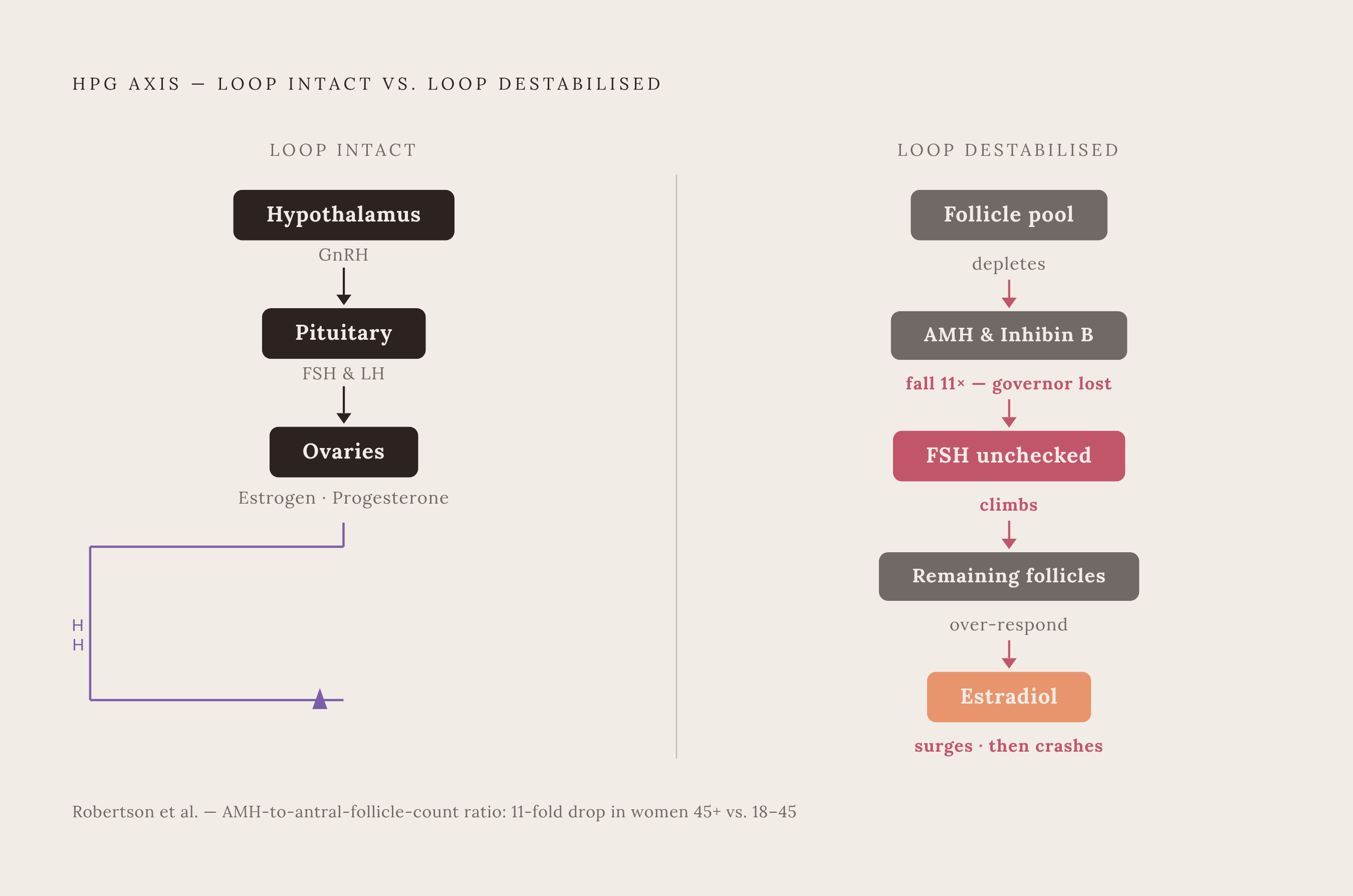
The hypothalamic-pituitary-gonadal (HPG) axis works as a closed loop. The hypothalamus signals the pituitary gland, the pituitary answers by releasing FSH and luteinizing hormone (LH), and the ovaries respond by producing estrogen and progesterone. Those hormones travel back up and suppress FSH and LH, keeping the whole cycle from running away with itself, the way a thermostat quiets a furnace once the room hits temperature.
In a normal cycle, each hormone has a job at a specific phase. During the follicular phase, FSH rises to recruit a batch of follicles, estradiol climbs as those follicles mature, and a protein called inhibin B fine-tunes how much FSH gets suppressed along the way. A surge in LH triggers ovulation and the release of an egg. Then, during the luteal phase, the corpus luteum (what's left of the follicle after ovulation) takes over progesterone production, estradiol holds relatively steady, and both hormones suppress FSH until the corpus luteum breaks down and the cycle resets.
Two other players keep this system orderly without getting much credit. Anti-Müllerian hormone (AMH) holds back FSH-stimulated follicle growth, tempers aromatase activity, limits LH receptor levels, and restrains progesterone synthesis, all of which keeps follicle recruitment from turning chaotic. Inhibin B, made by granulosa cells inside the follicles, adds its own direct suppression of FSH, separate from whatever estradiol happens to be doing. Together, AMH and inhibin B act as guardrails on the follicular phase.
The loop only corrects itself as long as ovarian reserve holds up, and that's the detail the rest of this piece hangs on. The disruption doesn't start in the brain or the pituitary, no matter how often perimenopause gets described as a brain-driven event. It starts on the ovarian side, when the supply of follicles runs low.
What starts to change as ovarian reserve declines
Follicle depletion wears down the pool the entire loop depends on, and it does so years before most women notice anything different about their cycles. By the time a period actually shifts, declining follicle numbers have already been driving FSH upward for a while, and that rise occurs quietly, within a cycle that still looks normal on paper.
AMH and inhibin B fall first, and they fall early. Robertson et al. (2020) found an 11-fold drop in the ratio of AMH to antral follicle count in women 45 and older compared with women aged 18 to 45, with inhibin B suppressed in the older group as well. That gap points to something specific: the follicles left in an older ovary aren't just fewer in number. They behave differently, producing less of the hormone that's supposed to keep FSH in check.
Once AMH drops, FSH-driven follicle recruitment loses its governor. More follicles start advancing toward the dominant phase than would have in earlier reproductive years, because the brake that used to slow that process down has gone soft.
Declining ovarian reserve raises FSH levels well before it disrupts period regularity, and that difference is measurable in hormone testing. Relying on cycle length alone to gauge where a woman stands is the wrong instinct, and it's the one most women default to because it's the only thing they can actually feel. Under a staging system for reproductive aging, Stage -3a is defined by shorter cycles alongside FSH that's elevated and more variable during the early follicular phase. Progesterone tends to decline before estrogen does, too, because a growing share of cycles become anovulatory: menstruation still happens, but without ovulation, the luteal phase produces almost no progesterone.
The Robertson data makes the disconnect concrete. Women 45 and older in that study still showed normal patterns for estradiol, progesterone, LH, and inhibin A, yet their FSH was already elevated and their inhibin B already suppressed. The downstream signals looked fine while the upstream ones had already shifted. Early perimenopause gets missed constantly, precisely because the hormone most people think to test, estradiol, can still read completely normal while the system feeding into it has already started to wobble.
Why estrogen doesn't just decline, it swings
Most women expect estrogen to taper off gradually, the way a dimmer switch fades a light. That's the wrong mental model, and clinging to it is probably the single biggest reason perimenopause confuses people as long as it does. Estradiol swings, often widely, for years before it settles into a lower range, and the swinging does more of the damage than the eventual decline ever does.
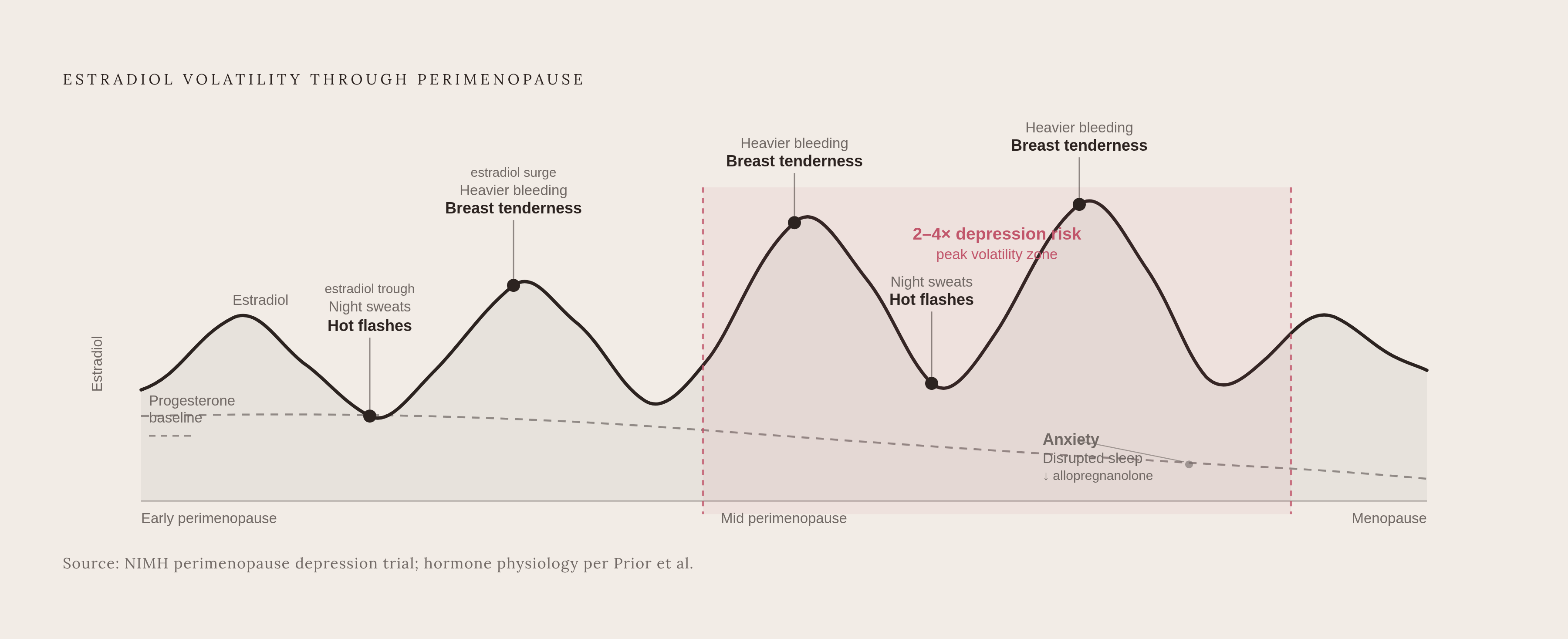
Why does this happen? Fewer follicles and less inhibin B mean FSH climbs, and elevated FSH pushes the remaining follicles harder than it would have earlier in a woman's reproductive life. Those follicles respond by producing estradiol in surges, sometimes reaching levels higher than anything seen in a woman's twenties or thirties, before losing function and crashing. What follows is a string of overcorrections, one after another, with no telling which direction the next one runs.
Research on the menopause transition confirms that estradiol, progesterone, and FSH don't move in straight lines, and day-to-day variability in estradiol stays substantial throughout. That variability isn't cosmetic. An NIMH-sponsored clinical trial found that women in the menopause transition face a 2 to 4-fold increase in risk for major depression, and the researchers tied that risk to day-to-day estradiol variability during the transition. Volatility is the variable that matters here, not deficiency, and that's a distinction most conversations about perimenopause skip right past.
STRAW+10's Stage -1, the late menopausal transition, captures the contradiction well. FSH can read in the menopausal range on one draw and within normal reproductive range on the next, particularly when estradiol happens to be spiking at the moment of the test. The loop can produce two opposite-looking readings within the same stretch of weeks.
That has a direct symptom consequence. A woman can have a hot flash, a classic low-estrogen signal, one week, and then breast tenderness or heavier bleeding, symptoms that look more like estrogen excess, the next. She doesn't have two conditions running side by side. She has one oscillating system caught at two different points in its swing, and a single blood draw can land on either point almost at random, producing a result that's falsely reassuring or falsely alarming depending purely on timing. For exactly this reason, hormone levels including FSH and estradiol are not reliable single-point markers during perimenopause.
FSH's role beyond signaling ovulation
FSH usually gets described as a messenger, the pituitary's way of telling the ovaries to get moving. That description undersells it badly. FSH has receptors in tissues that have nothing to do with ovulation, and treating it purely as an ovarian signal misses what it's doing everywhere else in the body.
Bone is one of those places. FSH receptors sit on osteoclasts, the cells that break down bone tissue, and FSH can stimulate that resorption directly, independent of whatever estrogen happens to be doing at the time. That's not a minor footnote; it means correcting estrogen alone may not fully offset the bone loss that rising FSH drives on its own, which has real implications for how bone density gets managed during the transition.
Cholesterol tells a similar story. Serum FSH correlates positively with total cholesterol and with the prevalence of hypercholesterolemia, and blocking FSH has been shown to inhibit cholesterol production in the liver and lower serum cholesterol. FSH isn't just tracking alongside cardiovascular risk here. It looks like it's participating in it directly.
The brain shows a comparable pattern. A study published in Frontiers in Medicine (Zeng et al., 2026) linked estradiol depletion and FSH elevation to specific atrophy in the thalamus among perimenopausal women with hypertension, atrophy that predicted lower cognitive scores and disruption in the brain's ventral attention network.
Taken together, these findings force a rewrite of what rising FSH actually means during the transition. Most explanations of perimenopause treat FSH as a passive marker, a number that just confirms ovarian function is winding down. It's an active agent with its own receptors and its own downstream effects on bone, lipids, and brain tissue. It's an active agent with its own receptors and its own downstream effects on bone, lipids, and brain tissue, and that's exactly the groundwork the next section builds on.
How the destabilized loop produces the symptom picture women experience
Hot flashes and night sweats trace back to estradiol drops within the oscillating pattern described above. When estradiol falls, even temporarily, the hypothalamus loses its usual thermoregulatory signal, and temperature control briefly misfires. That's why a woman can have a rough week of flashes followed by several calm weeks, instead of a steady climb in symptoms.
Mood and anxiety trace back to progesterone, specifically to its metabolite allopregnanolone, which acts on a class of calming brain receptors. As ovulation becomes unreliable, that metabolite drops, and the falling allopregnanolone produces anxiety or restlessness that appears before a woman notices any change in her cycle. The 2 to 4-fold rise in depression risk tied to estradiol variability, mentioned above, is probably the clearest single piece of evidence that mood symptoms track the swings themselves rather than some eventual lower baseline.
The scale of that anxiety burden isn't small. Global data show a standard measure combining years lost to illness and early death from anxiety disorders among perimenopausal women rose from 625.51 to 677.15 per 100,000 between 1990 and 2021, with projections putting that figure at 1,180.43 per 100,000 by 2035, a 40.67% increase from 2021 levels. Those numbers describe a rising population-level burden, not statistical noise.
Sleep disruption often appears before hot flashes do, and progesterone's early decline explains why: progesterone has a direct sleep-promoting effect, so its drop registers in sleep quality before estrogen swings low enough to trigger vasomotor symptoms. Sleep-disordered breathing also tends to worsen across the transition independent of age or body weight, which suggests the hormonal shift itself, not just aging in general, drives part of that decline.
Cardiovascular risk follows a similar logic, and this is where the "it's just estrogen" explanation falls apart fastest. Research drawing on a large national sample found that perimenopausal women were substantially more likely to have a low cardiovascular health score compared with women still cycling regularly. Cholesterol and blood sugar drove most of that gap: perimenopausal women were 76% more likely to score low on cholesterol and 83% more likely to score low on blood sugar. Estrogen swings affect insulin sensitivity, how LDL particles behave, and where fat gets stored around the abdomen, changes that are visible in lab measurements well before the number on a scale moves.
Bone follows the same pattern of inconsistency. As estradiol behaves more erratically in late perimenopause, its restraint on osteoclasts becomes unreliable too. A November 2025 cross-sectional study in Frontiers in Endocrinology, with 130 participants, identified an estradiol threshold of 62.7 pmol/L for predicting perimenopausal bone loss, and proposed pairing that number with the bone resorption marker β-CTX (at a threshold of 0.3 ng/mL or higher) to catch high-risk women earlier.
Together, these mechanisms explain why perimenopause gets misread as often as it does. Symptoms arrive one at a time, sometimes years apart, and several of them, anxiety, fatigue, brain fog, disrupted sleep, overlap heavily with thyroid disorders, depression, and anemia. Without the hormonal context laid out above, there's no obvious thread connecting them, and treating each symptom as its own standalone diagnosis keeps failing women at exactly this stage. Dr. Rajita Patil, an ob/gyn and director of UCLA Health's Comprehensive Menopause Care program, has said the symptoms are varied enough that many women, and even their doctors, fail to recognize them as signs of perimenopause.
What Hormone Testing Can and Cannot Tell You During Perimenopause
Everything above points to the same conclusion about testing: a single blood draw measures a moment, and perimenopause is defined by movement. Because estradiol and FSH oscillate rather than decline in a straight line, one draw can mislead in either direction, reading falsely low or falsely high depending purely on where the swing happened to land that day. The Canadian Menopause Society says this outright: FSH and estradiol are not reliable single-point markers during this transition. Treating a single FSH number as a verdict means misreading what that number was ever capable of telling anyone.
That doesn't make FSH useless. It makes timing and repetition the whole game. Clinical guidance generally recommends measuring FSH during the early follicular phase, typically day 2 through 5 of the menstrual cycle, to get the most interpretable reading. When the result is ambiguous, the guideline calls for two FSH measurements taken 4 to 6 weeks apart. A reading above 25 mIU/mL suggests the beginning of the menopausal transition, and above 30 mIU/mL is generally treated as diagnostic of menopause once paired with a full year without a period. FSH testing loses its meaning entirely in women taking combined hormonal contraception or high-dose progestogens, since those medications override the very signal the test is trying to read.
A fuller hormone panel, one that includes estradiol, progesterone, FSH, LH, AMH, DHEA-S, and testosterone, gives a far more complete picture than any single number, because each hormone lights up a different part of the loop. AMH in particular reflects ovarian reserve in a way FSH alone can't, since it measures the size of the remaining follicle pool rather than the pituitary's response to it. Beyond the sex hormones, a handful of other markers help rule out conditions that mimic perimenopause or track its downstream risks: TSH and free T4 for thyroid function, ferritin and B12 for fatigue and anemia, vitamin D, glucose, insulin and HbA1c for metabolic health, lipids and ApoB for cardiovascular risk, and hsCRP for inflammation.
STRAW+10 treats menstrual cycle characteristics, not FSH, as the primary diagnostic criterion, using FSH only as a secondary marker. That ordering is deliberate: the pattern over time carries more diagnostic weight than any single number pulled from a single tube of blood, which argues for testing repeatedly rather than chasing one definitive result from one draw.
Measuring FSH and LH at 2 to 3 month intervals helps establish whether a woman is actually progressing through the transition. Tracking over time can show whether FSH is trending upward, whether estradiol spikes are getting less frequent, whether anovulatory cycles are becoming more common, the kind of pattern a single snapshot can't capture no matter how carefully it's timed.
None of that data means much without someone reading it against symptoms and cycle history. The same FSH value can mean something different depending on where a woman sits in the transition: in Stage -3a it might reflect an early, subtle shift, while in Stage -1 that same number could sit inside a completely different clinical picture. Numbers pulled loose from the loop they're supposed to describe tend to produce either false reassurance or unnecessary alarm, and the whole mechanism traced here, from the HPG axis down to inhibin B, exists to help tell the difference. Intermission Health, a direct-to-consumer testing service built exclusively around perimenopause that pairs a curated hormone blood panel with clinician-reviewed analysis trackable across multiple draws, is one option designed around that repeated-measurement logic.
Sources
- Neuroendocrine-vascular interaction is associated with thalamocortical disorganization and cognitive decline in perimenopausal hypertension
- Effect of progesterone sequential therapy on follicle stimulating hormone (FSH), luteinizing hormone (LH), and estradiol (E2) in perimenopausal dysfunctional uterine bleeding
- Study Details | NCT05388656 | Estrogen Variability and Irritability During the Menopause Transition | ClinicalTrials.gov
- Interactions between serum FSH, inhibin B and antral follicle count in the decline of serum AMH during the menstrual cycle in late reproductive age
- Endocrinology of the Menopause
- Endocrinology of the Perimenopausal Woman | GLOWM