Perimenopause vs PMDD in Women Over 35
Confusing two conditions wastes years on wrong medications.

Perimenopause and PMDD share so much surface symptomatology, irritability, low mood, anxiety, fatigue, brain fog, that a woman over 35 living through both at once is usually told to just wait it out, advice that gets the biology backwards. That advice gets the biology backwards. The two conditions run on distinct hormonal signatures and call for distinct treatment paths, and conflating them is why so many women spend years on the wrong medication before anyone asks the right question. This piece maps the clinical distinctions, the hormonal mechanisms driving each, and what it takes to tell them apart when they show up in the same body during the same years of life, roughly the mid-30s through the late 40s, which is exactly when both are most likely to be active at once.
What perimenopause is, and why it starts earlier than most women expect
Perimenopause is the physiological transition leading up to menopause: years of declining ovarian function that begin well before the final menstrual period and technically continue through the year after it. Most women enter perimenopause somewhere between ages 45 and 47, and the transition lasts an average of four years, though it can run anywhere from two to ten. Menopause itself, defined as twelve consecutive months without a period, arrives around age 52 for most women.
Averages hide the tail ends of the distribution, and the tail ends matter here. Perimenopause can begin as early as ten years before menopause. A woman in her late 30s with hormonal symptoms is not an outlier, she sits well within the expected range, even though most conversations about perimenopause skip her age bracket entirely and assume the transition starts in the late 40s.
The staging framework clinicians use, known as STRAW, breaks the process into defined phases. Early perimenopause, Stage -2, is marked by cycle irregularity: a shift of seven days or more from a woman's usual cycle length. Late perimenopause, Stage -1, involves cycles spaced more than two months apart, typically arriving in the late 40s to early 50s and lasting one to three years before menopause proper.
No single test confirms perimenopause, and that is the frustrating part for anyone looking for a clean answer. Diagnosis is one of exclusion, built from age, symptom pattern, and menstrual history rather than a lab value that lights up green or red. Perimenopause is not a before-and-after state, precisely because it is defined by hormonal flux rather than a fixed threshold. That flux is what makes its symptoms so slippery to pin down, and so easy to misattribute to something else entirely, including a psychiatric condition that has nothing to do with the ovaries.
How PMDD differs from PMS hormonally
Premenstrual dysphoric disorder, or PMDD, is classified in the DSM-5-TR as a distinct depressive disorder, a distinction that is not academic hairsplitting. That distinction is not academic hairsplitting. It changes how the condition gets treated and whether the person describing it gets taken seriously.
The diagnostic criteria require at least five symptoms present in most menstrual cycles over the past year, with at least one being a core mood symptom: marked mood swings, irritability or anger, depressed mood, or marked anxiety. Additional symptoms can include loss of interest in usual activities, trouble concentrating, fatigue, a sense of being overwhelmed, and physical symptoms like bloating or breast tenderness.
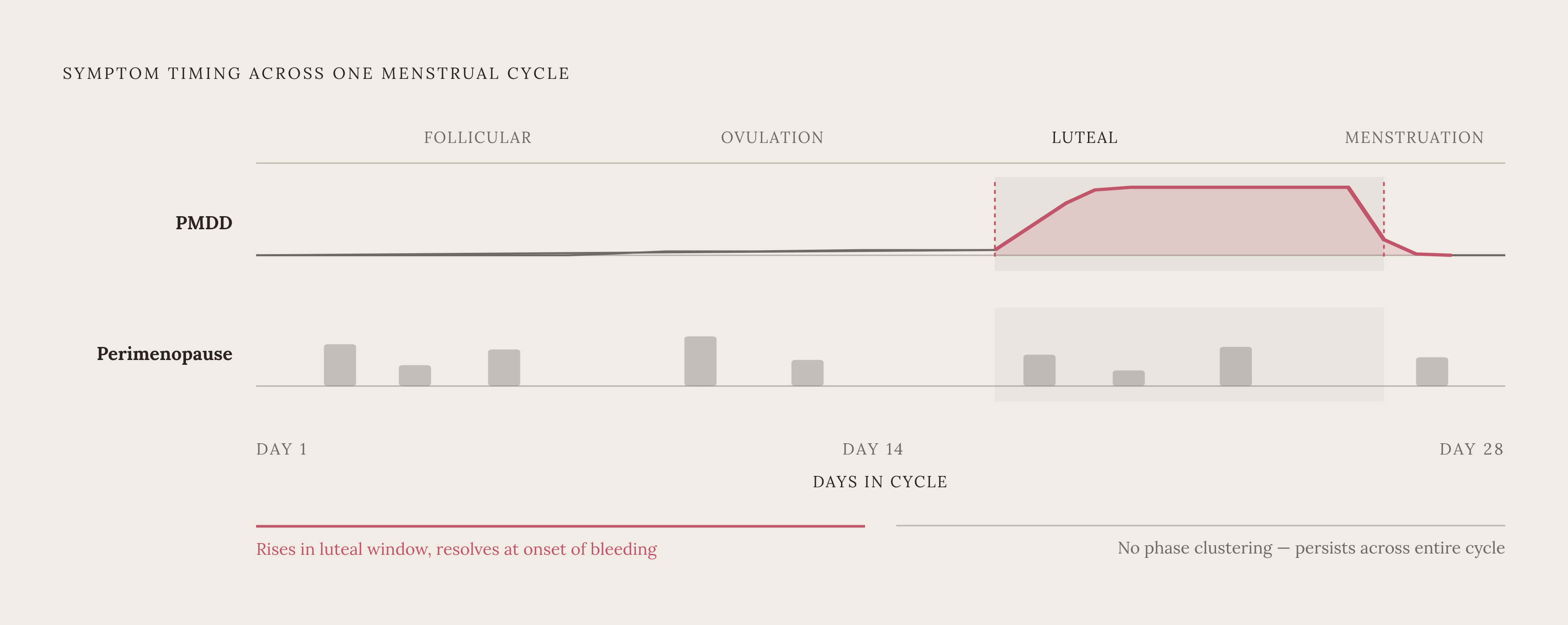
What separates PMDD from ordinary PMS is timing, and timing is the whole diagnostic hinge. Symptoms emerge during the luteal phase, roughly one to two weeks before menstruation, and lift rapidly once bleeding starts. That rise and fall, tethered tightly to the cycle, is the defining structural feature of the disorder.
So what is actually happening hormonally? PMDD is not caused by abnormal hormone levels. Women with PMDD do not have more estrogen or less progesterone than women without it. What they have is an abnormal sensitivity to entirely normal hormonal fluctuations, particularly to allopregnanolone, a metabolite of progesterone that interacts with GABA receptors in the brain. The hormone swing is unremarkable. The neurological response to it is not, and that single distinction, quantity versus sensitivity, is the one to hold onto when comparing PMDD to perimenopause later in this piece, since the two conditions run on fundamentally different hormonal logic even when they look identical from the outside.
PMDD affects roughly 2% to 8% of women of reproductive age. It also ranks among the more commonly missed diagnoses in general practice, frequently mistaken for generalized anxiety or depression by clinicians who never think to ask about cycle timing. A five-minute question about when symptoms hit relative to the period would catch most of these cases, and it rarely gets asked.
The hormonal mechanisms behind perimenopause: estrogen, progesterone, FSH, and why they fluctuate erratically
Estrogen does not decline steadily during perimenopause, and most explanations get this wrong by implying a smooth taper. 17β-estradiol, the primary form of estrogen in reproductive-age women, surges and drops erratically, sometimes within a single cycle, sometimes across several. That volatility carries consequences beyond reproduction, since estradiol also influences serotonin pathways and mood-regulating systems in the brain. When estrogen swings, mood swings with it, directly and mechanistically, not as some downstream side effect of simply feeling unwell.
Estrogen also plays neuroprotective, cardiovascular-protective, and bone-protective roles, so its erratic decline during perimenopause carries systemic implications well past mood.
Progesterone tends to decline before estrogen does, and that earlier drop is often the first perimenopausal signal a woman notices: it appears as cycle irregularity, disrupted sleep, and rising anxiety well before a single hot flash appears. When treatment enters the conversation, the type of progesterone affects both symptom relief and health risk, a distinction most prescribing conversations fail to acknowledge. Synthetic progestins like medroxyprogesterone acetate (MPA), norethisterone, and levonorgestrel behave differently in the body than bioidentical progesterone, and the two carry distinct risk and benefit profiles. Ask a prescriber directly which one is on the table. That question is worth asking before signing off on any hormone therapy plan, not after.
FSH and LH rise as the ovaries become less responsive to signaling from the brain, essentially requiring louder hormonal shouting to produce the same response they used to give quietly. Reference ranges run roughly 4 to 20 mIU/mL premenopause, 20 to 40 mIU/mL in perimenopause, and above 40 mIU/mL postmenopause, though these figures should be checked against lab-specific standards since ranges vary by assay. FSH becomes increasingly variable as the transition progresses, reflecting the ovaries' declining responsiveness.
The HPA axis adds another layer, and most workups do not address it. Stress hormones interact with the shifting estradiol and progesterone landscape in ways that can amplify mood symptoms and sleep disruption. Standard hormone panels do not capture this unless someone specifically requests it, so a piece of the picture goes missing by default.
Perimenopausal hormone chaos follows no fixed rhythm the way a normal menstrual cycle does. That unpredictability, frustrating as it is to live inside of, is itself a piece of diagnostic information rather than noise to filter out.
Why perimenopause's emotional profile is often mistaken for a psychiatric condition
Perimenopausal depression does not look like textbook depression, and that mismatch is why it gets misdiagnosed so often. The dominant mood profile is not sadness so much as anger, irritability, and sometimes paranoia, frequently expressed as verbal outbursts over minor stressors that feel completely out of character for the person living them. The change can feel entirely out of character to the woman experiencing it.
The data backs up how sharp this shift is. Research has found that women in perimenopause are 40% more likely to experience depression compared to premenopausal women without menopausal symptoms. Anxiety tells a similarly steep story: the global age-standardized disability burden from anxiety disorders among perimenopausal women rose from 625.51 to 677.15 per 100,000 between 1990 and 2021, with projections suggesting a climb to 1,180.43 per 100,000 by 2035, a 40.67% increase from 2021 levels.
An analysis of more than 145,000 digital symptom logs found that fatigue, headache, anxiety, and brain fog appeared consistently across every stage of perimenopause, not confined to some premenstrual window the way PMDD symptoms are. An industry report from Oova, drawing on hormone data from over 10,000 women, found that 73% of women reported feeling that "something is different" six to eighteen months before any noticeable cycle changes appeared. Mood and cognitive symptoms, in other words, often arrive before the menstrual irregularity that would normally prompt someone to even consider perimenopause.
A woman in early perimenopause might present with mood symptoms exclusively, still have regular periods, and walk away with a diagnosis of generalized anxiety or depression, treated accordingly, witho... A woman in early perimenopause might present with mood symptoms exclusively, still have regular periods, and walk away with a diagnosis of generalized anxiety or depression, treated accordingly, without anyone in the room asking about her hormonal context. The clinician was not careless here. The cycle simply had not yet given anyone a reason to ask.
The single structural distinction between perimenopause and PMDD
One clean diagnostic signal cuts through this entire comparison: PMDD follows the cycle. Perimenopause disrupts it. Everything else in this piece supports that one line, which serves as the anchor for the rest of the discussion.
PMDD symptoms cluster predictably in the luteal phase, that one-to-two-week stretch before menstruation, and lift within days of the period starting. It runs on suffering and recovery reliable enough to set a clock by. Perimenopause symptoms refuse that discipline. They drift across the month with little regard for cycle phase, and they do not reliably resolve just because menstruation occurs.
That gives rise to a practical tool anyone can use before ever stepping into a clinician's office: track symptoms against cycle day. If the worst days consistently fall in the ten to fourteen days before bleeding and reliably ease up afterward, PMDD is the more likely driver. If bad days scatter randomly across the month with no luteal clustering, perimenopause deserves a closer look.
But here is the real complication. In perimenopause, cycle irregularity makes the luteal phase itself hard to identify. Cycles lengthen, shorten, or vanish altogether, turning the premenstrual window into a moving target that is nearly impossible to track with precision. A woman with textbook PMDD at 32, who could predict her symptoms almost to the day, might find at 44 that the pattern has gone unreadable. Perimenopause scrambled the very cycle architecture her PMDD pattern depended on.
Hot flashes deserve a demotion here. Despite being the symptom most associated with menopause in popular imagination, they carry limited predictive power according to the symptom-log research cited above, and they are reliably linked mostly to night sweats and not much else. Their presence does not confirm perimenopause, and their absence does not rule it out, so anyone using hot flashes as the litmus test is measuring the wrong thing.
Cycle mapping remains the first and most accessible diagnostic tool available, but it only works while there is still enough menstrual regularity left to interpret. Once cycles become irregular, hormonal testing becomes necessary, and the next two sections cover what that testing can and cannot do.
Why PMDD and perimenopause overlap more often than clinicians assume
PMDD does not pack up and leave when perimenopause arrives. If anything, the opposite happens: PMDD symptoms often worsen during perimenopause, driven by the same unpredictable estrogen and progesterone swings covered above. A 2014 study of 100 perimenopausal women found that roughly one in four met full diagnostic criteria for PMDD, a rate dramatically higher than the much lower prevalence seen in the general population.
Why would that be? Recall the mechanism from earlier: PMDD comes from an abnormal neurological sensitivity to normal hormonal fluctuations, particularly involving progesterone metabolites that interact with GABA receptors. Perimenopause does not calm that sensitivity down. It amplifies the very swings the sensitivity reacts to. As hormonal amplitude increases, so does the intensity of the PMDD response, which explains why women with a long-standing PMDD history sometimes describe their late 30s and 40s as the worst their symptoms have ever been.
That has two clinical implications, and most people only catch one of them. A woman who chalks up worsening premenstrual symptoms to "just hormones getting worse with age" may be missing an underlying, diagnosable, and treatable condition. And a clinician treating PMDD in isolation, without asking whether perimenopause is amplifying it, misses half the picture too, even with the best intentions in the room.
Both conditions share a frustrating trait: they run hormone-driven, underdiagnosed, and routinely dismissed, sometimes by well-meaning providers who were simply never trained to look for the overlap. That shared pattern of dismissal compounds the diagnostic delay rather than resolving it. For a woman whose premenstrual symptoms have noticeably sharpened in her late 30s or 40s without an obvious explanation, perimenopause acting as an amplifier of preexisting PMDD is a real hypothesis, and she should name it directly to a clinician rather than waiting to be asked.
What hormone testing can and cannot tell you when differentiating these conditions
A full hormone panel typically covers estradiol, progesterone, FSH, LH, testosterone, DHEA-S, and AMH (anti-Müllerian hormone), each offering a different piece of the picture. A thyroid panel, including TSH, Free T4, and Free T3, belongs in that workup too, since thyroid dysfunction can mimic the symptoms of both perimenopause and PMDD closely enough to send a diagnosis in the wrong direction.
Timing decides whether any of this data means anything. Female hormones fluctuate across the cycle by design, so baseline testing is generally recommended on days 3 through 5. Progesterone reads most informatively when drawn in the mid-luteal phase, where low levels can help explain irregular cycles or disrupted sleep. But in perimenopause, cycles are often too irregular to time testing reliably in the first place, and that difficulty is itself a diagnostic signal rather than a lab failure.
What can FSH actually confirm? Rising FSH means the body is signaling harder for ovulation to occur, and elevated levels are consistent with perimenopause. A single FSH result is not diagnostic on its own, though, because perimenopausal hormones are erratic by definition. One normal reading does not exclude the transition, it just means that particular blood draw caught a quieter moment in a system that rarely holds still.
PMDD, notably, cannot be confirmed by any blood test. No hormonal marker distinguishes a woman with PMDD from the general population, since her hormone levels are, by definition, normal. Diagnosis here runs clinical, and it requires prospective symptom tracking across at least two full cycles. The closing section on record-keeping carries as much diagnostic weight as anything a lab can produce.
AMH is emerging as a possible staging marker for perimenopause, with future standardized criteria potentially combining estradiol, FSH, and AMH to stage the transition without relying solely on menstrual pattern. Call it a promising direction rather than standard practice today, since the research has not yet caught up to clinical use.
A normal thyroid stimulating hormone result does not rule out a psychiatric disorder, and a convincing perimenopausal history does not eliminate the possibility that PMDD or depression is also present. Testing informs the picture. It does not replace clinical judgment, and it certainly does not replace the patient's own account of her symptoms over time.
Serial testing beats a single snapshot every time, and this is where a lot of workups fall short by stopping at one panel. Perimenopause is defined by variability, so one hormone panel captures exactly one data point in a system that never holds still. Tracking the same markers across multiple time points reveals the pattern of change that a single result, no matter how carefully timed, simply cannot show.
Building a symptom record that gives a clinician something actionable to work with
Before any blood draw, prospective cycle tracking stands as the most powerful diagnostic tool available, and it costs nothing but consistency. Daily symptom logging mapped to actual cycle day is what turns a frustrating, formless experience into something a clinician can actually act on.
A useful log records symptom type, severity, cycle day, whether symptoms resolve once menstruation starts, and which days felt like a clear baseline. Two full cycles of data mark the clinical minimum for assessing PMDD, and more is genuinely better, since a single cycle can get thrown off by illness, travel, or stress in ways that obscure the underlying pattern.
Cycle length deserves its own line in that log. A shift of seven or more days from a woman's usual cycle length is the STRAW definition of early perimenopause, so documenting that shift over several months gives a clinician concrete staging evidence instead of a vague impression.
Mark where in the cycle the worst days land. Do they cluster in the ten to fourteen days before bleeding, consistent with a PMDD pattern? Or do they scatter across the month with no luteal grouping at all, pointing more toward perimenopause? That one distinction, tracked patiently across a couple of months, does more diagnostic work than most single lab tests manage on their own.
Whether symptoms genuinely resolve after menstruation starts, fully, partially, or not at all, closes the loop on the record. Cycle length, symptom timing, severity, and resolution pattern together give a clinician the raw material needed to tell these two conditions apart, or to recognize, as is often the case in this age range, that both are present and both deserve treatment on their own terms.