Perimenopause vs Thyroid Dysfunction Symptom Overlap
Doctors must test for both conditions, not guess which one is causing symptoms.
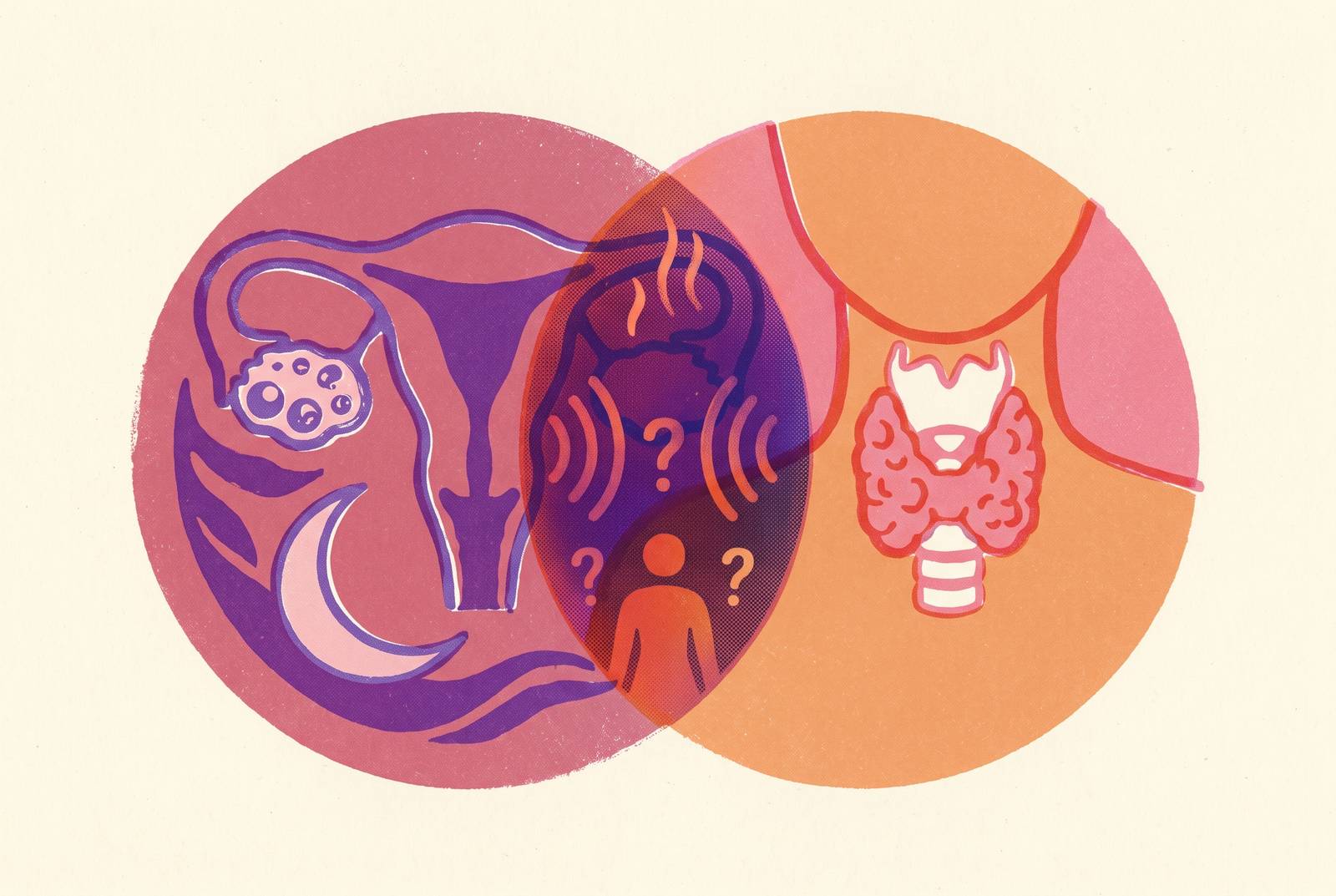
Perimenopause and thyroid dysfunction can produce nearly identical symptoms in the same woman, at the same age, often in the same year. Fatigue, weight changes, mood swings, disrupted sleep, irregular cycles: both conditions can generate every one of these on their own, and the clinical work lies in figuring out which one is driving the bus, or whether both are.
This isn't a coincidence of bad luck or crossed wires in the body. Both conditions cluster in women in their 40s and 50s, both stem from hormonal dysregulation, and thyroid disease risk actually keeps climbing into the 60s. Somewhere between 80% and 90% of women report symptoms during the perimenopause transition. A population that large means a meaningful number of those women are also walking around with undiagnosed thyroid disease. Hashimoto's thyroiditis and hypothyroidism are already disproportionately common in women, on their own timeline entirely separate from ovarian aging. Two conditions, same window, same demographic, overlapping symptom lists. The overlap isn't incidental. It's structural.
The stakes go beyond an inconvenient diagnostic puzzle. When one condition gets treated and the other goes unexamined, a woman can be told she's "just" perimenopausal, or "just" anxious, while an underlying thyroid disorder keeps working on her cardiovascular system, her bone density, and her cognitive function; all three already under pressure from declining estrogen. This piece isn't about picking a winner between the two diagnoses. It's about laying out why testing for both, rather than assuming one, is the sound first move, and what that actually looks like in practice.
What the perimenopause symptom picture looks like, before any thyroid comparison
Perimenopause typically starts in the mid-40s, with most women hitting the onset between ages 45 and 47, and it runs four to seven years before menopause itself, which lands on average between 51 and 52 in the country this data covers. That's the average case. The duration varies enough that some women are in it for eight to ten years, which means the window for confusion, misattribution, and half-explained symptoms can stretch out for the better part of a decade.
Clinicians using the STRAW staging system break the transition into phases, and the early phase (Stage -2) is defined by cycles that shift by seven or more days from a woman's usual length. The symptom that appears first is not the hot flash most women expect. Fatigue, brain fog, and a rise in anxiety and mood dysregulation tend to arrive before the classic vasomotor symptoms do. A study published in the journal Menopause gave this early pattern a name: "Not Feeling Like Myself," or NFLM. The first perimenopausal symptoms are frequently psychiatric and cognitive, not physical in the way people picture, which validates something that gets waved off constantly in exam rooms.
Late perimenopause (Stage -1) looks different. Cycles stretch more than two months apart, and vasomotor symptoms intensify, with roughly three in four women experiencing hot flashes that, once established, last a median of about seven years. Sleep problems climb during this stretch too, and keep climbing after menopause, driven by estrogen's role in quieting wake-promoting signals in the brain and progesterone's sedative effect through a calming brain-signaling pathway.
The mechanism producing this is not a smooth decline. Estrogen spikes above premenopausal levels before it crashes, producing waves of symptoms that can mimic acute illness or a mood disorder convincingly enough to send a woman down the wrong diagnostic path. Cortisol rises as estrogen and progesterone fall, creating a stress-hormone effect stacked on top of the ovarian one. That cortisol rise is one thread connecting these two conditions mechanically rather than just symptomatically. Periods that go irregular or stop before age 40 fall outside the perimenopause pattern and call for a separate workup.
What thyroid dysfunction looks like, and where its symptom map lands on top of perimenopause's
Hypothyroidism, an underactive thyroid, produces fatigue, weight gain, cold intolerance, constipation, depression, brain fog, thinning hair, dry skin, a slowed heart rate, and periods that turn heavy or irregular. Hyperthyroidism runs the opposite direction: weight loss, heat intolerance, palpitations, anxiety, insomnia, tremor, and periods that go light or vanish. That second list should sound familiar, because it tracks closely with perimenopause's vasomotor and anxiety symptoms.
Hashimoto's thyroiditis, an autoimmune condition, is the most common cause of hypothyroidism, and it hits women far more than men. What makes Hashimoto's especially tricky in this context is that the immune attack on the thyroid is often intermittent rather than constant, so symptoms fluctuate instead of holding steady. That episodic quality mirrors the hormonal volatility of perimenopause almost exactly, which means a clinician relying on symptom pattern alone has very little to work with.
Lining the two conditions up point by point makes the collision hard to miss. Fatigue appears in both conditions, and there's no way to trace it back to a cause from the complaint alone. Weight gain has two separate engines: hypothyroidism slows metabolism directly, while perimenopause drives insulin resistance and redistributes fat, but the woman on the scale reports the same thing either way. Mood and anxiety get dysregulated through entirely different chemistry (thyroid hormone in one case, estrogen and progesterone in the other) yet the clinical picture looks the same from across the desk. Sleep gets disrupted by impaired sleep architecture in hypothyroidism and by vasomotor events and progesterone loss in perimenopause. Cycles go irregular in both, through different hormonal pathways. Brain fog appears in both, tied to neuroinflammation in one case and slowed neurological function in the other. Even hair thinning, skin changes, and heart palpitations, often treated as classic thyroid tells, appear plenty in perimenopause too.
Then there's the cortisol connection again, and it deserves a second look here because it changes the diagnostic calculus rather than just adding noise to it. Chronic stress and elevated cortisol, common features of perimenopause, inhibit the conversion of inactive T4 into active T3. A woman with borderline thyroid function, someone who might have coasted along asymptomatic for years, can tip into a symptomatic hypothyroid state specifically because perimenopause has changed her hormonal environment. So picture the composite case: a woman in her mid-40s, fatigued, moody, gaining weight, cycles going haywire. She could be in perimenopause. She could have hypothyroidism. She could have both, with one condition triggering or worsening the other. Symptom review alone cannot sort this out, and that's precisely why it shouldn't be asked to.
The lab markers that help distinguish one condition from the other
Thyroid testing is, comparatively, the easier half of this equation to interpret. TSH (thyroid-stimulating hormone) is the primary screening marker: elevated TSH points to hypothyroidism, suppressed TSH points to hyperthyroidism, and as a single value it's more reliable on its own than anything perimenopause testing can offer. Free T4 and free T3 confirm whether the thyroid is actually producing hormone and converting it properly, which matters most in cases where TSH is in a borderline zone. Thyroid antibody tests, specifically TPO-Ab and TgAb, can catch Hashimoto's even while TSH is still technically normal, flagging the autoimmune process in its early stages before it's done enough damage to show up on the standard marker. TSH also doesn't fluctuate with the menstrual cycle the way estrogen and FSH do, so a single blood draw carries real weight.
Perimenopause hormone testing is a messier proposition. FSH rises as ovarian reserve declines, and clinical guidance generally supports its use in women in their early-to-mid 40s who have symptoms, or in women under 40 where primary ovarian insufficiency is suspected. Past 45, symptom pattern and cycle history often carry the diagnostic weight on their own. Estradiol can swing from high to low across different days of the same perimenopausal cycle, so a single value rarely settles anything; it's far more useful tracked over time than read in isolation. Progesterone declines more steadily and is best tested mid-luteal phase, around day 21, where low levels alongside otherwise intact cycles suggest early perimenopausal change. AMH (anti-Müllerian hormone) falls as ovarian reserve depletes, often ahead of any FSH rise, and it's a decent window into ovarian trajectory, though clinical guidance cautions against using it alone to diagnose perimenopause or pin down timing.
The core caveat: trying to define menopausal status off a single FSH or estradiol reading is unlikely to produce anything useful, because the fluctuation during this transition is simply too wide. Timing matters too. FSH should be drawn early in the cycle, around days two through five, estradiol works best sampled at multiple points, and progesterone belongs in the mid-luteal window. Oral contraceptives suppress FSH and will throw off any reading taken while a woman is on them. Cortisol becomes relevant when fatigue, weight gain, and mood symptoms don't resolve after targeted treatment for either thyroid or ovarian issues, since adrenal function is a third axis that perimenopause disturbs and one that rarely gets tested until the first two paths run dry. A full panel run at the right point in the cycle, reviewed by someone who understands how these systems interact, produces a signal that dwarfs what comes from testing one marker at a time as an afterthought.
Contextual clues that lab results alone don't capture
Age and the specific pattern of cycle change carry real diagnostic weight. Irregular cycles in the mid-40s that follow the STRAW -2 trajectory, shifts of seven or more days in cycle length, point strongly toward perimenopause. Thyroid dysfunction can disrupt cycles at any age and doesn't generally follow that particular pattern.
Hot flashes and night sweats are fairly specific to estrogen fluctuation, and their presence leans hard toward perimenopause. Hyperthyroidism produces heat intolerance and sweating too, though through a different physiological mechanism. Flip that around: cold intolerance in a fatigued woman is a flag for hypothyroidism, since perimenopause tends to run hot rather than cold. Weight gain has a shape that distinguishes the two. Perimenopause drives insulin resistance as estrogen declines, while hypothyroid weight gain follows a different metabolic mechanism.
Onset timeline is one of the more useful, least glamorous clues available. Thyroid dysfunction can start at any life stage. Perimenopause has a fairly predictable age window, generally kicking off in the mid-40s, so any of these symptoms appearing before 40 should prompt a thyroid and POI workup before perimenopause gets assumed by default. Family history offers a rough clue too: a mother's menopause timing can hint at a daughter's, imperfectly, while a personal or family history of autoimmune conditions is worth noting in this context.
Treatment response might be the most underused clue of all. If standard perimenopause treatment, hormone therapy, doesn't touch the symptoms, thyroid dysfunction should move up the list of suspects. And the reverse holds just as well: thyroid treatment that leaves fatigue and cycle irregularity unresolved is a signal to look at ovarian hormones next. One more practical note: hormonal contraceptives can affect key markers and alter how hormone levels read on a panel, so any lab result in a woman on hormonal birth control needs to be read with that in mind.
Why both conditions can be present simultaneously, and why that matters for testing strategy
Autoimmune thyroid disease is more common in women generally, and both conditions share the same demographic window. That's not two conditions that happen to share a symptom list. That's two conditions sharing a demographic window.
The cortisol-thyroid link described earlier deserves to be restated as a mechanism, not just a coincidence. Cortisol tends to rise during perimenopause, and chronic elevations in cortisol are associated with inhibited conversion of T4 to active T3. A woman with subclinical hypothyroidism, someone who might never have noticed a problem in her 30s, can become symptomatic precisely because perimenopause has shifted her internal chemistry. Treating the perimenopause alone leaves the thyroid piece untouched, still generating symptoms that estrogen therapy alone may not resolve.
Estrogen affects levels of thyroid-binding globulin, or TBG, forming a second mechanical link. As estrogen fluctuates through perimenopause, TBG shifts with it, which changes the balance between free and bound thyroid hormone in the blood. A thyroid patient who has been stable for years on a fixed dose can suddenly become symptomatic again because perimenopause has changed how her body handles the hormone she's already taking.
What follows from this is fairly direct. A woman who tests positive for perimenopause markers still benefits from a thyroid screen. A woman whose thyroid panel explains some, but not all, of her symptoms deserves an ovarian hormone workup rather than a shrug. And because perimenopause unfolds over years with hormone levels in constant motion, a single test date only captures one frame of a moving picture. Tracking both thyroid and ovarian markers over time can reveal whether symptoms rise and fall with specific hormonal swings (more consistent with perimenopause) or stay constant regardless of cycle phase (more consistent with thyroid disease). A baseline panel that covers both systems, read by a clinician who understands how they interact, gives far more to work with than testing one condition, waiting, and only then testing the other.
What to bring to a clinical appointment to avoid being dismissed or sent home with a single answer
Symptom timing is data, and it should be treated that way. When did the fatigue start? Has it changed? Does it track with a particular point in the cycle? That pattern information rarely gets captured in a fifteen-minute appointment unless a patient shows up with it already written down.
Cycle details matter just as much: length, flow, and the size of the gaps between periods. STRAW staging depends on this exact information (shifts of seven or more days in cycle length, or gaps stretching past two months) and none of it exists in the chart unless a woman has actually recorded it herself.
Ask, directly and specifically, for both panels rather than waiting to see which one a clinician reaches for first. That means a thyroid panel (TSH, free T4, TPO antibodies) alongside ovarian hormone testing (FSH, estradiol, progesterone, AMH). Noting whether symptoms are constant or tied to cycle phase helps a clinician prioritize too: steady, unchanging symptoms lean thyroid; episodic, cycle-linked symptoms lean perimenopause.
One asymmetry matters going in. Per NICE NG23, women 45 and older don't need lab confirmation to start perimenopause treatment. Thyroid disease is different: it requires lab confirmation before treatment begins. A patient who understands that gap is in a much stronger position to push for a full thyroid workup even when a clinician feels confident the answer is perimenopause and nothing else. And if symptoms only partially improve after treating one condition, that's worth returning with, because a partial response is itself diagnostic information, not a sign to give up and live with what's left.
Perimenopause remains chronically under-diagnosed, and its symptoms get misattributed constantly, to stress, to anxiety, to simply getting older. A woman who walks in already knowing which markers she wants checked, and why, is far better positioned to avoid being sent home with half an answer. At-home hormone testing, reviewed by a clinician, can offer a starting point for women who face real barriers to getting a timely appointment, and tracked over the years of the perimenopause transition, that kind of longitudinal data builds exactly the pattern that a single fifteen-minute visit was never built to capture.