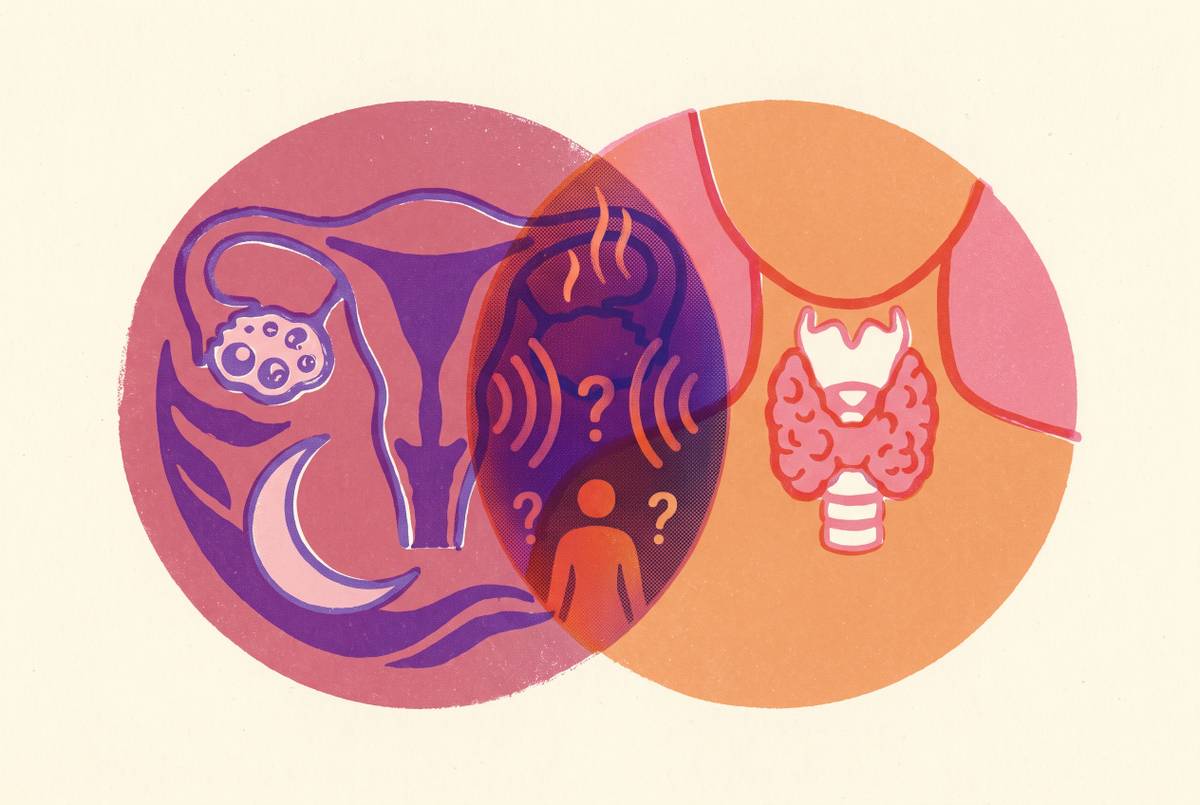
The Full Spectrum of Perimenopause Symptoms
Understanding the hormonal chaos behind unexpected midlife symptoms.

Perimenopause produces a far wider range of symptoms than most women are prepared for: heart palpitations, gum inflammation, a sudden loss of the word that was on the tip of the tongue a second ago. None of these are random. Each one traces back to a specific hormonal mechanism that, once explained, makes the body's behavior legible instead of alarming. The transition can start in a woman's late 30s, typically runs through the 40s into the early 50s, and lasts anywhere from a few years to a decade, with no single test marking its official start. What follows is a map of mechanisms, section by section: how one shifting signal in the body produces effects that look, on the surface, like a dozen unrelated problems.
What is actually happening hormonally, and why "estrogen decline" is too simple
The standard shorthand goes something like this: estrogen drops, symptoms follow. That framing is clean, memorable, and wrong, and it's worth saying plainly, because it sends women looking for the wrong fix. Recent scientific reviews describe perimenopause as a period marked by intermittent, sometimes dramatic spikes in estrogen, alongside falling progesterone and a feedback loop between brain and ovaries that's lost its usual timing. The pattern is closer to a signal getting noisier before it goes quiet than to a steady downward slope.
In early perimenopause, menstrual cycles shorten or start varying in length, and the ovaries can swing from a high estradiol peak one week to something close to zero the next. Late perimenopause looks different: gaps between periods stretch out as ovulation happens less reliably, and progesterone, whose release depends on ovulation, falls off sharply as a result.
Follicle-stimulating hormone tells part of this story. As the ovaries respond less to signaling, the pituitary gland compensates by pushing out more FSH, trying to force ovulation to happen anyway, which is why FSH climbs over the course of the transition. In the early reproductive years, FSH sits somewhere around 4 to 20 mIU/mL depending on where a woman is in her cycle; postmenopause is confirmed above 40 mIU/mL. Perimenopause lives in between those two numbers, and a single FSH reading in that window is close to meaningless, since it can swing wildly from one draw to the next.
The upshot: symptoms trace back to unpredictable swings and the loss of a rhythm the body spent decades calibrated to. That also explains why two women at the same stage of perimenopause can report opposite symptoms; one is dealing with an estrogen flood, the other a trough. Same transition, different weather.
The neurological symptoms that often arrive first
For a lot of women, the earliest noticeable change isn't physical at all. It's fatigue that doesn't lift, anxiety that shows up without a trigger, crying that seems to come from nowhere, or a strange disconnection from one's own thoughts. In March 2024, a study published in the journal Menopause gave this cluster a name: "Not Feeling Like Myself," or NFLM. Naming it mattered, because plenty of women had already been told this was stress, or depression, or simply midlife catching up with them.
The mechanism is worth sitting with. Estrogen plays a role in brain chemistry regulation, so when estrogen swings erratically, neurological function can destabilize well before any obvious physical symptom shows up. Brain fog, meaning trouble finding words, difficulty concentrating, short-term memory slips, gets reported by somewhere between 40% and 60% of midlife women. Clinical literature tends to describe these changes as mild and reversible, but that framing doesn't match the subjective experience, which can feel disorienting, even frightening, in the moment. That gap, between what's clinically mild and what's subjectively alarming, is exactly where misdiagnosis happens.
Here's the detail that matters most: these neurological symptoms often show up before periods become noticeably irregular. So neither the woman nor her doctor connects them to a hormonal transition, because the more obvious marker, cycle irregularity, hasn't appeared yet. When the first thing that changes is mood or mental clarity, a hormonal explanation deserves consideration alongside a psychiatric one.
Depression and anxiety during perimenopause are not the same as ordinary mood disorders
Longitudinal research puts the risk of a major depressive episode during perimenopause at 2 to 5 times higher than during late premenopause. That is not a subtle difference, and it argues against treating a new depressive episode in a 44-year-old the same way a clinician would treat one in a 28-year-old. Anxiety follows its own pattern too: it tends to peak in late perimenopause and decline after menopause, a shape that points toward hormonal volatility as the driver rather than life circumstances alone. If anxiety were purely situational, there's no obvious reason it would resolve on a schedule tied to ovarian function.
The scale of this is showing up in population data. Research published in PMC tracked the global age-standardized burden of anxiety disorders among perimenopausal women rising from 625.51 to 677.15 per 100,000 between 1990 and 2021, with projections putting it at 1,180.43 per 100,000 by 2035, a 40.67% increase from 2021 levels.
Mechanistically, progesterone has anxiolytic properties that help buffer the nervous system. When progesterone falls sharply in late perimenopause, that buffering effect goes with it, and women can end up with anxiety that doesn't respond to the usual stress-management playbook, because that playbook was built for a different kind of anxiety.
Here is the failure mode worth naming directly: a woman in her 40s shows up with new-onset depression or anxiety, gets an antidepressant prescription, and no one checks her hormonal status first. That is close to the default pathway, given how few clinicians are trained to ask about cycle patterns before reaching for a prescription pad. The distinction between hormonally-driven mood change and a primary mood disorder isn't academic. It determines whether the treatment offered addresses the cause or just the symptom sitting on top of it.
Hot flashes and night sweats: what thermoregulation has to do with estrogen
Hot flashes are the symptom everyone expects, but the mechanism behind them rarely gets explained. Estrogen helps calibrate the hypothalamus's internal thermostat, the narrow temperature range the body works to maintain. When estrogen fluctuates erratically, that thermostat gets oversensitive: a small internal temperature shift, one that would normally go unnoticed, triggers a full vasodilatory response instead. Skin flushes, heat spreads, sweating starts. Night sweats are the same mechanism, just happening while asleep, fragmenting sleep on their own, independent of anything else going on.
Intensity and frequency vary enormously, both across different women and across different stages of the same woman's transition. Late perimenopause tends to bring the most frequent and severe episodes.
Hot flashes carry consequences beyond discomfort, and treating them as a cosmetic annoyance misses what's actually going on underneath. SWAN longitudinal data shows that LDL cholesterol and total cholesterol peak during this same transition window; the relative odds of LDL-C reaching 130 mg/dL or higher come in at 2.1 in early postmenopause compared to premenopause. A hot flash, in this light, is the hypothalamus doing exactly what it's built to do, given a hormonal signal that's stopped behaving predictably. The body is responding rationally to bad information.
Why perimenopause disrupts sleep even when hot flashes aren't the reason
Research surveyed by the Journal of Clinical Medicine and Longevity Hub put the share of perimenopausal women reporting meaningful insomnia or poor sleep quality at up to 60%. Night sweats explain some of that, but treating them as the whole story misses much of the mechanism.
Two separate pathways are at work here, and they don't get nearly enough daylight next to each other. Estrogen decline disrupts thermoregulation during sleep, the night-sweat pathway already covered above. Progesterone decline works differently: progesterone has its own sleep-promoting effects, and losing it can degrade sleep quality directly, with no temperature spike needed to explain it.
That's why some women sleep through the entire night, wake up having had no night sweats at all, and still feel unrefreshed. The hours slept haven't changed; the architecture underneath those hours has. Poor sleep doesn't stay contained to sleep, either. It worsens brain fog and mood on its own, feeding back into the neurological symptoms covered earlier and making the original hormonal cause harder to spot underneath the pileup. A drop in sleep quality with no obvious cause deserves to be raised with a clinician as a hormonal question.
The cardiovascular and metabolic changes that begin during the transition, not after it
Cardiovascular risk usually gets filed under postmenopause, treated as something that starts once the transition is over. The evidence argues against that timeline. The pivot starts earlier, during the transition itself, and filing it under postmenopause delays monitoring by years.
Estradiol plays a direct, active role in glucose and lipid regulation, fat distribution, and insulin sensitivity. As estradiol turns erratic rather than stable, those metabolic markers start moving too. Perimenopausal women show measurable increases in visceral fat, fasting glucose, total cholesterol, and systolic blood pressure compared to premenopausal peers, and SWAN longitudinal data confirms that total cholesterol, LDL, HDL, triglycerides, and lipoprotein(a) all peak during late perimenopause and early postmenopause, well before the final period arrives.
The sudden shift toward central weight gain that a lot of women notice during this window reflects a hormonally driven change in how the body distributes fat, more than aging or lifestyle drift alone. Cardiometabolic monitoring, cholesterol panels, glucose checks, blood pressure tracking, belongs in perimenopause itself, not held back until menopause is confirmed. Waiting for that confirmation before running the panels is waiting too long. A shift in weight distribution or cholesterol numbers during this window deserves investigation, not a shrug and a comment about turning 45.
Bone loss quietly accelerates during late perimenopause
No symptom announces this one. There's no ache, no flush, no obvious signal, which is precisely why it deserves to be named outright rather than left for a fracture to reveal later.
Estrogen normally restrains osteoclasts, the cells responsible for breaking down old bone tissue. As estrogen turns erratic in late perimenopause, that restraint weakens, and bone resorption starts outpacing new bone formation. A 2025 cross-sectional study involving 130 participants found that estradiol levels alone could predict perimenopausal bone loss at a threshold of 62.7 pmol/L, with a resorption marker called β-CTX adding further precision. A preliminary finding, but one pointing toward earlier identification of women at higher risk.
Standard guidelines push DEXA bone scans to age 65 for women without other risk factors, and that guideline is almost certainly too conservative for a meaningful subset of women. A growing number of clinicians now argue for earlier baseline scans, particularly for women with a family history of osteoporosis, low body weight, or signs they've entered the transition early. The case is straightforward: bone loss that starts in perimenopause compounds year over year, and catching it early leaves more options on the table. The absence of symptoms reflects timing, not absence of activity.
The less-discussed symptoms — palpitations, dental changes, joint pain, and skin shifts
Estrogen influences autonomic regulation of heart rhythm, so erratic estrogen levels can trigger transient episodes of a racing or irregular heartbeat. These are generally benign, but cardiac causes need to be ruled out through actual evaluation, not assumed away because a woman happens to be in her 40s.
Joint pain and muscle aches follow a similar logic. Estrogen has anti-inflammatory effects on connective tissue, and as levels swing, joints, particularly knees and hips, can stiffen or ache with no injury behind them at all.
Skin and hair changes trace back to estrogen's role in collagen production and moisture retention. As estrogen becomes reduced or erratic, collagen loss speeds up, often showing up as dryness, itching, or a new sensitivity to products that never caused a problem before.
Dental health belongs on this list too, and it's the least expected entry on it. Hormonal shifts during perimenopause can increase gingival inflammation and sensitivity, frequently showing up before a woman has any reason to connect it to perimenopause at all.
Genitourinary symptoms, vaginal dryness and increased urinary urgency, come from declining estrogen thinning vaginal and urethral tissue. These tend to worsen over time rather than resolve on their own, and they're among the most under-reported symptoms on this entire list, largely because women don't bring them up with clinicians in the first place.
The connecting thread runs through every item here: estrogen receptors sit throughout the body, not just in reproductive tissue. That's exactly why fluctuation produces effects that look, at first glance, like a collection of separate, unrelated problems.
Why these symptoms are so often misattributed, and what gets missed as a result
A meaningful share of perimenopause cases get misdiagnosed, and recent reporting points to a structural reason why: clinicians often receive limited training on perimenopause during medical education. That's not a minor gap. Without a single definitive diagnostic blood test to fall back on, overlapping symptoms get sorted into more familiar diagnostic categories: thyroid disease, depression, generalized anxiety disorder, cardiac arrhythmia, autoimmune conditions.
Thyroid overlap deserves its own mention, because the symptom lists genuinely collide. Hypothyroidism shares fatigue, weight gain, mood changes, brain fog, and irregular periods with perimenopause; hyperthyroidism shares hot flashes, palpitations, anxiety, and sleep disruption. Thyroid disease is common in midlife women, and it can coexist with perimenopause rather than standing in for it. TSH testing is a reasonable first step to rule it out, but the hormonal inquiry shouldn't stop there, which is where it stops far too often.
The practical cost of getting this wrong is time. Women spend months, sometimes years, on treatments aimed at the wrong diagnosis while the actual hormonal transition continues unaddressed underneath. The STRAW+10 framework offers clinicians a structured way to stage where a woman sits in the transition, based on menstrual cycle patterns and FSH trends tracked over time. But it requires longitudinal data, observations gathered across multiple cycles, not a single blood draw at one appointment. That requirement, more than anything, explains why so many cases get miscategorized before anyone thinks to apply the framework at all.
What hormone testing can and cannot tell you during perimenopause
A single FSH result is the test most often ordered, and it's also the test most likely to mislead. Given everything laid out above, one number, drawn on one day, in one part of a cycle that may itself be shortening or lengthening unpredictably, is being asked to summarize a process that's inherently a moving target. That is asking too much of a single blood draw. A high reading might reflect a genuine shift toward late perimenopause, or it might just as easily reflect a routine fluctuation that reverses itself two weeks later, which is exactly why so many clinicians describe a single hormone panel as a snapshot of weather rather than a forecast of climate.
What actually clarifies the picture is pattern: tracking cycle length, symptom timing, and hormone trends across months. A woman armed with three months of cycle-length data and a symptom log brings more diagnostic signal to that appointment than a single FSH number ever could, and that is worth knowing before the blood draw gets ordered as the whole plan. Intermission Health, a perimenopause blood panel service with clinician-reviewed results designed to be tracked over time, is one option built around exactly that logic.