Late Perimenopause Symptom Changes Near Final Transition
Hot flashes worsen as mood swings fade in late perimenopause.

Late perimenopause is not just "the tail end of perimenopause" but a distinct, clinically defined stage with its own hormone pattern and its own symptom signature. Some symptoms that dominated the earlier years start to fade, while others, especially hot flashes and night sweats, get worse right as everything else seems to calm down. Understanding why that split happens is the key to figuring out where a woman actually stands in the transition, rather than guessing based on how bad any single week feels.
The staging framework clinicians use is called STRAW+10, revised in 2012 from an original 2001 workshop, and it splits the menopausal transition into Stage -2 (early) and Stage -1 (late) based on menstrual and hormonal criteria. Perimenopause overall runs anywhere from four to ten years, but late perimenopause, Stage -1, is usually shorter: one to three years, typically landing in the late 40s or early 50s. The marker that flips a woman from early to late stage is concrete and easy to track without a lab visit: a gap of 60 days or more between periods. Endocrinologist Jerilynn Prior's parallel model, developed at the University of British Columbia, uses that same 60-day cycle gap as the entry point into what she calls the late menopause transition, which lines up with STRAW -1 and gives readers a simple way to mark their own place on the timeline. None of this resolves until 12 consecutive months pass without a period. That's the actual finish line, called menopause. Everything before it, no matter how far along, is still technically perimenopause. And because the shift from stage to stage is gradual rather than sudden, most women don't realize they've crossed into the late stage until they look back at a few months of cycle spacing and notice the pattern changed on them.
Why early perimenopause symptoms feel different from late ones, the hormone logic behind the shift
Early perimenopause is largely a progesterone problem. Cycles start skipping ovulation more often, and when ovulation doesn't happen, the body doesn't produce the progesterone that would normally follow it, while estrogen is still fluctuating rather than declining consistently. That imbalance is what drives a lot of the early mood swings, disrupted sleep, and cycle chaos women report in their early-to-mid 40s.
Late perimenopause flips the script. Estradiol, the main form of estrogen the ovaries make, starts to decline more consistently, even though it still jumps around some. Meanwhile FSH (follicle-stimulating hormone) climbs, because the pituitary gland is working harder to get a shrinking pool of ovarian follicles to respond. Picture it as a feedback loop that's losing its grip: FSH pushes, the ovaries respond less and less, so FSH pushes harder still. That loop was reliable for decades. Now it's straining.
Why does this matter beyond the reproductive system? Estrogen receptors sit in the brain, in bone tissue, in blood vessels, in skin, so when estradiol drops, the effects show up everywhere, not just in the menstrual cycle. Add to that the fact that cortisol tends to rise as estradiol falls, since the stress-response system (the HPA axis) and the reproductive hormone system (the HPG axis) are wired together. That interaction can stack sleep disruption on top of mood changes on top of metabolic shifts, which is part of why late perimenopause can feel like several problems compounding at once rather than one symptom at a time.
Here's the useful part for anyone trying to track their own experience: symptoms that felt scattered and unpredictable in early perimenopause tend to organize into a more consistent pattern in the late stage. That's because the hormonal floor is dropping steadily rather than swinging wildly in both directions, though some of that earlier unpredictability doesn't disappear completely.
Symptoms that tend to ease as the late stage progresses
Mood swings are often the first thing to soften. The sharpest emotional volatility in early perimenopause comes from big hormonal oscillations, so as estrogen and progesterone settle into a lower but steadier state, the most extreme mood spikes tend to level out.
Menstrual migraines follow a similar arc. These are headaches tied to estrogen fluctuation around the menstrual cycle, recognized as a known perimenopausal symptom, and they often taper off as cycles become less frequent. Fewer cycles means fewer of the estrogen drops that trigger them. Breast soreness, tied to hormonal surges, tends to ease for the same reason: fewer surges.
There's also a specific symptom cluster worth naming directly. A study published in the journal Menopause in March 2024 gave a formal name to the experience many women describe as "not feeling like myself," abbreviated NFLM in the research. It's most closely tied to anxiety, vigilance, fatigue, brain fog, and volatile mood, and it tends to lessen as the underlying hormonal volatility decreases.
But easing doesn't mean gone. Many women still carry baseline fatigue, brain fog, or low mood into late perimenopause. What changes is the acute, unpredictable spike, not necessarily the underlying symptom. Cycle irregularity itself shifts character too: instead of alternating between heavy, light, and missed periods the way it does earlier on, periods in late perimenopause tend to become more uniformly light and infrequent. Unpredictable in timing, yes, but more predictable in pattern.
Why vasomotor symptoms intensify precisely when other symptoms are easing
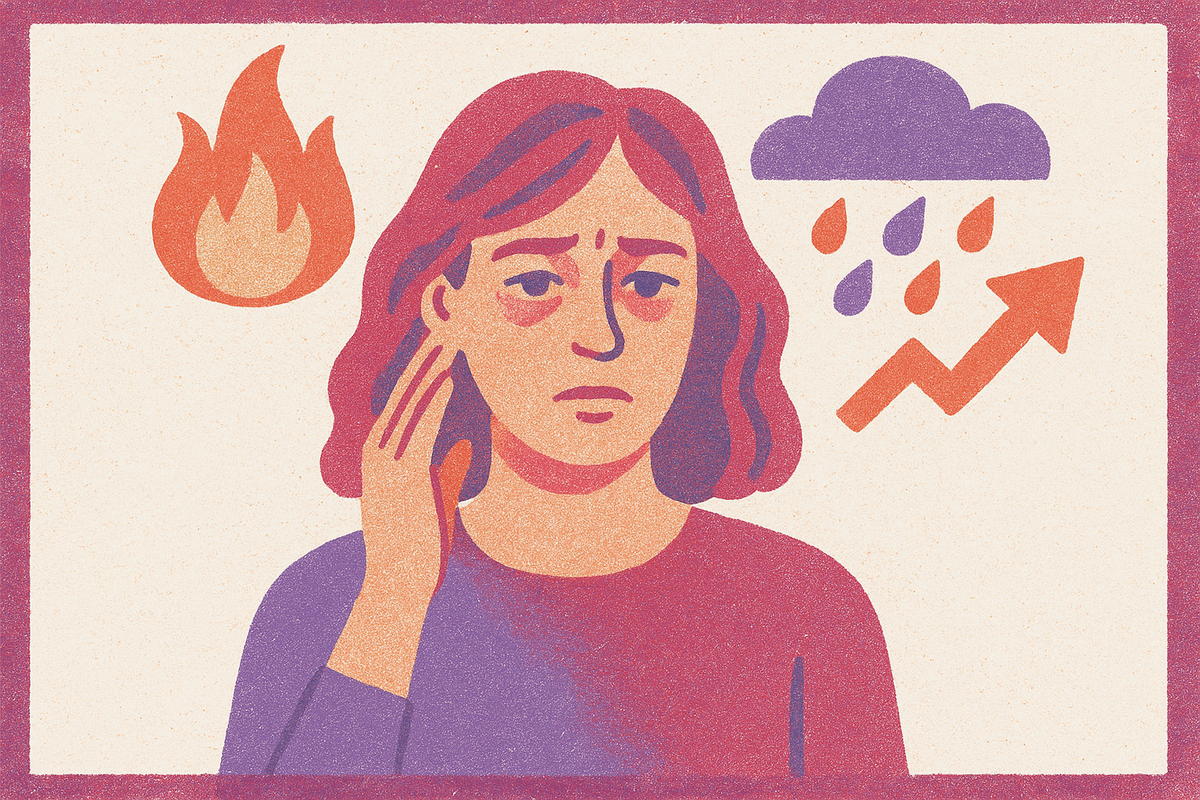
Here's the paradox at the center of late perimenopause: the very hormonal shift that calms mood swings is the one that makes hot flashes worse.
The Canadian Multicentre Osteoporosis Study found hot flashes and night sweats peak in late perimenopause at a prevalence of 79%. Across the broader menopausal transition, somewhere between 60% and 80% of middle-aged women deal with some degree of vasomotor symptoms. Late perimenopause is where that number tops out.
The mechanism comes down to the hypothalamus, which manages core body temperature within a narrow comfort range. As estradiol declines, that comfort range narrows further, so small increases in body temperature that used to go unnoticed now trigger a flush. A typical hot flash lasts one to five minutes, though some run as long as 60 minutes, and night sweats are the same event happening during sleep.
So why does declining estrogen calm mood while it inflames vasomotor symptoms? Because the two processes respond to different things: mood volatility is tied to the pattern of hormonal swings, while vasomotor symptoms are linked to how estrogen levels affect the hypothalamus's thermostat. Estrogen doesn't have to swing to trigger a flush. It just has to be low.
And the consequences ripple outward. Night sweats break up sleep, and that disrupted sleep compounds the metabolic and cardiovascular strain that is already climbing at this stage of the transition. There's also a data point worth taking seriously: research has linked frequent, severe, and long-lasting vasomotor symptoms to markers of cardiovascular risk, including high blood pressure, endothelial dysfunction, and unfavorable cholesterol patterns. That reframes hot flashes as more than a comfort issue. They may be carrying information about what's happening in the vascular system underneath.
Prior, the UBC endocrinologist, frames it as the body's internal thermostat malfunctioning more often as menopause approaches, a description that treats vasomotor symptoms as an expected response of the thermoregulatory system to estrogen withdrawal rather than some inexplicable glitch.
The symptoms that are new in late perimenopause, not just intensified versions of earlier ones
Some symptoms in late perimenopause aren't old symptoms turned up louder. They're new arrivals, because they depend on a level of estrogen decline that simply hadn't happened yet in the earlier stage.
Vaginal dryness is the clearest example. Estrogen keeps vaginal tissue elastic and moist, so as estradiol falls more consistently in late perimenopause, dryness and related genitourinary symptoms often show up for the first time, distinct from the mood and cycle-driven symptoms of the early years. Urinary urgency and frequency ride along with the same mechanism: local estrogen withdrawal affecting the genitourinary tract, often noticed for the first time in this stage.
Some women who only had night sweats earlier start getting daytime hot flushes now, as the transition deepens further. Some women also notice other unfamiliar symptoms specific to this stage, reflecting how broadly estrogen's decline can affect systems beyond the reproductive tract.
Bone loss deserves particular attention here because it's silent. It actually begins before the final period, but picks up pace through late perimenopause as estrogen's protective effect on bone density fades. Osteoporosis affects roughly 1 in 5 women over age 50, which makes late perimenopause the point where bone health stops being a distant concern and becomes something to act on now, not later.
None of these are symptoms that simply got worse from an earlier version. They're new, because they need a more sustained estrogen decline to appear at all, and that sustained decline is the defining feature of the late stage rather than the early one.
How to recognize where you are without relying on a single hormone test
Cycle spacing is the single most useful self-observable clue. A gap of 60 days or more between periods puts a woman in the late perimenopause zone under STRAW+10 criteria, no lab work required. What matters more than any one cycle is the overall trend: periods generally getting lighter, shorter, and less frequent, rather than the alternating heavy-light-missing pattern that's typical earlier on.
FSH is where things get more complicated than people expect. Yes, FSH rises as perimenopause progresses. But a single FSH reading is unreliable for staging, because levels can swing day to day and even drop back into premenopausal range during late perimenopause. FSH only becomes a dependable marker after the final period, once levels stabilize. For context, the STRAW -1 research criteria combine elevated FSH with amenorrhea intervals of 60 days or more, which is exactly why clinicians look at cycle history and hormone levels together rather than leaning on either alone.
Estradiol behaves the same unreliable way. It swings up and down through late perimenopause, so one low reading doesn't confirm the transition is ending. Estradiol only becomes reliably undetectable after menopause is fully complete. All of which points to a broader truth: menopause is a clinical diagnosis, built from symptoms, menstrual history, and age together, not a number pulled from a single blood draw.
That raises a practical question. If one snapshot is unreliable, what actually works? Repeated measurement over months, tracking the trend rather than any single data point, since hormone levels can swing within a single day or week and a downward trajectory only becomes visible across a longer stretch of time. That's the logic behind longitudinal hormone tracking generally: it's built to catch the trend a snapshot would miss.
Worth noting: women on progesterone-only birth control, or those who've had a hysterectomy, don't have menstrual cycle data to lean on at all. For that group, symptom patterns and tracked hormone levels carry even more weight, since the usual 60-day marker isn't available to them.
What the body is moving toward, the biological shift into postmenopause
Menopause arrives after 12 consecutive months without a period. From that point forward, estrogen settles into a consistently low level instead of the up-and-down pattern that defined the years before it.
That settling is, for many women, a relief. Once the erratic oscillations stop, the most unpredictable symptoms, particularly mood swings, tend to recede as the hormonal oscillations that drove them settle into a more stable low-estrogen baseline.
Vasomotor symptoms, though, don't necessarily follow suit. Research shows hot flashes and night sweats can persist for more than 10 years past the final period in some women, and those who had symptoms earlier in the transition tend to have a longer overall course of vasomotor symptoms. That's worth sitting with: menopause marks the end of the transition, not automatically the end of the hot flashes.
Genitourinary symptoms tend to stick around too, and usually need ongoing management, since they're driven by the new sustained low-estrogen state itself rather than by fluctuation. Bone loss continues to progress through the postmenopausal years, which makes this window a high-leverage moment for bone-protective decisions, not some later point down the road. Cardiovascular risk shifts here as well: without estrogen's earlier protective effects on lipids, vascular function, and inflammation, the metabolic risk profile changes, and late perimenopause is the moment that shift becomes something to actually plan around rather than something abstract.
The body does adapt. Over time it establishes a new baseline at low estrogen, and for most women symptoms gradually ease as that baseline holds. But the timeline for that adjustment varies a great deal from one woman to the next, and there's no fixed schedule that applies evenly across the board.