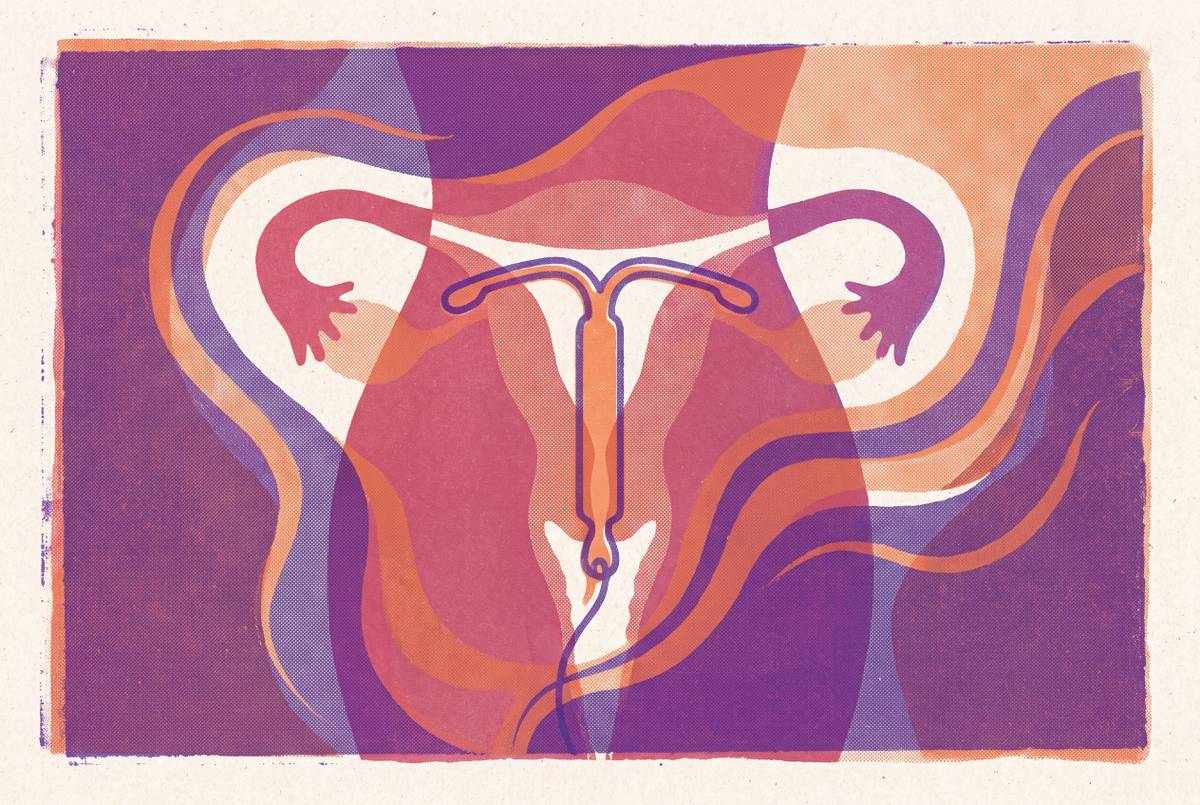
Pregnancy Risk During the Perimenopause Transition
Irregular periods don't mean you can't get pregnant after forty.
A meaningful share of unplanned pregnancies after 40 trace back to a simple mix-up: irregular periods get treated as a sign that ovulation has ended, when the two things are different biological events. A cycle can stretch to six weeks, skip entirely, or arrive twice in a month, and none of that tells a woman whether an egg was released. Ovulation and menstrual regularity run on related but separable tracks during this transition, and the gap between them is where risk hides. Menopause itself has one clinical definition: 12 consecutive months without a period. Until that full year has passed, the ovaries remain capable of releasing an egg, however scattered the signals leading up to it, and pregnancy stays on the table no matter how disordered the cycle has become.
That matters because the instinct to read irregularity as a kind of built-in contraception is understandable but wrong. A woman whose periods have become unpredictable has not received a signal that her fertile window has closed. She has received a signal that her hormonal system has entered a transition where ovulation becomes erratic rather than absent, and where no single missed period or long gap can be interpreted on its own. The rest of this piece works through why that happens and what it means for the decisions women make about contraception and conception during these years.
Why perimenopause hormones fluctuate rather than simply decline
Perimenopausal hormone swings allow ovulation to occur even when everything about a woman's cycle suggests the system is winding down. The answer sits in how perimenopausal hormones actually move, which is not a gradual descent but something closer to a chaotic oscillation. Estrogen does not decline in a straight line through these years. It spikes and crashes from one cycle to the next, often unpredictably. There is no stable "normal range" for estradiol that applies across perimenopause the way there might at other life stages.
Progesterone does trend downward over time, largely because fewer cycles result in ovulation as the transition progresses. But some cycles still do, and those are exactly the cycles that carry pregnancy risk. Meanwhile FSH, follicle-stimulating hormone, rises as the body works harder to recruit and mature an egg from a shrinking pool of follicles. That elevation reflects reduced ovarian reserve. It does not mean ovulation has stopped.
Women earlier in perimenopause are more likely to experience symptoms associated with high estrogen than with low estrogen. That runs against the common assumption that perimenopause is simply a slow drain of hormone levels toward zero, and it confuses women trying to use symptoms as a proxy for how far along the transition they are. Someone might reasonably expect hot flashes and low energy to signal declining fertility, when in fact she may be in a relatively estrogen-rich phase of an unpredictable cycle. The duration of this chaotic period also varies enormously. Perimenopause can last months for one woman and years for another, and the stretch of time during which ovulation remains possible, however sporadically, differs from person to person in ways no calendar can predict in advance.
How fertility declines across the perimenopausal years
If the hormonal picture is this unpredictable, what does that mean for the actual odds of pregnancy at a given age? Fertility does decline meaningfully across the perimenopausal years, but it declines gradually, and it does not reach zero at any recognizable milestone before menopause is confirmed. In the early forties, the chance of pregnancy in any given month runs around ten percent. By the late forties that figure drops to somewhere around two or three percent. By age fifty it falls below one percent. Below one percent is not the same as zero, and that distinction is the structural point of this whole discussion: there is no age at which a woman can assume, with certainty, that conception is off the table short of confirmed menopause.
CDC data reflect this directly. More babies are currently born to women aged 40 to 44 than to teenage mothers, and these outcomes are not exclusively the product of fertility treatment. Spontaneous pregnancies continue to occur at these ages. The underlying driver of the overall decline is egg quality rather than hormone levels on their own: as eggs age, the rate of chromosomal abnormality rises, which is also why miscarriage becomes more common even in cycles where conception does occur.
Where a woman sits within perimenopause also shapes her odds. Earlier in the transition, more cycles are ovulatory and ovarian reserve remains comparatively larger. Later in the transition, anovulatory cycles, cycles without ovulation, become more frequent. But that late stage itself can last one to three years, and ovulation continues to occur sporadically throughout it. A woman cannot look at her stage of perimenopause and conclude she has crossed into safety. She can only conclude that her odds have shifted, not that they have vanished.
Why most perimenopause pregnancies are unplanned
The behavioral consequence of all this unpredictability is that most pregnancies in this age group are not planned. A large majority of pregnancies in women over 40, around 75 percent, are unplanned, a rate comparable to or higher than in younger age groups. That figure is explained by lower perceived risk paired with less consistent contraceptive use, not by higher fertility.
The logic that leads a woman to let contraception lapse during perimenopause is not careless. It follows directly from the biology covered above: if cycles are irregular and periods have become unpredictable, conception starts to feel unlikely, and both the motivation and the habit behind consistent contraception erode together. One might argue this is simply what happens when a visible signal (regular periods) disappears while the underlying mechanism (ovulation) keeps functioning in the background. Tracking cycles to predict fertile windows, the method sometimes called natural family planning, depends on a kind of regularity that perimenopause specifically removes. University Hospitals OB/GYN physician Corinne Bazella, MD, has noted that cycle tracking is not recommended as a method during this stage precisely because ovulation timing becomes erratic.
Women on hormonal contraception face a related but distinct version of the same confusion. The contraceptive itself can mask the underlying cycle changes that would otherwise signal where a woman stands in the transition, making it genuinely difficult to know whether menopause has been reached while still on the method. That creates uncertainty not about whether to use contraception, but about when it becomes safe to stop, a question the next two sections take up directly.
What the risks of a perimenopausal pregnancy look like
What actually happens, clinically, if conception occurs during these years? The clinical risks of a pregnancy at this stage, planned or not, shift upward. At 35 and older, a threshold providers call advanced maternal age, risk rises for chromosomal abnormalities, preeclampsia, gestational diabetes, C-section delivery, and preterm birth or low birth weight. These risks stem more from egg quality than from perimenopause as a condition in itself: older eggs carry a higher likelihood of chromosomal error, which is the same mechanism behind both rising miscarriage rates and rising rates of pregnancy complications.
Maternal mortality and severe maternal morbidity also rise substantially with age starting at 40, with particularly steep increases at each successive five-year threshold after that. That progression makes confirming menopause before stopping contraception a genuine clinical safety question. A pregnancy that occurs after a woman assumes, incorrectly, that her fertility has ended carries real additional risk compared with a pregnancy planned and monitored from the outset.
None of this is reason for alarm among women who want to conceive during these years. For those hoping to get pregnant at 40 or older, Cleveland Clinic ob/gyn and menopause specialist Catherine Caponero, DO, recommends seeing a fertility specialist right away rather than waiting, since fertility continues to decline through this window and earlier evaluation improves the odds of a good outcome. The goal of naming these risks clearly is to help women act with the right urgency, whichever direction they are headed, rather than to suggest that pregnancy after 40 is inherently unsafe.
Why hormone tests cannot tell you when to stop using contraception
Given how clearly these risks are tied to timing, it is tempting to look for a single test that settles the question of when fertility has truly ended. No blood test currently available can predict, with reliable accuracy, when menopause will officially occur, and none of the existing hormone measures offer a dependable timeline for how long fertility will last or when ovulation will stop for good.
FSH, LH, and estradiol all fluctuate continuously throughout perimenopause. An elevated FSH reading in one cycle does not guarantee that the next cycle will be anovulatory. Ovulation can still occur even when hormone values look, on paper, like reserve has declined substantially. That matters in a very specific, practical way for women using hormonal contraceptives. Clinical guidance explicitly cautions against using an isolated FSH, LH, or estradiol reading to decide when to stop contraception, because combined hormonal contraceptives and hormone replacement therapy can suppress those values and make the picture read falsely reassuring. Progestogen-only methods are less likely to interfere with FSH measurement, which makes them somewhat more useful if hormone tracking is part of the plan, though even then a single value cannot carry the weight of a stopping decision.
AMH, anti-Müllerian hormone, holds up better than FSH as a marker because it stays comparatively stable across the cycle, giving a clearer picture of ovarian reserve over time. But AMH measures how many eggs remain, not whether ovulation has stopped or will stop soon. Even the most stable, best-studied marker available cannot answer the question women actually want answered, which is whether this specific month carries pregnancy risk. The field's direction reflects that limitation: rather than relying on any single-point measurement, the more useful approach tracks hormone patterns over time, matching how perimenopause itself behaves, as a multi-year fluctuation rather than a threshold crossed on one particular day.
What reliable contraception during perimenopause looks like
Given that no test can mark the finish line, what does reliable protection actually involve during these years? Reliable contraception during perimenopause exists, it is well studied, and in several cases it addresses symptom management at the same time it prevents pregnancy, but the right choice depends on individual health history rather than a default assumption about what works best at this age.
Progestin-releasing IUDs prevent pregnancy effectively while also managing the heavy, frequent bleeding common in early perimenopause, making them a method that solves two problems at once for many women. Progestin-only pills and estrogen patches offer another effective route, and tend to be the safer option for women with high blood pressure or who smoke, compared with combined hormonal contraceptives. Some women and their clinicians land on a combination approach: an IUD for pregnancy prevention paired with an estrogen patch for symptom relief and bone health. These two methods serve different functions, and using them together is a deliberate strategy.
The ethinyl estradiol used in contraceptive hormones is chemically different from the estradiol used in menopausal hormone therapy, and the two serve different clinical purposes. Treating them as interchangeable leads to confused decisions about both pregnancy prevention and symptom management, so the conversation with a provider should keep them distinct. Permanent options, tubal ligation or a partner's vasectomy, remain entirely valid choices for women who are certain they do not want to conceive again; neither should be treated as too drastic a step for this age group.
Providers often recommend continuing contraception through age 55. And the only fully reliable confirmation that menopause has arrived, the only signal that overrides every hormone value and every method of tracking discussed above, is 12 consecutive months without a period.
How understanding your hormone pattern over time changes the decisions you can make
Perimenopause behaves as a years-long pattern of fluctuation, not a single line crossed on a specific date. The most useful thing a woman can do is track that pattern rather than wait on one test or one symptom to deliver a verdict. A single hormone reading, however thorough the panel, captures one moment inside a fluctuation that may run for years. What actually reveals where a woman stands in the transition is the direction those values move across repeated measurements, not what any individual result shows in isolation.
Tracking estradiol, FSH, progesterone, and AMH serially gives a woman and her clinician a way to see whether she is drifting toward anovulation or still cycling actively, information relevant both to someone trying to avoid pregnancy and to someone trying to achieve it. If the pattern matters more than any single data point, what turns that pattern into something a woman can actually act on? Clinical interpretation is the answer. A clinician reviewing values over time can separate a meaningful trend from ordinary month-to-month noise, and that review is what converts raw numbers into something decision-relevant. Values collected without that context can mislead nearly as easily as no testing at all, which is why the conversation with a provider, repeated over time rather than conducted once, remains the step nothing else in this picture can substitute for.
Sources
- Can You Get Pregnant During Perimenopause? Yes
- Can You Get Pregnant During Perimenopause?
- Perimenopause and Pregnancy: Why Irregular Cycles in Your 50s Are Tricky
- Maternal and perinatal complications according to maternal age: A systematic review and meta‐analysis
- FSRH Guideline Contraception for Women Aged Over 40 Years