When in Your Menstrual Cycle to Test Perimenopause Hormones
Testing on the right cycle day reveals what a single blood draw might miss.
Timing matters in perimenopause testing because the hormones themselves refuse to sit still long enough for a single blood draw to mean much on its own. Knowing which day of the cycle to test each hormone, and why that day was chosen, is what turns a lab report into something a clinician can actually act on.
Why perimenopause makes hormone timing a moving target
Perimenopause covers the transitional years before menopause, usually starting in the mid-40s but sometimes as early as the mid-30s, and it can run anywhere from a few months to as long as 14 years, with an average length of about 7 years blog.walgreens.com. That is a wide window, and inside it, the ovaries are not winding down in any tidy, linear fashion. Progesterone tends to drop first, largely because ovulation becomes inconsistent, while estrogen often does the opposite of what people expect: it spikes higher before it eventually falls. So the early complaint is rarely "not enough hormones." It is more often too much estrogen relative to too little progesterone, a mismatch rather than a simple deficiency.
That mismatch produces the symptom list most women recognize once they start comparing notes: irregular cycles, periods that are suddenly heavier or lighter, hot flashes, night sweats, mood swings, disrupted sleep, joint aches, brain fog. None of those symptoms come labeled with a cause. What research increasingly suggests is that it is not just the average hormone level driving how bad symptoms feel, it is the size of the swing. Women whose estradiol jumps around more violently report more intense hot flashes and night sweats, independent of what their average estradiol level actually is.
That single fact, that amplitude matters as much as level, is the whole reason cycle-day timing becomes a practical skill rather than a technicality. A blood draw taken on the wrong day can land in the middle of a swing and report back something completely misleading. Get the day right, and the same draw becomes informative.
Hormone level "normal" ranges and testing timing
Single-snapshot testing is structurally shaky in perimenopause. FSH is the clearest example: the same individual can show FSH readings that vary by a wide margin from one test to the next across a span of months, so a "normal" reading today says very little about what next month's reading will show, and vice versa.
Progesterone works the same way but with more forgiving logic once the timing is understood. A low progesterone reading taken early in the cycle is expected and means nothing clinically, since progesterone is not supposed to be elevated then anyway. Context is doing all the work there.
Jim Staheli, D.O., Medical Director for Broad Health, Hone Health's affiliated medical practice, has pointed out that testing too early in the cycle can return normal-looking results even when a woman's symptoms are entirely real. The test can be technically accurate and still be functionally useless, because it caught the hormone at the wrong moment of its arc. A single at-home FSH test, however convenient, is considered by clinicians an unreliable way to determine perimenopausal status by itself. Fluctuation is the baseline condition of this stage of life, not a glitch in the data. It is the baseline condition of this stage of life. The same logic applies to progesterone: a low progesterone result early in the cycle is expected and clinically meaningless; the same low result on days 19–21, when progesterone is supposed to be at its peak, is a meaningful signal.
The two testing windows that matter most when cycles are still regular
For anyone whose cycles are still regular enough to count, two windows carry most of the diagnostic weight.
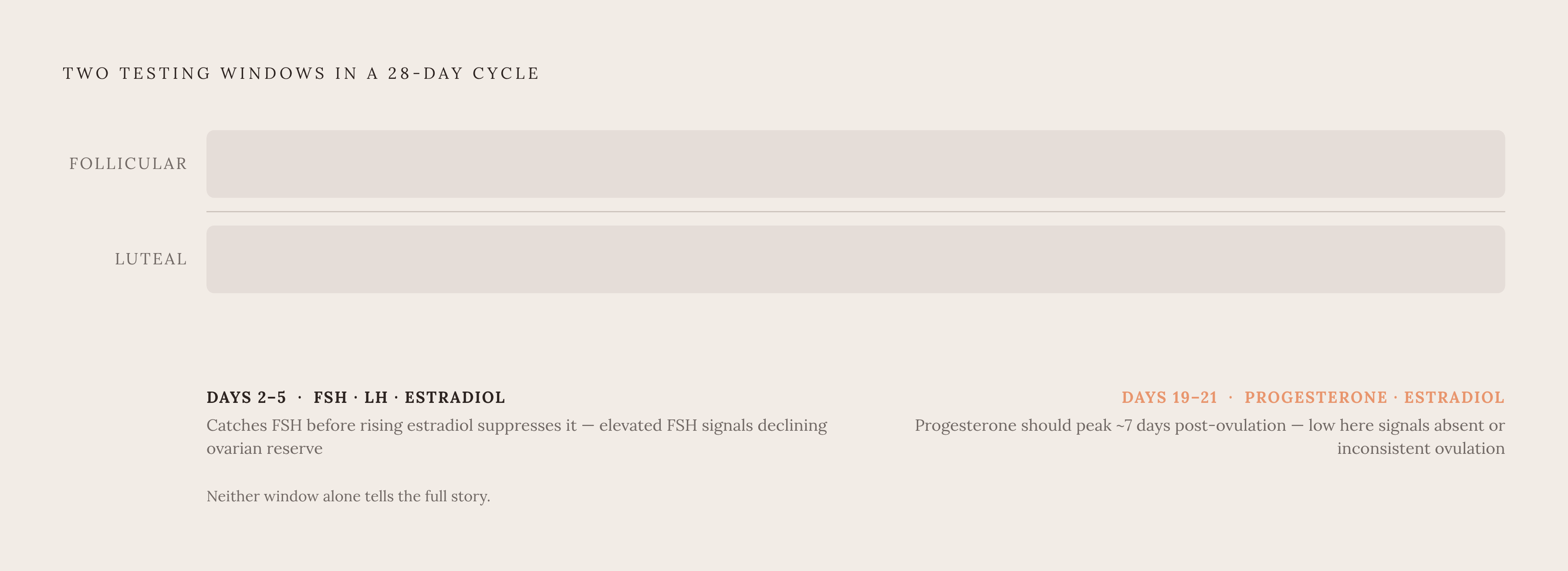
FSH is tested here to capture its natural baseline before rising estradiol suppresses it; an elevated reading at this point suggests ovarian function is beginning to decline. The 2025 European Society of Endocrinology clinical practice guideline formally backs this, recommending FSH testing at day 2 to 5 of the cycle, or after more than 40 days have passed without a period. LH gets pulled at the same time mostly as a baseline reading. The mid-cycle LH surge that signals ovulation is a separate measurement entirely, used to catch ovulation itself rather than to stage perimenopause.
Progesterone peaks roughly a week after ovulation, so testing here checks whether ovulation actually happened and confirms the luteal phase produced enough progesterone to support it. A low reading at this point, when it should be at its highest, is a far stronger red flag for inconsistent or absent ovulation than the identical number would be earlier in the cycle. Some clinicians also test estradiol on day 5 and day 12, layering in follicular-phase and pre-ovulatory readings to build a fuller picture of how estrogen is trending across the month.
Why bother with both windows instead of picking one? Because they answer different questions. Early-cycle FSH shows how hard the pituitary gland is having to work to get the ovaries to respond. Mid-luteal progesterone and estradiol show what the ovaries actually did in response. Put together, they tell a story that neither one tells alone. Days 2–5 (early follicular phase, often called the "Day 3 test"). Target hormones: FSH, estradiol, LH. Days 19–21 (mid-luteal phase).
Hormone Reference Ranges in a Perimenopausal Context
Reference ranges look authoritative on paper, but in perimenopause they need translation. Clinicians generally start paying closer attention once levels sit consistently above 25 mIU/mL alongside emerging symptoms, though a single elevated reading rarely settles anything on its own; the pattern across repeated tests is what carries weight. Rajita Patil, M.D., of UCLA Health's Comprehensive Menopause Care, has framed it in practical terms: FSH above 25 may suggest perimenopause, while levels of 50 or higher are most likely consistent with it.
Estradiol's reference range is almost comically wide by comparison. Pre-menopausal levels run anywhere from 30 to 400 pg/mL, and that width is not a flaw in the test, it is a reflection of how dramatically estradiol swings across a single cycle blog.walgreens.com. After menopause, it typically settles down to 30 pg/mL or less blog.walgreens.com. In perimenopause, a reading can land almost anywhere inside that 30-to-400 band, and the fact that it moves that much is itself part of the diagnostic picture blog.walgreens.com.
Erratic or elevated LH in perimenopause indicates the ovaries are responding inconsistently to pituitary signaling.
Progesterone is the one hormone where a "normal" range badge can be the most deceptive. A progesterone value can sit technically inside its reference interval and still be clinically meaningful only once it's read against the estrogen level drawn at the same time. Low-normal progesterone paired with high estrogen signals a relative imbalance even when neither number individually trips an alarm. Ranges, in the end, are built from population averages. What one perimenopausal woman's result means depends on her cycle day, her symptoms, and ideally what her last few tests looked like. Normal (still menstruating): 4.7 to 21.5 mIU/mL blog.walgreens.com. After menopause: 25.8 to 134.8 mIU/mL blog.walgreens.com. Weeks 1–2: 1.37 to 9 IU/L blog.walgreens.com. At ovulation: 6.17 to 17.2 IU/L blog.walgreens.com. Weeks 3–4: 1.09 to 9.2 IU/L blog.walgreens.com. After menopause: 19.3 to 100.6 IU/L blog.walgreens.com.
Hormones that don't require cycle-day precision (and what they add)
Some hormones can be tested without this kind of calendar math. AMH, or Anti-Müllerian hormone, is produced by granulosa cells inside growing follicles and reflects roughly how many viable follicles remain, a rough gauge of ovarian reserve. It barely moves across the cycle, so it can be drawn on nearly any day without distorting the result. It declines steadily with age and functions as a fairly dependable predictor of when menopause will arrive, and it has also been linked to how severe hot flashes and night sweats tend to get. The STRAW+10 framework recognizes AMH, alongside antral follicle counts, as more useful than traditional FSH testing for tracking fertility potential specifically.
TSH, thyroid-stimulating hormone, is not a reproductive hormone at all, but it belongs in any serious perimenopause panel. Hypothyroidism produces weight gain, mood changes, and menstrual irregularity, a symptom list that overlaps heavily with perimenopause itself, so testing TSH helps rule thyroid dysfunction in or out as a contributing cause. Quest Health's Menopause & Perimenopause Assessment Test Panel, priced at $155, bundles TSH together with FSH, estradiol, LH, and prolactin for exactly this reason. Like AMH, it isn't cycle-day sensitive and can be drawn at the same appointment as everything else.
Testosterone rounds out the list. Total testosterone drifts downward gradually with age and can affect energy, mood, libido, and sleep quality in women. It, too, is not cycle-day sensitive the way FSH and progesterone are, but it adds useful context about the androgenic side of the perimenopausal picture. Practical takeaway: a well-designed panel pairs cycle-sensitive markers (FSH on days 2–5, progesterone and estradiol on days 19–21) with cycle-insensitive markers (AMH, TSH, testosterone) drawn at a convenient point, ideally the early-follicular visit for efficiency.
Adjusting the timing strategy when cycles are irregular or absent
All of this day-counting logic assumes a cycle regular enough to count. Late perimenopause, STRAW Stage -1, is defined by cycles spaced more than two months apart, and at that point, counting to day 3 or day 21 simply is not possible. The 2025 European Society of Endocrinology guideline anticipates this directly: once more than 40 days have passed without a period, FSH gets measured whenever the blood draw happens, cycle day no longer being a meaningful reference point. FSH effectively becomes the primary biochemical marker at that stage, with symptom history and the pattern of cycles over the prior year carrying more of the diagnostic weight than any single lab value.
Hormonal contraceptives complicate this picture further. Women using continuous birth control to manage perimenopausal symptoms cannot rely on last-menstrual-period timing at all, since there often isn't one to anchor to; their status gets assessed through FSH alone, and that usually requires a pill-free interval to get a reading that means anything. That's because hormonal contraceptives suppress the body's own FSH, estradiol, and progesterone production, which makes any cycle-timed test unreliable without a proper washout period first.
For anyone navigating irregular cycles without contraception, the practical approach is fairly simple: keep a record of the last menstrual period and the pattern of recent cycles, then test FSH, ideally alongside AMH and TSH, at any point once 40 days have passed since the last period. But the interpretive bar shifts too. Without a cycle day to anchor the reading, that FSH result has to be weighed against symptoms and, ideally, confirmed with a repeat test, since single-point variability only gets worse once cycles stop following any predictable rhythm.
Factors that can distort results regardless of when you test
Even a test drawn on exactly the right day can get thrown off by something that has nothing to do with the menstrual cycle. High-dose biotin supplementation is a known and FDA-recognized culprit: it interferes with immunoassay-based hormone tests, and the standard advice is to pause high-dose biotin for at least 48 to 72 hours before any hormone blood draw. Time of day matters too, since hormone concentrations tend to run higher earlier in the morning, so an afternoon draw on the exact right cycle day can still read differently than a morning one would have.
Acute stress and illness can transiently push hormone levels up or down in ways that don't reflect a woman's actual baseline, so a draw taken in the middle of a bad flu or an unusually stressful week may not be representative of anything ongoing. Certain medications interfere with hormone readings as well. Disclosing every current medication to the ordering clinician before testing isn't optional, it's part of making the result usable. And hormonal contraceptives deserve a second mention here, since their suppression of FSH, estradiol, and progesterone applies as a general confounder well beyond just the irregular-cycle scenario discussed earlier. None of these factors are exotic. They are mundane, easily controlled for, and easy to overlook, and that is why they trip up so many otherwise well-timed tests.
One Well-Timed Test as a Starting Point, Not a Conclusion
Even a test drawn on the perfect day only captures one instant inside a system that is, by nature, unstable. Research published in the Journal of Clinical Endocrinology & Metabolism found that hormone patterns tracked over time predicted symptom severity and treatment response more accurately than any single hormone measurement could. That finding reframes what a "good" test result should even mean here. Persistently elevated or wildly variable FSH across several cycles carries more diagnostic weight than one high reading in isolation. The pattern, not the single data point, is what approaches a diagnosis.
What does tracking over time actually surface that a one-off test cannot? FSH may be climbing steadily or just bouncing around unpredictably, mid-luteal progesterone may be low every cycle or only sometimes, estradiol swings may be widening month over month, and AMH may be declining at roughly the rate expected for a given age. Each of those questions requires more than one data point to answer. A single blood draw, however well-timed, functions better as a starting point than a verdict.
None of this replaces clinical judgment, either. Raw numbers on a lab report, without someone trained to read them in context, leave a patient unable to tell a meaningful pattern from ordinary noise, or perimenopause from an overlapping thyroid condition producing similar symptoms. The STRAW+10 framework itself treats the menstrual cycle as the primary tool for staging reproductive aging, with hormone levels serving a secondary, supporting role. The numbers only mean something inside that clinical frame. So the practical path forward is straightforward, if not always simple to execute: test at the windows that matter, FSH early, progesterone and estradiol mid-luteal, repeat across a few cycles to see whether a pattern emerges, and bring all of it to a clinician equipped to read the whole picture rather than one isolated number.