Weight Changes During Perimenopause and Hormonal Mechanisms
Hormonal shifts during perimenopause drive metabolic changes independent of diet and exercise.
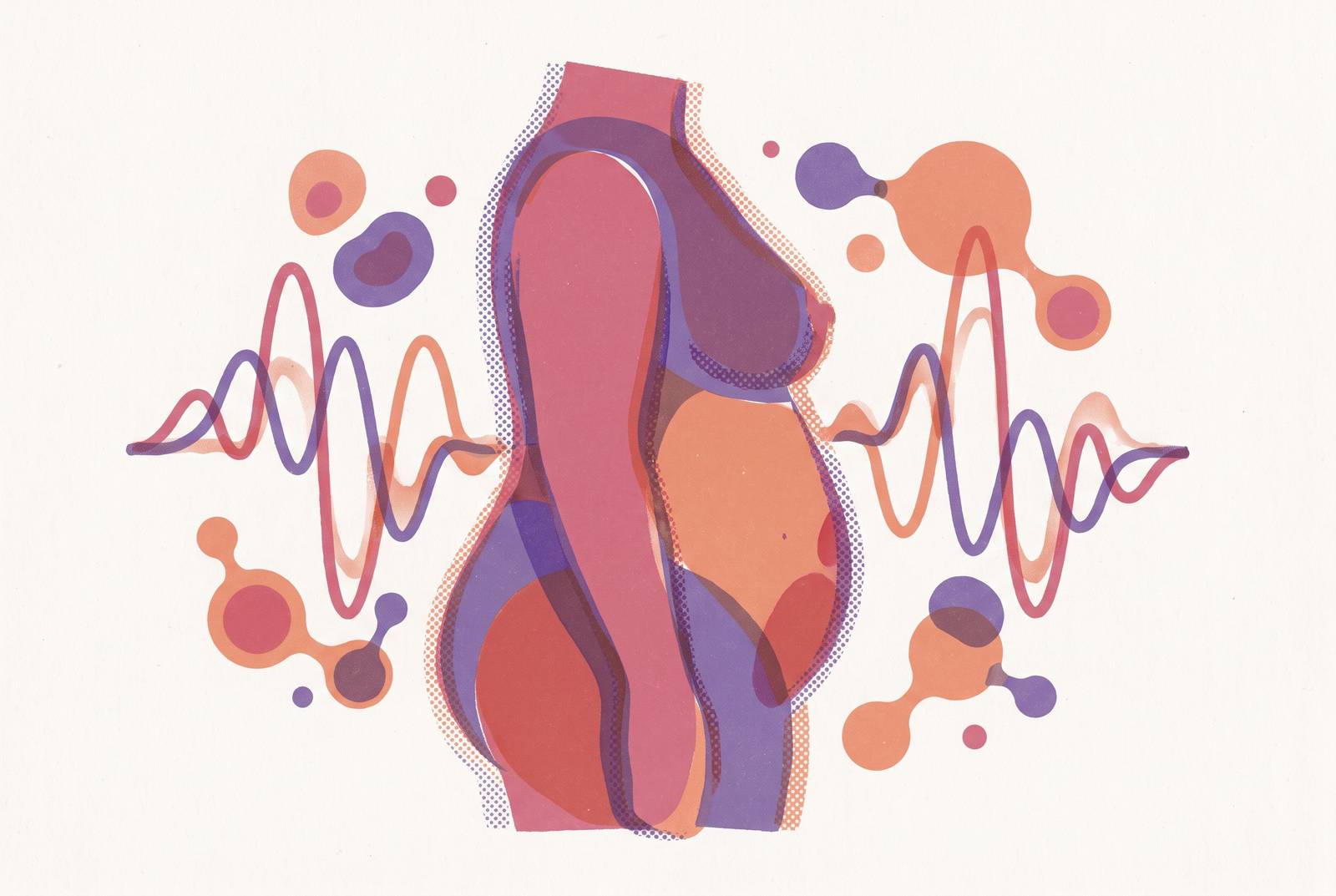
Declining estrogen, rising FSH, cortisol dysregulation, and disrupted sleep change where fat accumulates and how the body uses energy. Knowing how these changes work together helps women tell which care meets their needs and which advice is just general guidance for midlife.
Why perimenopausal weight change is a hormonal story, not an aging or lifestyle story
Women can eat and exercise as they did when their weight stayed steady and still see their body shape change during perimenopause. Murphy et al. (2026) document that women describe these changes as qualitatively different from earlier experiences. These experiences raise the question of what has changed in the body’s response.
Perimenopause is a multi-year remodeling of the endocrine system, beginning with menstrual irregularity and ending one year after the final menstrual period. Manning, Stockman, and Zanni (2025) describe it as “an obesogenic sensitive period,” when the hormonal environment increases susceptibility to fat accumulation independent of caloric intake. This makes food and activity relevant but incomplete explanations.
What actually changes in the body during perimenopause, and the scale of the shift
Women generally gain little weight across the transition, but the change in body composition is larger than the number on the scale suggests. Greendale et al.’s SWAN longitudinal study found that the rate of fat gain roughly doubled at the start of the menopausal transition while lean mass declined. Even a small change in weight can hide a gain in fat and a loss of muscle.
Location changes as well as quantity. Manning et al. (2026) describe expansion of visceral fat deep in the abdomen together with a reduction in subcutaneous fat around the hips and thighs. Waist circumference can increase measurably even when weight changes little.
Manning, Stockman, and Zanni also describe a clinical case of a 46-year-old woman who gained weight mostly around her middle after she started a medication with mild-to-moderate obesogenic effects. The gain exceeded what the medication alone would predict and persisted after discontinuation and added lifestyle interventions. A single case cannot establish the usual course, but it illustrates the heightened susceptibility that the broader body composition findings ask researchers to explain.
How declining estrogen drives fat redistribution and insulin resistance
Estradiol is a metabolic regulator as well as a reproductive hormone. It regulates lipoprotein lipase activity differently in fat beneath the skin and fat around the abdominal organs. As estradiol falls, that regulation shifts in a way that favors visceral fat accumulation.
Estrogen also supports insulin sensitivity, which is how readily cells respond to insulin’s signals. When estrogen falls, cells can become less responsive, and the body compensates with higher insulin levels. That compensatory hyperinsulinemia promotes fat storage and inhibits fat breakdown.
Visceral fat has links to systemic inflammation and more common cardiovascular risk factors, so the change also matters for health. Manning et al. (2026) link this redistribution to accelerated atherosclerotic cardiovascular disease risk during perimenopause. Estrogen decline is the central driver in this account, but its effects are not confined to fat. It also changes how the body maintains muscle, which in turn changes how the body uses energy.
How muscle loss compounds the metabolic slowdown
Estrogen helps maintain muscle structure and oxidative capacity, meaning its capacity to use energy through oxidative processes. As this support declines and lean mass falls, resting energy expenditure also falls. An eating pattern that previously matched the body’s needs can consequently provide more energy than the body now requires.
Muscle contributes a significant share of resting metabolic rate, below the largest contributor’s share, and is the predominant site of glucose disposal under insulin-stimulated conditions. Losing muscle therefore affects both baseline energy use and the body’s ability to handle glucose. These effects compound the insulin resistance associated with expanding visceral fat.
Calorie restriction does not directly address the loss of muscle, whereas resistance training targets its preservation. Aerobic exercise can reduce visceral fat, but it serves a different role. The form of movement matters when the tissue being lost is metabolically important.
How FSH elevation and estrogen variability — not just estrogen decline — shape the trajectory
The estrogen pathway is not a smooth descent from high levels to low ones. FSH rises as the pituitary increases its signal to ovaries that are becoming less responsive, beginning in the late reproductive phase before estrogen falls substantially. In early perimenopause, stronger stimulation of remaining follicles can produce elevated estrogen even while FSH is rising.
Progesterone can fall earlier because the corpus luteum weakens first. This creates a phase of relative estrogen dominance. Early symptoms may consequently resemble severe PMS, which does not fit the common expectation of uniformly low estrogen. A normal FSH result or high estradiol result can also occur after the transition has begun.
Variability itself appears relevant to metabolism. Greater estrogen variability is associated with more pronounced increases in total fat mass, although the relationship with visceral fat specifically is more complex. That distinction matters because an association does not establish that every fluctuation directly causes abdominal fat gain. It does establish why the trajectory cannot be understood from the net fall in estrogen alone.
How cortisol interacts with estrogen loss to accelerate visceral fat accumulation
Cortisol adds a stress-hormone pathway to the same abdominal pattern. It preferentially promotes visceral fat accumulation, acting where declining estrogen is already redirecting storage. Cortisol dysregulation during perimenopause is therefore not best understood as a separate issue caused only by a demanding life. It is a hormonally mediated amplifier of changes already underway.
Cortisol also degrades lean mass and worsens insulin sensitivity. Through these effects, the gains in abdominal fat and losses in muscle place a greater strain on metabolism together than either would alone. More visceral fat is associated with increased inflammation, which can raise cortisol and promote further visceral fat accumulation.
Estrogen variability may intensify this interaction, although the specific relationship between variability, cortisol, and visceral fat remains more complex than a simple cause-and-effect claim. The useful distinction is between the average estrogen level and the instability of the hormonal environment. Stress reduction may support that environment, but it does not remove the underlying ovarian transition.
How sleep disruption ties the hormonal mechanisms together into a daily feedback loop
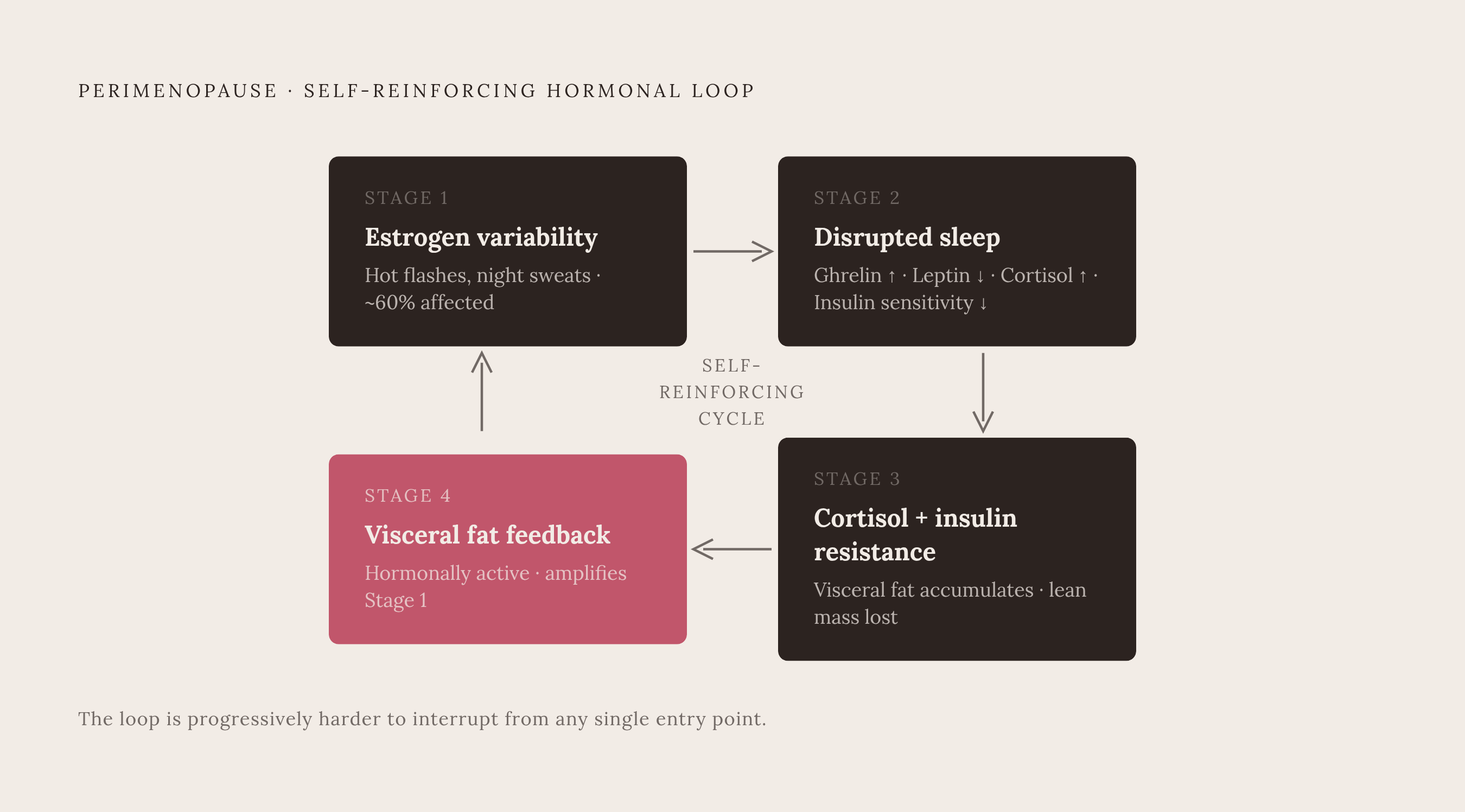
Hot flashes and night sweats disturb sleep architecture in roughly 60% of perimenopausal women. These vasomotor symptoms arise from changes involving estrogen’s role in thermoregulatory signaling. Hormonal change can disturb sleep even when sleep habits are good.
Once sleep becomes short or fragmented, it affects the same metabolic pathways from another direction. Ghrelin, a hunger signal, increases, while leptin, a satiety signal, decreases. Cortisol rises, and insulin sensitivity worsens.
The loop now has a clear sequence. Estrogen variability contributes to vasomotor symptoms, those symptoms interrupt sleep, and disrupted sleep worsens conditions favoring visceral fat accumulation. Visceral fat is itself hormonally active and may amplify the cycle. This interlocking pattern explains why diet, exercise, stress reduction, or sleep hygiene alone may be insufficient, and why a useful clinical explanation must account for more than the most visible symptom.
Why the same symptoms get attributed to aging, thyroid disease, or depression — and how to tell the difference
This connected physiological pattern produces weight gain, fatigue, mood changes, cognitive slowing, and sleep disruption that overlap with hypothyroidism and depression. Thyroid disease also becomes more prevalent during the same decade in which perimenopause begins.
Hashimoto’s thyroiditis, an autoimmune cause of hypothyroidism, can produce persistent weight gain, cold intolerance, dry skin, depression, and fatigue. Because symptoms alone may not reliably tell it apart from perimenopausal changes, testing can help with the differential diagnosis. Misattribution can also run in either direction. A hormonal transition can be labeled thyroid disease or depression, while actual thyroid disease or depression can be dismissed as part of “the change.”
The distinction matters because treating mood symptoms alone can leave hormonally driven metabolic changes unaddressed. Conversely, recognizing perimenopause should not make every symptom hormonal by default. Murphy et al. (2026) found that women were actively trying to “make sense of” their weight and body shape variations. What they lacked was not engagement, but an explanatory framework able to separate overlapping causes.
What hormone testing can and cannot tell a perimenopausal woman about her body composition trajectory
Hormone testing can contribute to that framework, but a measurement is not the same as a diagnosis or a forecast. FSH fluctuates for years before menopause and can be suppressed by high estradiol in early perimenopause. Measuring FSH and estradiol together is more informative than either alone, with low estradiol and elevated FSH strengthening the clinical case.
If testing is pursued, timing affects interpretation. Measurement at day 2–5 of the menstrual cycle or after an extended gap without menstruation gives the most interpretable result. Even then, no single FSH cutoff is definitive. The result must be read against menstrual patterns, symptoms, and the wider hormonal context.
Repeated measurements can provide more information about a changing pattern than one snapshot, including relative estrogen dominance, variability, or sustained decline. They do not, however, establish exactly how much fat a woman will gain or where it will accumulate. Clinician-interpreted hormone patterns over time can help explain the conditions influencing body composition without fully predicting the outcome.
What women can do when they understand what is driving the change
Action becomes more specific when it follows the mechanism. For estrogen-related changes, the evidence supports discussing hormone therapy with a clinician during perimenopause rather than automatically deferring the conversation until postmenopause. That discussion should treat hormone therapy as a targeted intervention with limited scope for resolving weight changes. For lean mass loss, resistance training directly targets muscle preservation, while aerobic exercise complements it through dose-dependent reductions in visceral fat.
Sleep care also becomes more precise when its hormonal trigger is recognized. Discussing treatment for vasomotor symptoms, including hormone therapy or non-hormonal options, addresses the source of sleep interruption. Making sleep a priority and reducing stress can lower allostatic load, the burden that builds up in the body from stress. They support the hormonal environment without substituting for attention to the underlying estrogen variability.
Finally, longitudinal data can give women and clinicians a personal baseline against which to interpret change. Hormone patterns, symptoms, and body composition can be considered together when assessing an intervention rather than treating an isolated laboratory shift as success. Self-advocacy then has a concrete purpose, which is to seek an explanation tied to mechanisms and followed over time.