Perimenopause and Cardiovascular Risk Changes in Midlife
Cardiovascular risk accelerates during perimenopause, not after menopause ends.

Cardiovascular risk in midlife women begins changing during perimenopause. Fluctuating and declining estrogen reshapes several risk pathways at once, making the transition years an important window for prevention. The practical message is to assess heart health while those changes are developing, with attention to reproductive stage and trends over time, rather than wait until the final menstrual period is behind you.
Why cardiovascular risk in women is a perimenopause story, not a menopause story
Many women are told to watch their heart health “after menopause”. That advice reflects a real rise in risk, but draws attention to it too late. It mistakes the point when risk becomes clinically visible for the point when it begins accumulating. By the final menstrual period, the processes affecting cholesterol, blood sugar, blood pressure, and the heart itself may already be underway.
The American Heart Association's May 2026 analysis found that perimenopausal women were twice as likely to have a low cardiovascular health score as women who still had regular menstrual cycles. Cholesterol and blood sugar largely drove the gap, which was not explained by age alone. Care that focuses on postmenopause can therefore leave women without screening or counseling in the years when they could begin to prevent disease.
How estrogen's withdrawal reshapes lipids, fat distribution, and blood pressure simultaneously
Estrogen's decline changes several connected systems, allowing each change to reinforce the others. Total cholesterol, LDL cholesterol, triglycerides, and apolipoprotein B increase, while HDL cholesterol may become less protective. The SWAN HDL ancillary study, published in 2025 in JACC Advances, found that HDL during perimenopause can lose its anti-inflammatory and reverse cholesterol transport properties. The distinction between HDL's amount and its function helps explain why a higher HDL level after menopause does not always correspond to a lower atherosclerotic burden.
At the same time, body composition shifts in ways that a weight measurement may not capture. Starting about two years before the final menstrual period, the rate of fat mass gain doubles while lean mass falls, apart from the effects of chronological aging. Even with little overall weight gain, women may accumulate visceral adipose tissue, which has a different metabolic and inflammatory profile from subcutaneous fat. That redistribution matters because visceral fat drives insulin resistance, which in turn worsens lipid profiles.
Estrogen's decline is accompanied by increased angiotensin type 1 receptor expression, higher angiotensin-converting enzyme activity, greater vasoconstrictor and sympathetic activity, and increased salt sensitivity. These changes help push up systolic blood pressure and pulse pressure. Meanwhile, worsening lipid profiles accelerate endothelial dysfunction, further connecting metabolic change to arterial function.
What is happening inside the heart itself, before symptoms appear
The heart is not merely a passive recipient of changes in blood and arteries. The machinery in its own cells can change during the transition, before estrogen is fully withdrawn. A 2024 Brock University / IMPART Team Canada study found significantly diminished SERCA2a activity by the end of perimenopause in a mouse model of ovarian failure. SERCA2a is a calcium-handling pump critical to cardiac contractility, and its molecular regulators fluctuated substantially during the perimenopausal period. This model evidence locates a potential source of dysfunction inside the heart itself, with its applicability to women still uncertain.
Heart failure with preserved ejection fraction, or HFpEF, disproportionately affects women and accounts for a growing share of heart failure cases. One proposed framework is that HFpEF-relevant changes begin accumulating during perimenopause, become amplified after menopause, and manifest as disease years or decades later. Studies of postmenopausal women who already have the disease are less able to show when those changes began. The possibility of an earlier origin strengthens the case for prevention during the transition, without implying that cellular changes inevitably become clinical disease.
Why the perimenopausal stage within the transition is the moment risk accelerates fastest
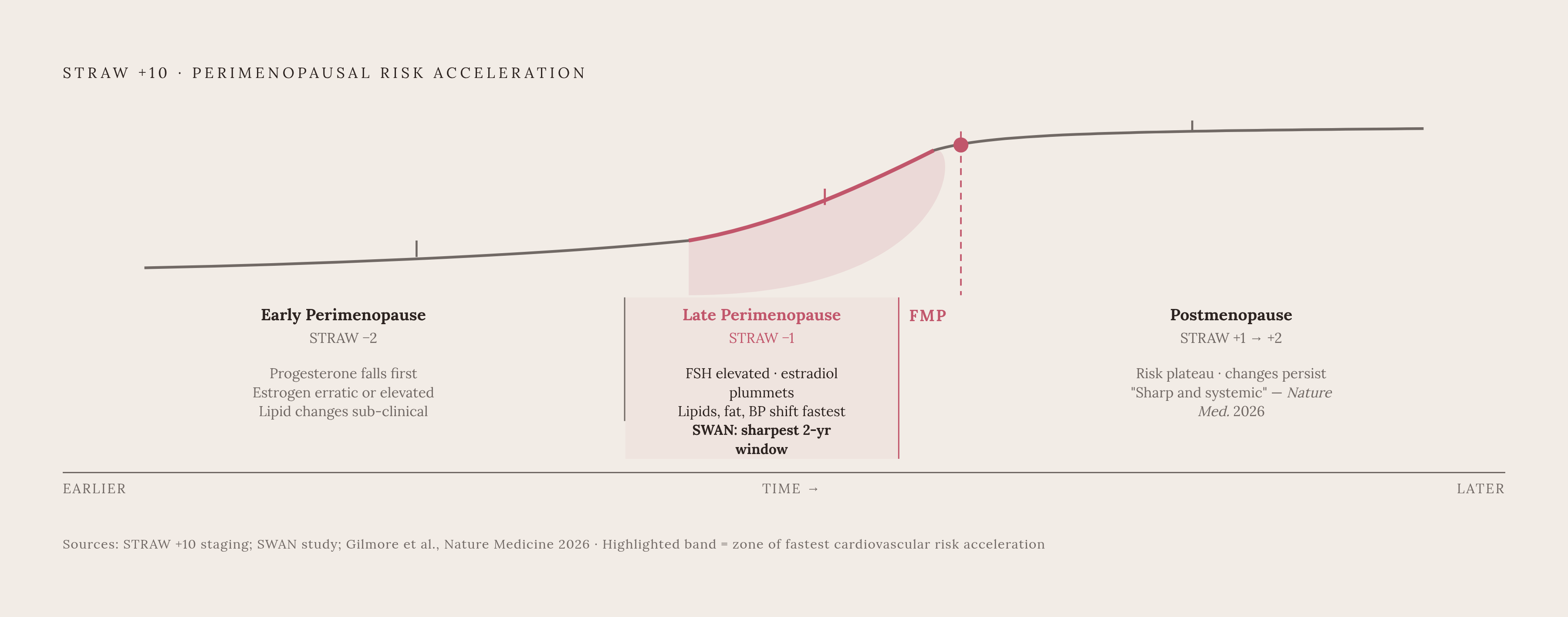
The STRAW+10 staging system uses menstrual cycle characteristics and FSH levels, with the final menstrual period as its reference point. In early perimenopause, STRAW −2, progesterone falls first while estrogen remains erratic or even elevated. Heavy bleeding, breast tenderness, and irritability can occur during this period of relative estrogen dominance, yet may be misread as unrelated to the transition. Lipid and metabolic changes can be beginning even when they are not yet measurable.
Late perimenopause, STRAW −1, brings a more unstable hormonal environment. FSH becomes consistently elevated and rises further, while estradiol plummets and spikes erratically. This is when changes in lipids, fat distribution, and blood pressure accelerate most sharply. SWAN longitudinal data placed the most abrupt lipid changes within the two-year window surrounding the final menstrual period, although the trajectory begins earlier. A 2026 Nature Medicine population-scale study across 90 laboratory tests described physiological change at the final menstrual period as “sharp and systemic”.
Changes already underway in early perimenopause speed up in late perimenopause and need more urgent attention. Normal or elevated estradiol early in the transition can look reassuring without establishing whether cardiovascular risk is changing. Stage provides the temporal context that the broad label of perimenopause leaves out.
Why a single hormone test taken at the wrong moment misleads rather than informs
That changing slope also exposes the limits of a one-time hormone test. FSH can rise in early perimenopause while responding follicles continue producing enough estrogen to keep estradiol normal or elevated. Consequently, one elevated FSH result does not confirm the transition, and one normal estradiol result does not rule it out. There is no single normal estradiol range that makes an isolated result a reliable description of perimenopause. A snapshot captures only a moment in a volatile process.
The 2026 NICE Guideline advises against laboratory testing to identify perimenopause in women 45 and over. The European Society of Endocrinology likewise says women over 45 with typical symptoms do not need biochemical testing for diagnosis or care. For these women, symptoms give the information needed for diagnosis, while a single hormone result may make things less clear. Recognizing this limitation is important because an apparently reassuring result should not become a reason to disregard the transition or its cardiovascular context.
Recommendations place FSH measurement at day 2–5 of the menstrual cycle or after more than 40 days without menstruation. For women under 40 who may have premature ovarian insufficiency, or who are aged 40–45, the advice is to take two measurements 4–6 weeks apart. Serial lipid, blood pressure, and blood sugar measurements address whether risk markers are changing, whereas hormone measurements, when clinically useful, help place those changes in reproductive context.
The systemic failure to recognize perimenopausal cardiovascular risk in clinical settings
Clinicians can miss the transition itself and lose the context they need to understand its metabolic effects. The 2025 “Perimenopause Focus” survey, commissioned by Biote and conducted in August 2025 among more than 1,000 U.S. women ages 30–60 who work full or part-time, found that more than a third felt misdiagnosed when seeking care for perimenopause symptoms. A third received diagnoses and treatment for anxiety, and more than a quarter for depression. These are reports of patient experience rather than independent confirmation of diagnostic error, but they identify a substantial recognition gap.
The same survey found that fewer than half had their primary care provider or ob-gyn initiate discussions about perimenopause symptoms. Only a few felt they knew enough when their symptoms began. When the transition is not recognized, care directed at sleep or mood symptoms may leave the wider biological change unexamined, including lipids, blood pressure, or blood sugar considered through a hormonal lens.
Risk perception adds another barrier. A 2024 cross-sectional study in perimenopausal and postmenopausal women found that roughly three-quarters of those who misperceived their cardiovascular risk underestimated it. Among women in the high-risk group, 93.3% underestimated their risk. Research centered on postmenopausal cohorts helps explain why clinical attention is calibrated to a later stage. Women's lack of recognition and the system's delayed attention can therefore reinforce each other.
What perimenopause-aware cardiovascular screening would actually look like
A better approach would change both the timing of screening and the interpretation of results. Lipid panels, blood pressure checks, and blood sugar measurements remain central, but reproductive stage gives them additional context. The American Heart Association's May 2026 analysis found that perimenopausal women were 76% more likely to have a low cholesterol score even after accounting for aging. It framed perimenopause as a “window of opportunity” to reassess risk and prompt lifestyle changes.
Assess whether a woman's measurements are stable, trending, or accelerating. Longitudinal tracking of visceral adiposity, insulin sensitivity markers, and blood pressure can make that distinction more visible than a single comparison with a population reference. When hormone testing is clinically useful, its trajectory can add context to lipid and metabolic changes. This does not make a lipid panel without FSH worthless, or turn routine hormone testing into a requirement. It means a cardiovascular result and a reproductive history answer more together than either does alone.
The CARAMEL study reflects growing research interest in individualized, reproductive-stage-aware assessment of cardiovascular risk using real-world data. Its retrospective design addresses the broader need to understand women within their transition. A curated, clinician-reviewed longitudinal hormone panel can contribute hormonal context where additional testing is appropriate. Its value depends on interpretation.
What women can do now, within and outside the clinical system
Women can start by bringing up perimenopause when they discuss cardiovascular health and asking what their lipid and blood sugar results mean in that context. Irregular cycles, sleep disruption, and mood changes are relevant because they occur during the same underlying shift as metabolic and cardiovascular changes. Bringing these patterns into one conversation can counter the tendency to treat them as unrelated problems. The purpose is not to attribute every symptom to hormones, but to keep reproductive stage from disappearing from the assessment.
Requesting serial cardiovascular measurements can also make the discussion more informative. One lipid panel or blood pressure reading is a photograph, while repeated measurements show whether the picture is changing. When hormone testing is appropriate, clinicians also need to consider when tests are taken and what the results mean, since more data does not always make things clearer. For women seeking more than a single visit provides, structured, repeated testing of hormones and metabolic indicators can help build that longitudinal picture with clinician interpretation. It should connect hormonal context to cardiovascular assessment.
The practical priority is to establish a heart-health baseline during the transition. That creates a basis for recognizing change and discussing early intervention while risk is still developing. Perimenopause is a period to use, with an opportunity to influence its outcome and act before cardiovascular disease becomes established.
Sources
- Perimenopause may offer a “window of opportunity” for heart disease prevention in women
- Accuracy of self-perceived cardiovascular disease risk and factors predicting risk underestimation in perimenopausal and postmenopausal women in Ismailia, Egypt
- CARAMEL: Retrospective Study for Personalized Risk Assessment of Cardiovascular Disease in Menopausal and Perimenopausal Women Using Real World Data
- Perimenopause Decreases SERCA2a Activity in the Hearts of a Mouse Model of Ovarian Failure
- Perimenopause as an obesogenic sensitive period: Contributions to elevated cardiovascular risk - ScienceDirect